


























Views
Downloads
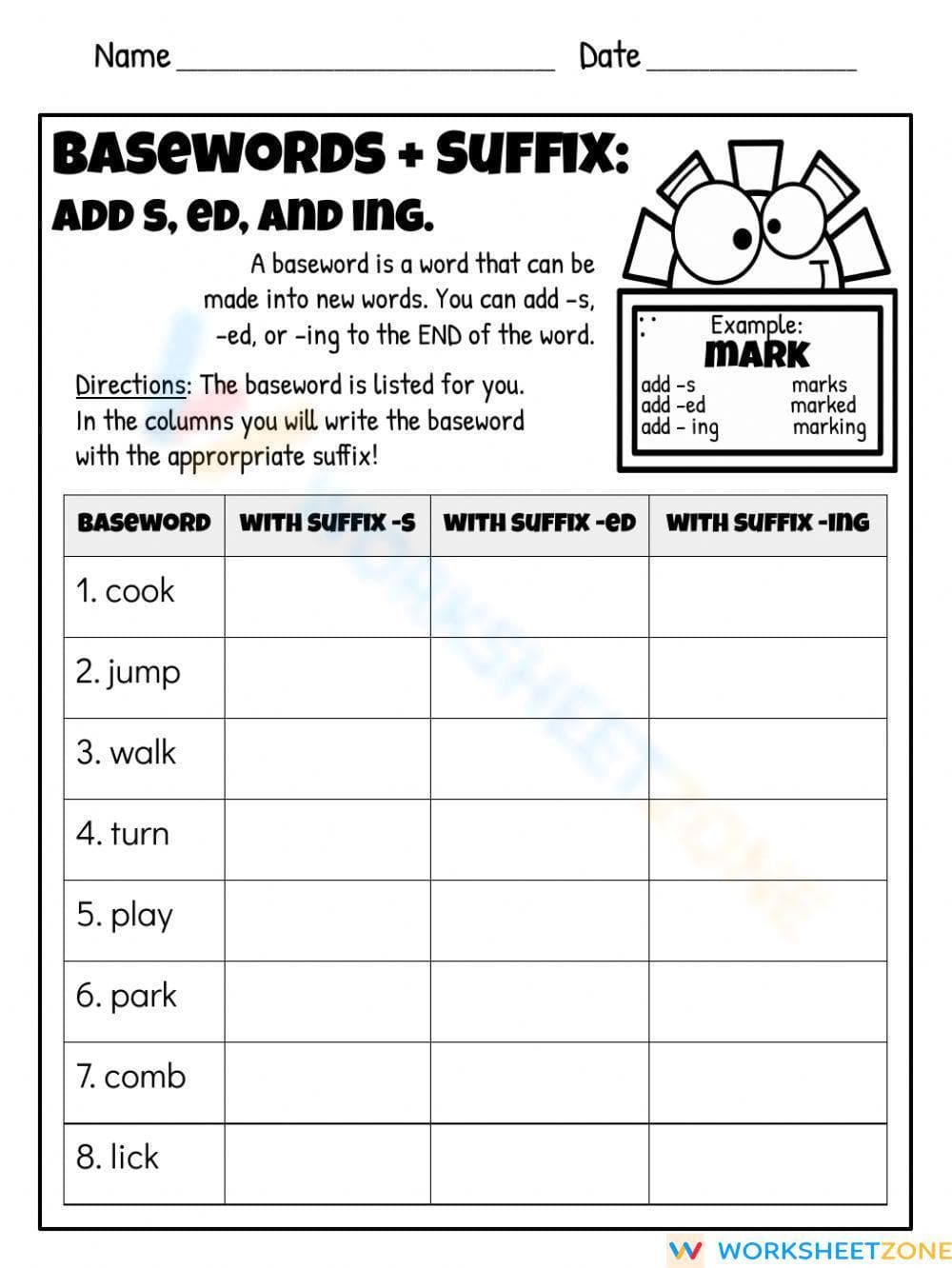

Essential Suffixes Worksheet: -s, -ed, -ing | Grade 1-2
Paste this activity's link or code into your existing LMS (Google Classroom, Canvas, Teams, Schoology, Moodle, etc.).
Students can open and work on the activity right away, with no student login required.
You'll still be able to track student progress and results from your teacher account.
This Grade 1 and Grade 2 phonics worksheet provides targeted practice for students learning to apply inflectional endings. By systematically adding -s, -ed, and -ing to common basewords, learners develop a concrete understanding of how suffixes alter word meaning and tense. This resource ensures students master essential morphology skills through repetitive, structured application.
At a Glance
- Grade: 1–2 · Subject: ELA Phonics
- Standard:
CCSS.ELA-LITERACY.L.1.4.C— Identify frequently occurring root words and their inflectional forms like -s, -ed, and -ing- Skill Focus: Inflectional Endings and Basewords
- Format: 1 page · 24 problems · Answer key included · PDF
- Best For: Independent phonics centers or homework practice
- Time: 15–20 minutes
This printable PDF features eight high-frequency basewords, including "cook," "jump," and "play," arranged in a clear grid format. Students are prompted to write each word three times with the appropriate suffix, totaling 24 independent tasks. The worksheet includes a visual example using the word "mark" to guide student work, reducing the need for constant teacher intervention during the activity.
The zero-prep design allows for immediate classroom integration. First, print the single-page document (30 seconds). Second, distribute to students as a "do-now" or literacy center rotation (30 seconds). Third, review the completed columns using the provided answer key to provide instant feedback on spelling and suffix application (1 minute). Total teacher preparation time is less than two minutes.
This activity is explicitly aligned to CCSS.ELA-LITERACY.L.1.4.C, which requires students to identify root words and their inflectional forms. It also supports CCSS.ELA-LITERACY.L.2.4.C by reinforcing the use of root words as clues to word meaning. Both standard codes can be copied directly into lesson plans, IEP goals, or district curriculum mapping tools.
Use this worksheet as a formative assessment after a direct instruction lesson on verb tenses. Alternatively, assign it as a quiet sub-plan activity to maintain instructional momentum while the lead teacher is away. Observe students as they work to identify if any struggle with the "licked" or "jumping" spelling patterns, indicating a need for targeted small-group intervention.
This resource is designed for first and second-grade students who are transitioning from basic decoding to more complex morphological awareness. It is particularly effective for English Language Learners (ELLs) who need explicit practice with English verb endings. Pair this worksheet with a suffix anchor chart or a short reading passage to reinforce the skills in context.
According to the RAND AIRS 2024 analysis of primary literacy instruction, structured morphological practice is a critical component of successful early reading development. Mastery of the CCSS.ELA-LITERACY.L.1.4.C standard, which focuses on identifying root words and their inflectional forms like -s, -ed, and -ing, serves as a fundamental building block for both reading fluency and writing accuracy. Students who can fluently manipulate basewords and suffixes demonstrate significantly higher comprehension levels as they encounter more complex multi-syllabic words in later grades. This worksheet provides the repetitive, low-stakes practice necessary to cement these phonics concepts without overwhelming young learners. By isolating the suffixes from complex sentence structures, the resource allows students to focus entirely on the mechanics of word construction, a pedagogical approach supported by the latest research in the science of reading.


