


























Views
Downloads

Subtraction Within 20 Word Problems | Grade 1 Printable
Paste this activity's link or code into your existing LMS (Google Classroom, Canvas, Teams, Schoology, Moodle, etc.).
Students can open and work on the activity right away, with no student login required.
You'll still be able to track student progress and results from your teacher account.
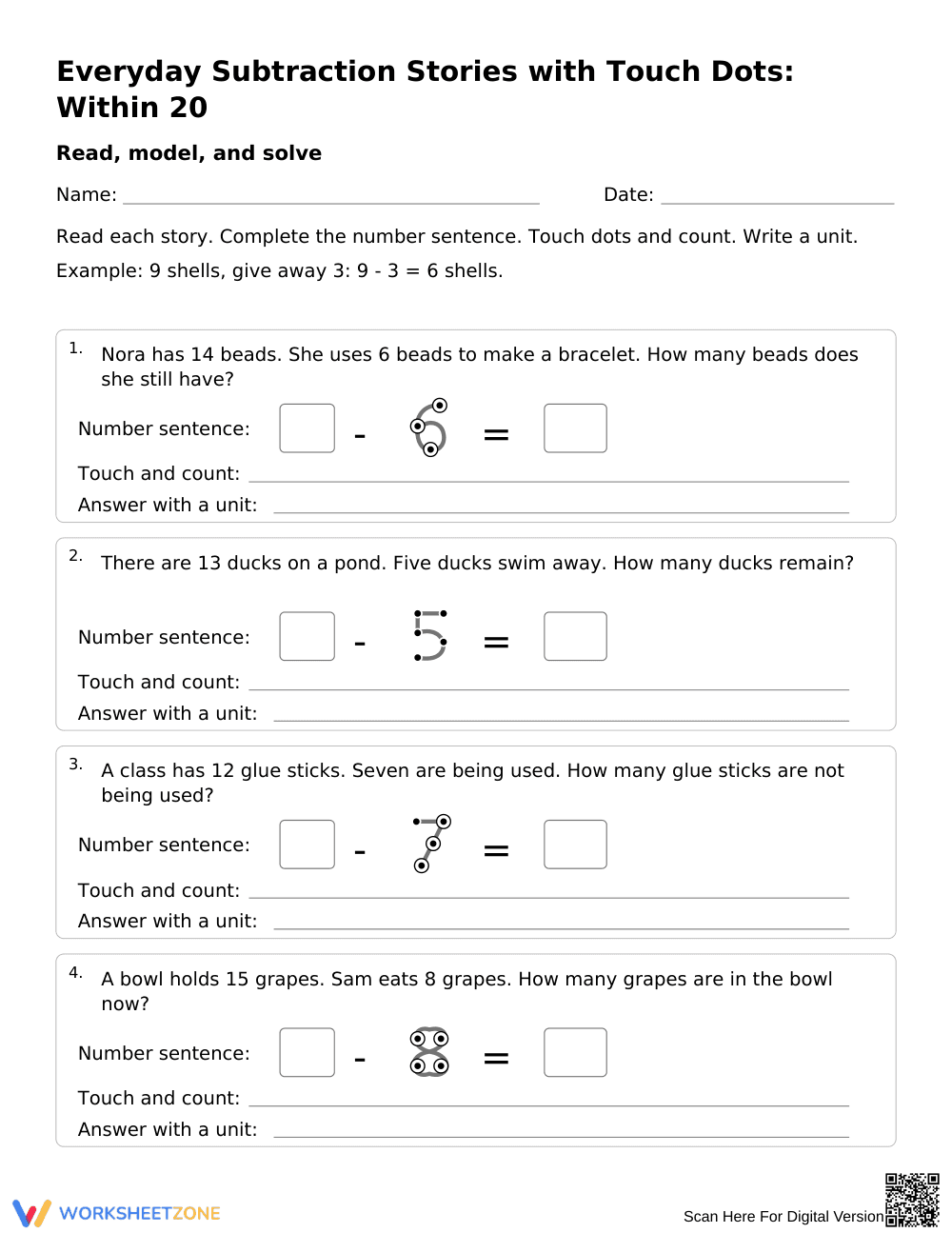
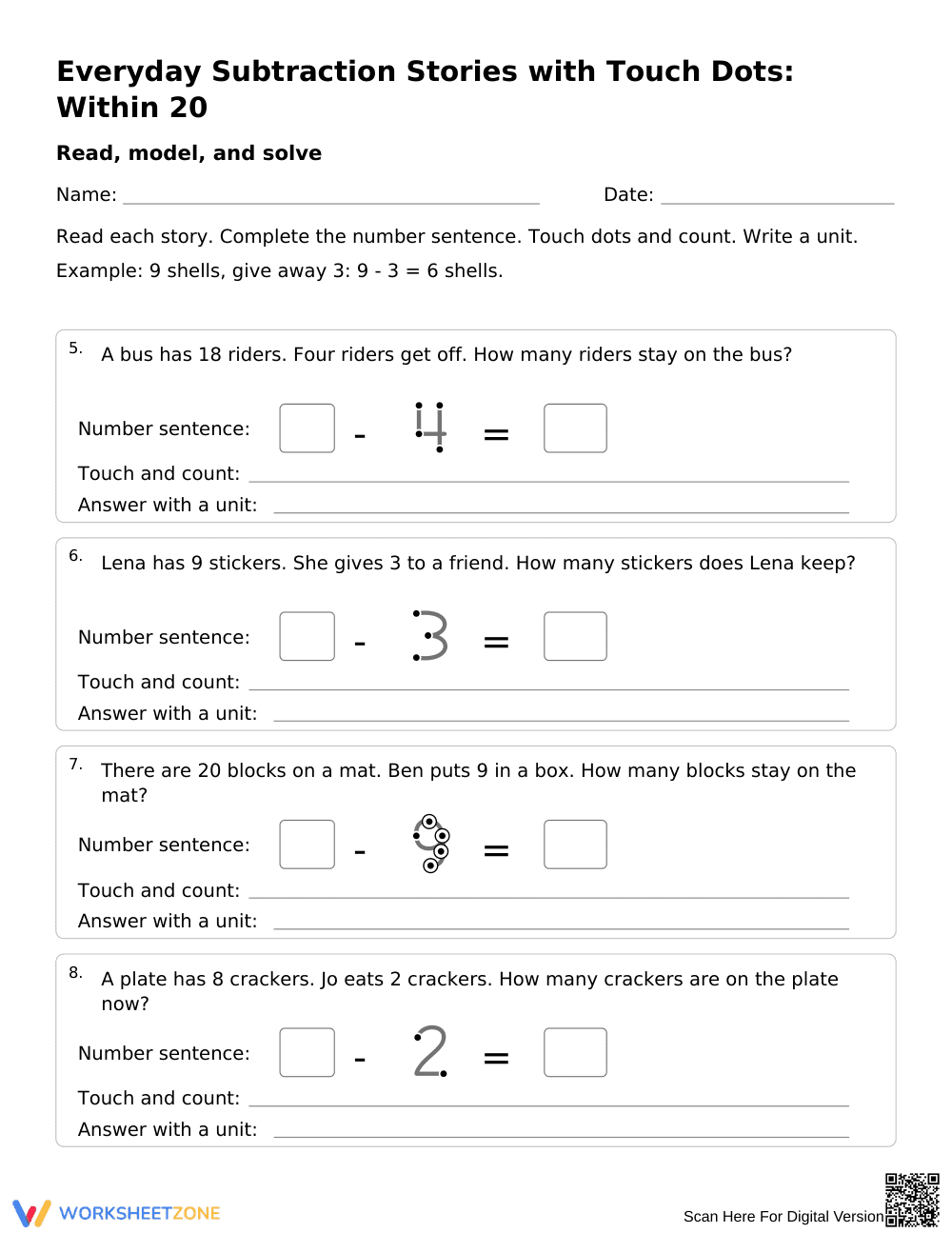
This Grade 1 math worksheet develops subtraction fluency within 20 through contextual word problems supported by visual touch dots. Learners translate realistic story scenarios into number sentences, count backwards using tactile dot points on the subtrahend, and record their final answers with appropriate measurement units to demonstrate complete operational understanding.
At a Glance
- Grade: 1 · Subject: Math
- Standard:
CCSS.MATH.CONTENT.1.OA.A.1— Solve word problems involving subtraction within 20 using concrete visual strategies- Skill Focus: Subtraction word problems with touch dot counting
- Format: 2 pages · 8 problems · Answer key included · PDF
- Best For: Guided small groups and intervention practice
- Time: 20–30 minutes
What's Inside
Across two student pages, this resource features eight varied subtraction story problems situated within 20. Each item contains a complete narrative scenario, scaffolded equation boxes for the minuend and difference, pre-printed touch dots on the subtrahend digit, and dedicated lines for touch-and-count tracking and labeled unit responses. A full one-page answer key provides complete equations and unit labels for rapid checking.
Skill Progression
- Guided practice: An explicit top-of-page worked example establishes the full response cycle (reading the story, forming the equation 9 - 3 = 6, and labeling units).
- Supported practice: Problems 1 through 4 provide structured equation frames and touch dots on single-digit subtrahends to anchor counting-back strategies.
- Independent practice: Problems 5 through 8 expand number ranges up to 20, challenging students to maintain counting accuracy, track calculations on blank work lines, and state units autonomously.
This layout mirrors the gradual-release framework, moving learners smoothly from modeled examples to independent contextual problem-solving.
Standards Alignment
Primary standard: `CCSS.MATH.CONTENT.1.OA.A.1` — Use addition and subtraction within 20 to solve word problems involving situations of adding to, taking from, putting together, taking apart, and comparing, with unknowns in all positions. Supporting standard `CCSS.MATH.CONTENT.1.OA.C.5` reinforces relating counting to subtraction by counting down. Both standard codes can be copied directly into lesson plans, IEP goals, or district curriculum mapping tools.
How to Use It
Deploy this activity after direct instruction on subtraction word problem vocabulary such as "remain" or "still have." During small-group instruction, observe whether students correctly tap single touch dots once and double-ringed touch dots twice while counting backward from the initial minuend. Expect completion in 20 to 30 minutes.
Who It's For
This worksheet serves general Grade 1 math classes, special education resource rooms, and Tier 2 RTI interventions requiring tactile math support. It pairs naturally with an anchor chart outlining "take away" signal words and physical touch-math numeral cards.
According to research highlighted in the RAND AIRS 2024 report on foundational numeracy, providing explicit multisensory scaffolds, such as touch points, accelerates fact retention and conceptual transference for early elementary learners solving contextual mathematics problems. Standard CCSS.MATH.CONTENT.1.OA.A.1 requires students to bridge the gap between abstract operations and real-world scenarios. By integrating visual-tactile dots directly on the subtrahend, this resource lowers cognitive load, allowing developing readers to focus on language comprehension and counting accuracy. The structured layout ensures that students do not just compute numbers mechanically, but instead clearly connect the minuend, subtrahend, and difference back to everyday objects, securing lasting numeracy foundations.


