


























Views
Downloads


Printable Subtraction with Decomposition Worksheet | Gr 3-4
Paste this activity's link or code into your existing LMS (Google Classroom, Canvas, Teams, Schoology, Moodle, etc.).
Students can open and work on the activity right away, with no student login required.
You'll still be able to track student progress and results from your teacher account.
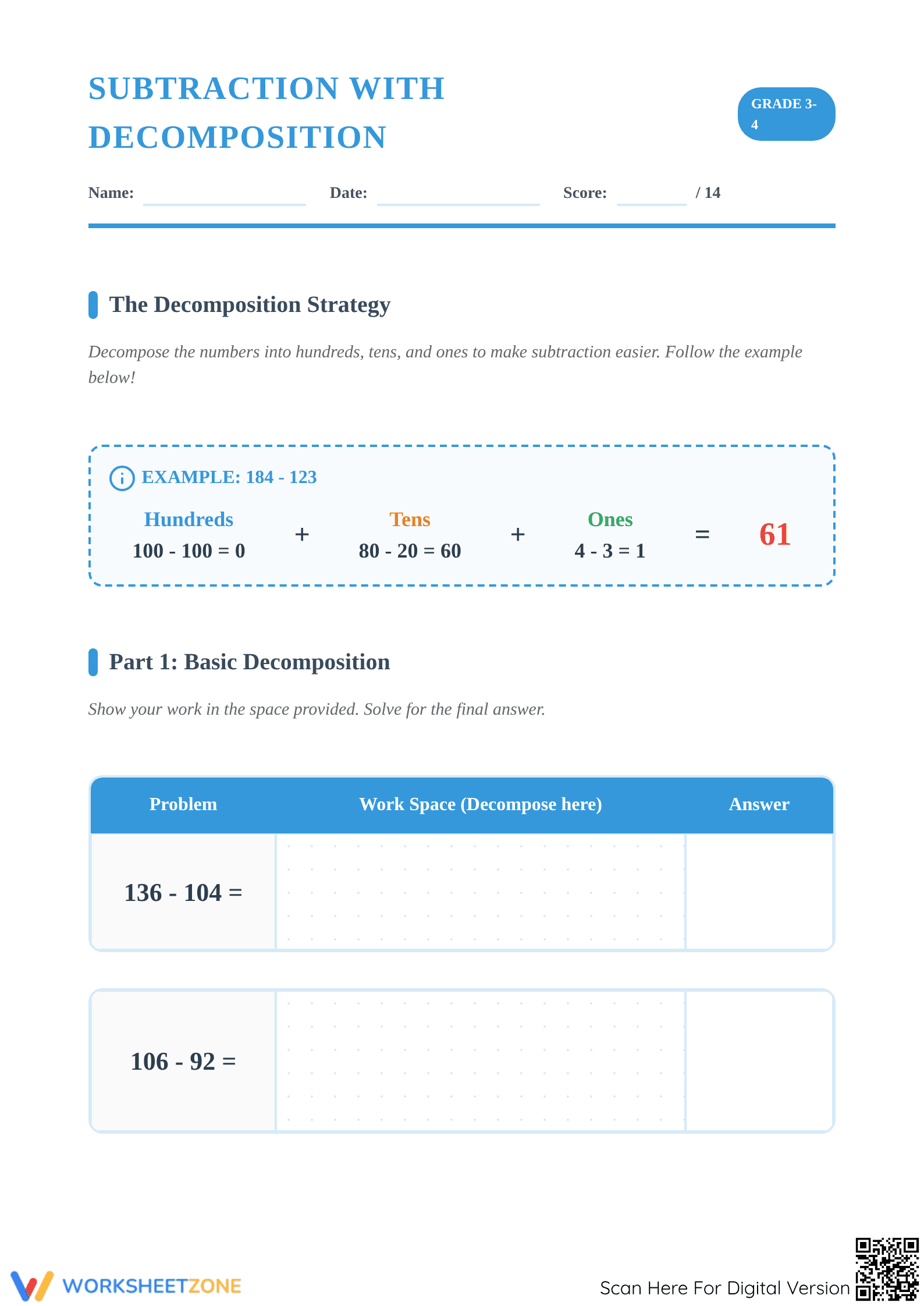
This comprehensive Grade 3 and Grade 4 subtraction with decomposition worksheet provides students with a structured pathway to mastering multi-digit subtraction. By focusing on place value strategies, learners develop a deep conceptual understanding of regrouping. Students will decompose numbers into hundreds, tens, and ones to solve complex problems with procedural accuracy and confidence.
At a Glance
- Grade: 3 – 4 · Subject: Math
- Standard:
CCSS.MATH.CONTENT.3.NBT.A.2— Fluently subtract within 1000 using strategies based on place value- Skill Focus: Subtraction with Decomposition
- Format: 4 pages · 14 problems · Answer key included · PDF
- Best For: Independent practice or formative assessment
- Time: 25–35 minutes
What's Inside
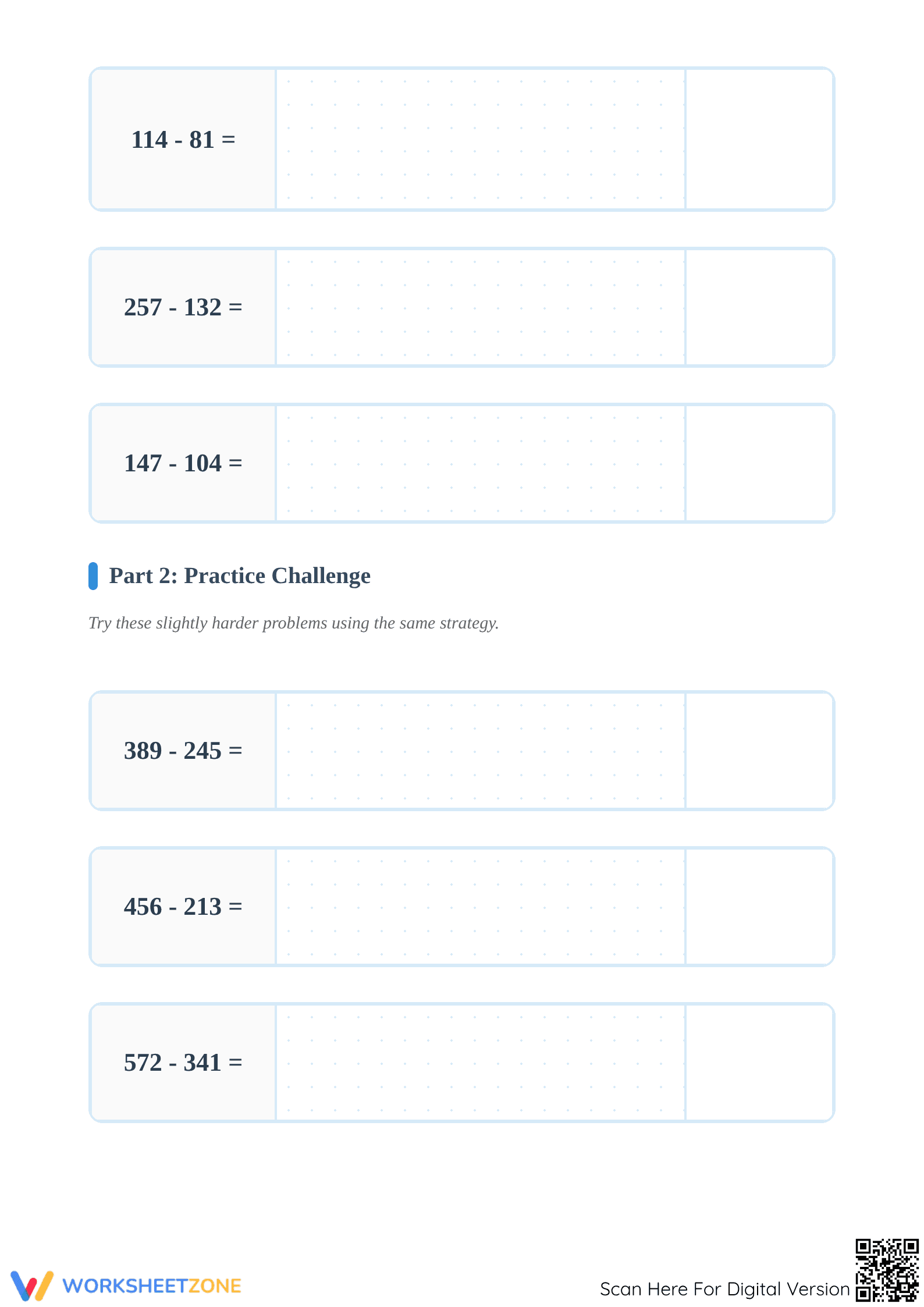
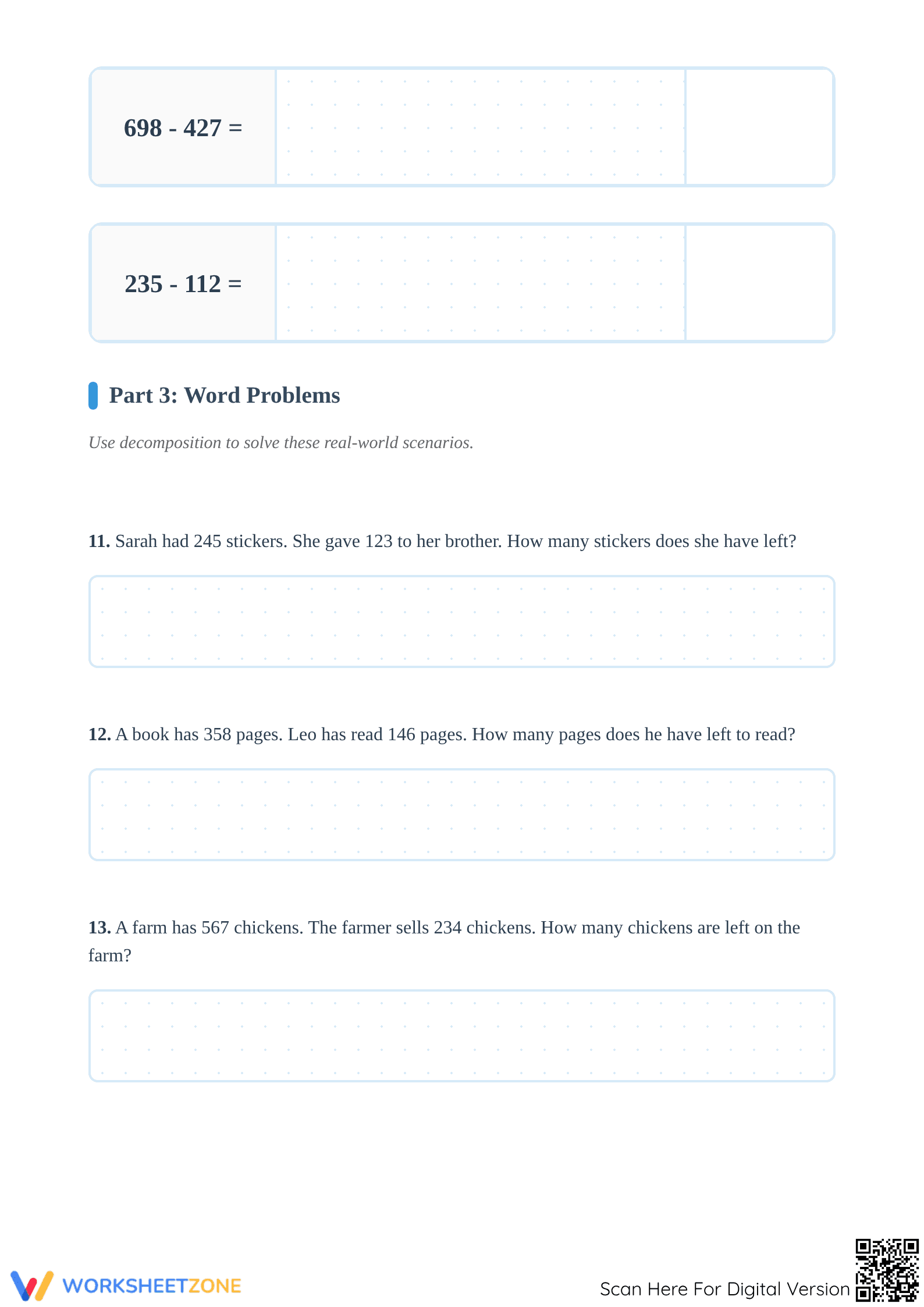
Inside this four-page PDF, you will find a clear, step-by-step example problem that models the decomposition strategy using place value labels. The worksheet is divided into three distinct sections: basic decomposition practice, a challenge section with larger numbers, and a final page dedicated to real-world word problems. A dotted grid workspace is provided for every calculation to ensure neatness and organization.
Zero-Prep Workflow
This resource is designed for a zero-prep workflow in any elementary classroom. Teachers can print the entire packet in seconds. Distributing the materials to a class takes less than a minute, and the included answer key allows for a rapid five-minute review session or self-grading. This makes the worksheet an ideal solution for emergency sub plans or last-minute instructional shifts.
Standards Alignment
The primary alignment for this resource is `CCSS.MATH.CONTENT.3.NBT.A.2`, which requires students to subtract fluently within 1000. It also supports `CCSS.MATH.CONTENT.4.NBT.B.4` for multi-digit fluency. Both standard codes can be copied directly into lesson plans, IEP goals, or district curriculum mapping tools to ensure instructional consistency across the grade levels.
How to Use It
Use this worksheet as a primary practice tool after a direct instruction lesson on regrouping. It is particularly effective during small-group rotations where teachers can observe students as they decompose the tens and hundreds. For formative assessment, watch for students who struggle to align their place values in the word problem section to identify those needing additional intervention.
Who It's For
This resource is tailored for third and fourth-grade students learning the standard algorithm or place value subtraction. It includes scaffolds like the dotted workspace for students needing organizational support. It pairs naturally with base-ten blocks or place value charts for a concrete-representational-abstract instructional sequence that builds lasting mathematical fluency and problem-solving skills.
Aligned to the CCSS.MATH.CONTENT.3.NBT.A.2 standard, this worksheet focuses on the plain-English skill of fluently subtracting multi-digit numbers using place value strategies. Research from EdReports 2024 emphasizes that high-quality instructional materials must provide students with multiple opportunities to engage with decomposition to build foundational algebraic thinking. By breaking numbers into hundreds, tens, and ones, students move beyond rote memorization toward a conceptual understanding of regrouping. This structured approach is proven to reduce cognitive load during complex calculation phases. NAEP data consistently shows that students who master decomposition in Grade 3 demonstrate significantly higher proficiency in multi-step word problems by Grade 5. This resource serves as a critical bridge between basic mental math and the standard algorithm, ensuring students can justify their mathematical reasoning while maintaining procedural accuracy across varied problem types and real-world application scenarios.


