


























Views
Downloads



Essential Subtraction Riddles Worksheet for Grades 4-5 (Printable)
Paste this activity's link or code into your existing LMS (Google Classroom, Canvas, Teams, Schoology, Moodle, etc.).
Students can open and work on the activity right away, with no student login required.
You'll still be able to track student progress and results from your teacher account.
Engage your students with this multi-digit subtraction riddle worksheet, designed to transform standard math practice into a rewarding puzzle-solving experience. Students solve 17 unique subtraction problems across four thematic challenges to reveal hidden riddles. This activity strengthens computational fluency while maintaining high engagement through self-checking mechanics that motivate learners to achieve accuracy.
At a Glance
- Grade: 4-5 · Subject: Math
- Standard:
CCSS.MATH.CONTENT.4.NBT.B.4— Fluently subtract multi-digit whole numbers using standard algorithms to solve problems- Skill Focus: Multi-digit subtraction and mental math
- Format: 4 pages · 17 problems · Answer key included · PDF
- Best For: Independent practice or fun sub plans
- Time: 25–40 minutes
What's Inside
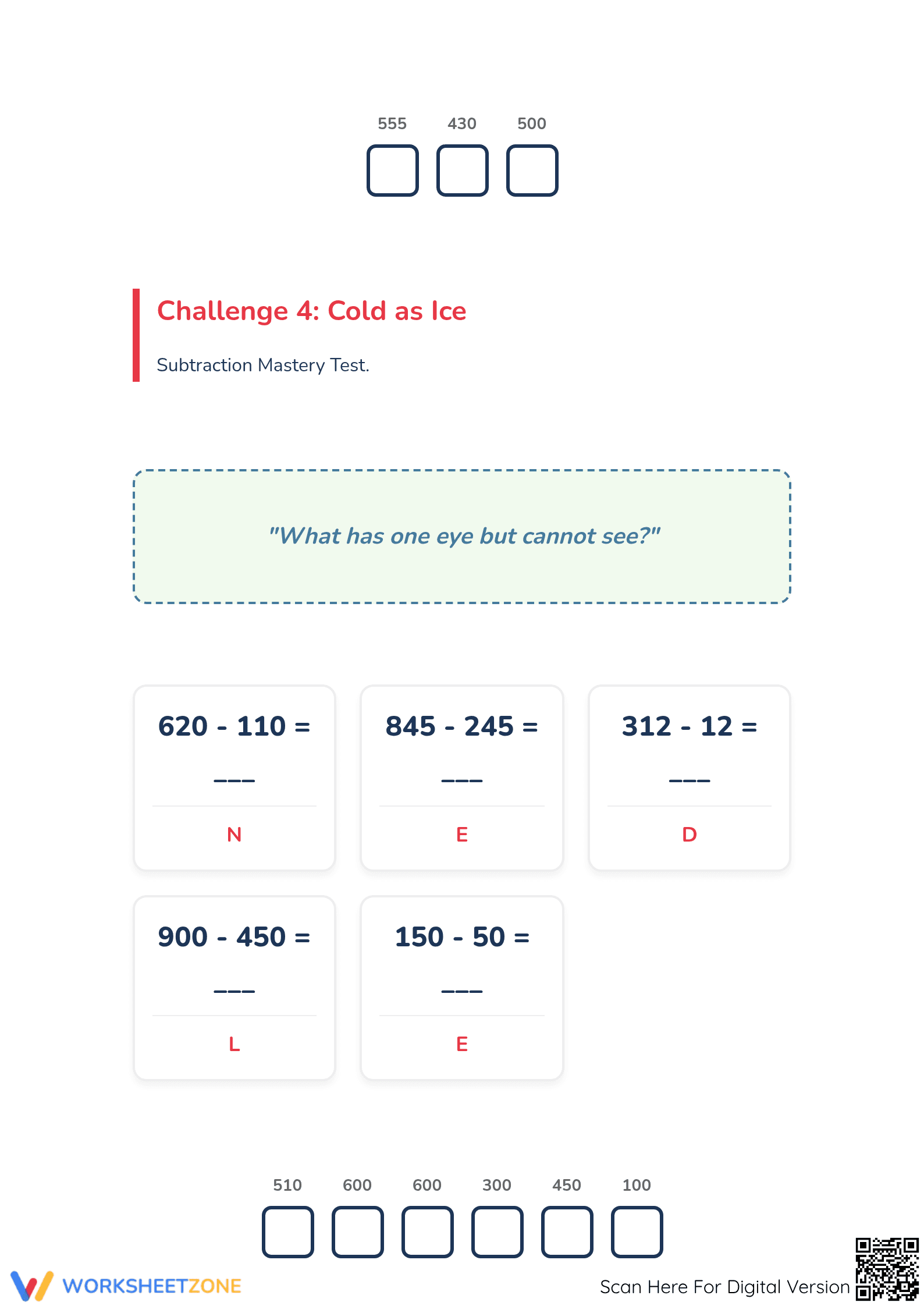
This comprehensive 4-page PDF features four distinct challenges that guide students through subtraction problems ranging from two-digit to four-digit numbers. Each page presents a new riddle, such as "The Water Mystery" and "The Time Keeper," with dedicated space for calculations and a letter-key system. A full answer key is provided to ensure quick grading and immediate feedback for students.
Zero-Prep Workflow
The workflow for this activity is optimized for maximum efficiency:
- Print: Open the PDF and print the 4-page set (under 30 seconds).
- Distribute: Pass out the packets to students for independent or partner work (under 1 minute).
- Review: Use the included answer key to check for accuracy or have students self-correct (under 2 minutes).
Standards Alignment
This resource is primary aligned to `CCSS.MATH.CONTENT.4.NBT.B.4`, which requires students to fluently subtract multi-digit whole numbers using the standard algorithm. By requiring students to solve multiple variations of subtraction problems to find riddle letters, the worksheet provides the repetitive practice necessary for computational mastery. Both standard codes can be copied directly into lesson plans, IEP goals, or district curriculum mapping tools.
How to Use It
Use this worksheet as a mid-unit formative assessment to gauge student comfort with multi-digit subtraction. During the activity, circulate the room and observe if students are using standard algorithms or mental math strategies for specific problems like 1000 minus 500. It works exceptionally well as a quiet Friday activity or a homework assignment that students want to finish. Expect students to spend approximately 30 minutes on the full 17-problem set.
Who It's For
This resource is tailor-made for Grade 4 and 5 students who need to build fluency in subtraction without the boredom of traditional drill sheets. It offers natural differentiation for Grade 3 advanced learners or Grade 6 students requiring remedial support. It pairs perfectly with an anchor chart on regrouping strategies or a short direct instruction lesson on place value subtraction.
The use of gamified elements like riddles in mathematics practice significantly increases student time-on-task and reduces math anxiety. According to a Fisher & Frey (2014) study on instructional design, purposeful practice that includes a self-checking mechanism—like the letter-to-number mapping used here—promotes student agency and metacognitive awareness. This Grade 4-5 subtraction packet provides 17 structured opportunities for students to apply `CCSS.MATH.CONTENT.4.NBT.B.4` skills within a narrative context. By shifting the focus from rote calculation to puzzle solving, the worksheet supports the Gradual Release of Responsibility model, allowing students to independently verify their work through the logic of the riddle answers. This alignment ensures that mathematical rigor is maintained while student engagement is maximized, making it a valuable tool for achieving long-term fluency and retention in elementary mathematics curricula.


