


























Views
Plays

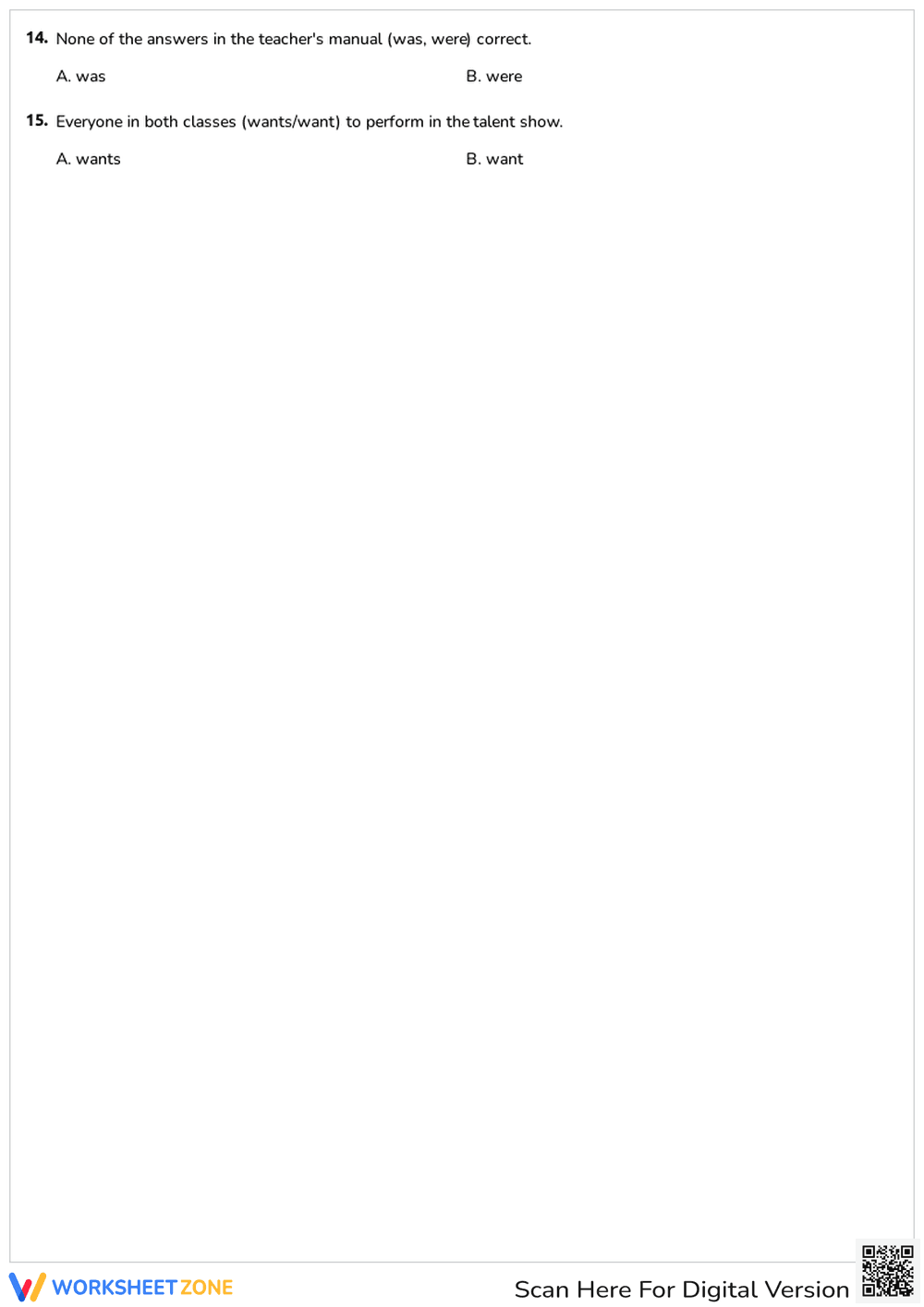

Subject-Verb Agreement Worksheet | Grade 3 Printable
Paste this activity's link or code into your existing LMS (Google Classroom, Canvas, Teams, Schoology, Moodle, etc.).
Students can open and work on the activity right away, with no student login required.
You'll still be able to track student progress and results from your teacher account.
This focused grammar worksheet helps students master subject-verb agreement when using indefinite pronouns. By completing these targeted exercises, third and fourth graders will learn to correctly identify whether singular or plural verbs are required, strengthening their foundational writing and editing skills for clearer communication.
At a Glance
- Grade: 3 · Subject: ELA
- Standard:
CCSS.ELA-LITERACY.L.3.1.F— Ensure subject-verb and pronoun-antecedent agreement- Skill Focus: Subject-Verb Agreement with Indefinite Pronouns
- Format: 2 pages · 15 problems · Answer key included · PDF
- Best For: Independent practice and review
- Time: 10–15 minutes
This printable resource features two pages containing 15 multiple-choice questions. Each question presents a sentence with an indefinite pronoun as the subject, requiring students to select the correct verb form from two provided options. The straightforward layout minimizes distractions, allowing students to focus entirely on the grammatical rules at hand. A complete answer key is included to facilitate quick grading and immediate feedback.
- Guided practice: The first few questions can be completed together as a class to model how to identify the indefinite pronoun and determine if it is singular or plural.
- Supported practice: Students work through the middle section in pairs, discussing their verb choices and referencing classroom anchor charts if needed.
- Independent practice: The final questions serve as a quick formative assessment to verify individual understanding of the grammar rules.
This structure perfectly supports a gradual-release, I Do, We Do, You Do instructional model.
This worksheet is directly aligned to CCSS.ELA-LITERACY.L.3.1.F, which requires students to ensure subject-verb and pronoun-antecedent agreement. It also supports general language progression by reinforcing proper sentence structure. Both standard codes can be copied directly into lesson plans, IEP goals, or district curriculum mapping tools.
Teachers can deploy this worksheet as a targeted warm-up activity before a broader writing lesson or as a standalone grammar center task. During independent work time, observe whether students are actively underlining the indefinite pronouns before selecting their verbs; this provides excellent formative assessment data. Most students will complete the 15 questions within 10 to 15 minutes.
This resource is ideal for third and fourth-grade students who need focused repetition to solidify their grasp of tricky grammar rules. For students requiring extra support, teachers can pre-highlight the subjects in each sentence. It pairs wonderfully with a mini-lesson or anchor chart detailing common singular and plural indefinite pronouns.
Mastering grammar rules like those outlined in CCSS.ELA-LITERACY.L.3.1.F is essential for developing clear and effective written communication. When students learn to ensure subject-verb and pronoun-antecedent agreement, they build the necessary foundation for more complex sentence structures in later grades. According to Fisher & Frey (2014), providing students with targeted, repeated practice on specific grammatical constructs significantly improves their ability to transfer these skills into their independent writing. This worksheet offers exactly that type of focused repetition, isolating indefinite pronouns to help students internalize the rules without the cognitive overload of drafting original text. By integrating this targeted practice into regular instruction, educators can efficiently bridge the gap between recognizing correct grammar and applying it consistently, ultimately fostering more confident and capable young writers.


