


























0
Views
0
Downloads

0.0
0
Save
0 Likes
Share
Structure, Function, and Reasoning: Cells Worksheet
0 Views
0 Downloads
Paste this activity's link or code into your existing LMS (Google Classroom, Canvas, Teams, Schoology, Moodle, etc.).
Students can open and work on the activity right away, with no student login required.
You'll still be able to track student progress and results from your teacher account.
Information
Description
What It Is:
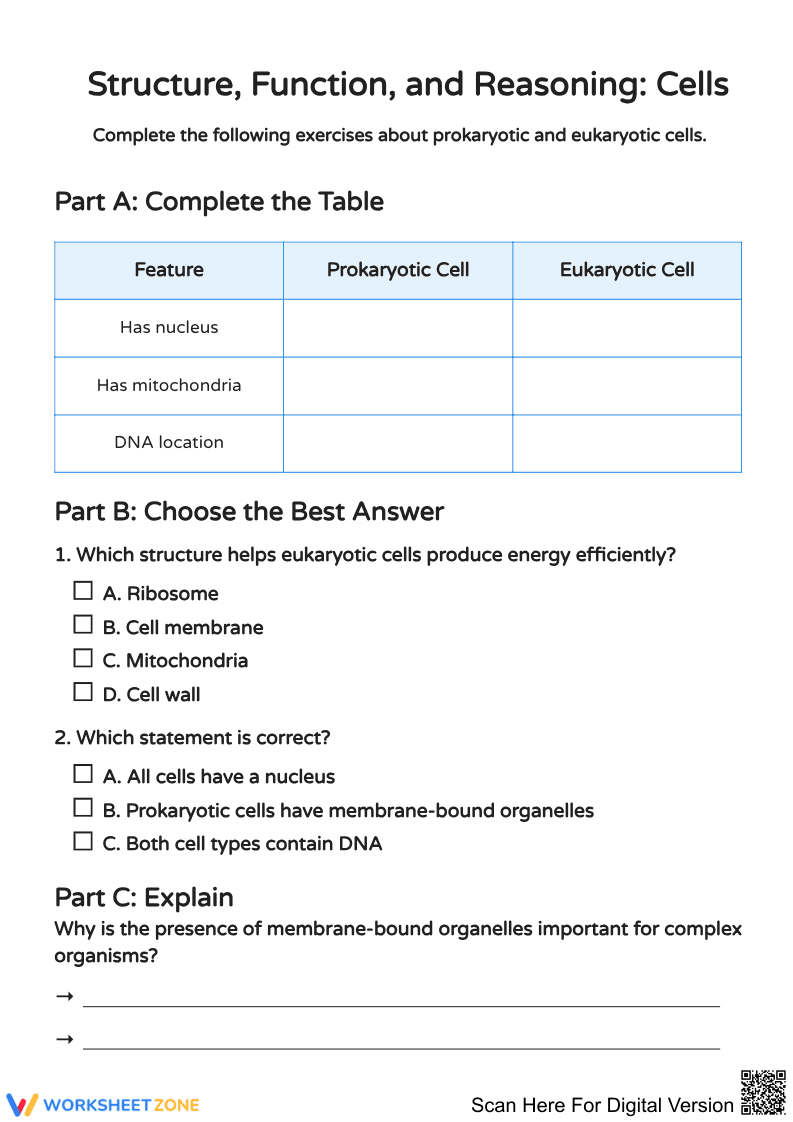
This worksheet guides students in comparing prokaryotic and eukaryotic cells by examining cell structures, organelles, and DNA location through tables and multiple-choice questions.
Why Use It:
It helps students build a clear understanding of cell structure and function while strengthening reasoning skills about how cellular complexity supports life processes.
How to Use It:
• Complete a comparison table for prokaryotic and eukaryotic cells.
• Answer multiple-choice questions about cell structures and functions.
• Explain why membrane-bound organelles are important for complex organisms.
Grade Suitability:
Best suited for Grade 8–10.
• Middle school life science classes.
• Introductory high school biology lessons on cells.
Target Users:
Middle school and early high school students, biology teachers, and homeschool learners.
This worksheet guides students in comparing prokaryotic and eukaryotic cells by examining cell structures, organelles, and DNA location through tables and multiple-choice questions.
Why Use It:
It helps students build a clear understanding of cell structure and function while strengthening reasoning skills about how cellular complexity supports life processes.
How to Use It:
• Complete a comparison table for prokaryotic and eukaryotic cells.
• Answer multiple-choice questions about cell structures and functions.
• Explain why membrane-bound organelles are important for complex organisms.
Grade Suitability:
Best suited for Grade 8–10.
• Middle school life science classes.
• Introductory high school biology lessons on cells.
Target Users:
Middle school and early high school students, biology teachers, and homeschool learners.


