


























Views
Downloads
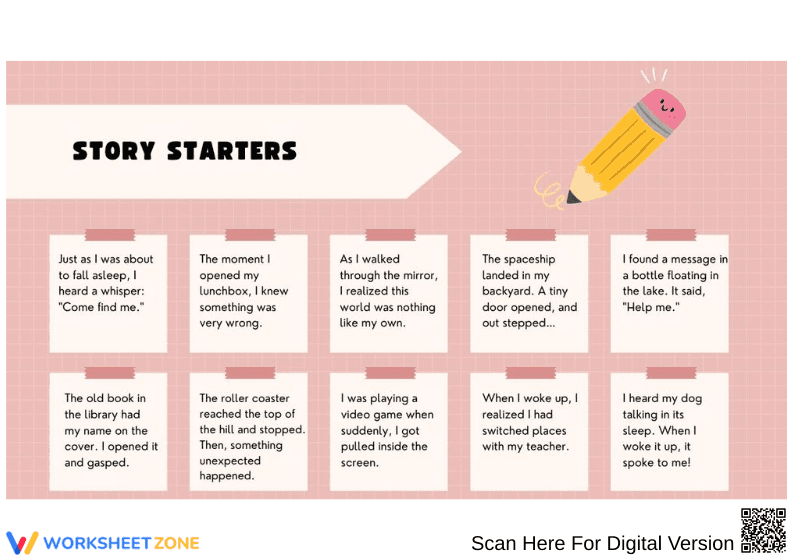

Story Starters Printable | Grade 4 Writing
Paste this activity's link or code into your existing LMS (Google Classroom, Canvas, Teams, Schoology, Moodle, etc.).
Students can open and work on the activity right away, with no student login required.
You'll still be able to track student progress and results from your teacher account.
This Grade 4 creative writing worksheet gives students six story starters that spark original narratives, helping young writers move past blank-page hesitation and build structured, imaginative stories aligned to CCSS.ELA-LITERACY.W.4.3.
At a Glance
- Grade: 4 · Subject: English Language Arts — Writing
- Standard:
CCSS.ELA-LITERACY.W.4.3— Write narratives using details, dialogue, and clear event sequences- Skill Focus: Narrative writing with guided story starters
- Format: 1 page · 6 prompts · Answer key included · PDF
- Best For: Independent writing practice or warm-up
- Time: 20–35 minutes
Inside this single-page PDF, students encounter six distinct story starters spanning adventure, mystery, and everyday scenarios. Each prompt provides an opening sentence or situation; students continue the narrative in their own words. The open-ended format pairs with any lined paper or writing journal. No answer key is required for creative output, though a teacher scoring guide is included to support consistent feedback on narrative elements such as setting, character, and plot sequence.
- Guided practice: Two starters include sentence frames and a brief story map scaffold (who, where, problem) to support writers who need structural cues before drafting.
- Supported practice: Two starters offer an opening sentence plus a single guiding question, reducing scaffolding while keeping a clear narrative entry point.
- Independent practice: Two starters present only a situation or first line, requiring students to generate all narrative elements independently.
This gradual-release sequence mirrors the I Do / We Do / You Do model, letting teachers assign all six prompts across a writing unit or select individual starters to match current instruction.
Primary standard: CCSS.ELA-LITERACY.W.4.3 — “Write narratives to develop real or imagined experiences or events using effective technique, descriptive details, and clear event sequences.” Supporting standard CCSS.ELA-LITERACY.W.4.5 applies when students revise drafts with peer or teacher feedback. Both standard codes can be copied directly into lesson plans, IEP goals, or district curriculum mapping tools.
Use these starters before direct instruction as a diagnostic to gauge baseline narrative voice, or after a mini-lesson on story structure as a low-stakes application task. Observe whether students establish a clear problem within the first three sentences — a reliable formative signal for W.4.3 readiness. Most Grade 4 writers complete one starter in 20–35 minutes; assigning two starters across a 45-minute block works well for early finishers.
Best suited for Grade 4 writers at all fluency levels. Students who struggle with idea generation benefit from the scaffolded starters; advanced writers can extend any prompt into a multi-paragraph story. Pairs naturally with a narrative anchor chart listing story elements (character, setting, conflict, resolution) posted during writing workshop.
This worksheet targets CCSS.ELA-LITERACY.W.4.3, requiring Grade 4 students to write narratives with descriptive details and clear event sequences. Story starters reduce cognitive load at the idea-generation stage, freeing working memory for craft decisions — a principle supported by Fisher & Frey (2014), whose gradual-release framework shows that structured entry points increase on-task writing time and draft quality in elementary classrooms. NAEP 2022 data indicate that only 27% of Grade 4 students perform at or above proficient in writing, underscoring demand for targeted narrative practice tools. Six prompts at varied scaffold levels make this resource suitable for whole-class instruction, small-group intervention, or independent center work, and the included scoring guide lets teachers translate observations directly into formative records or progress-monitoring notes.


