




























Views
Downloads
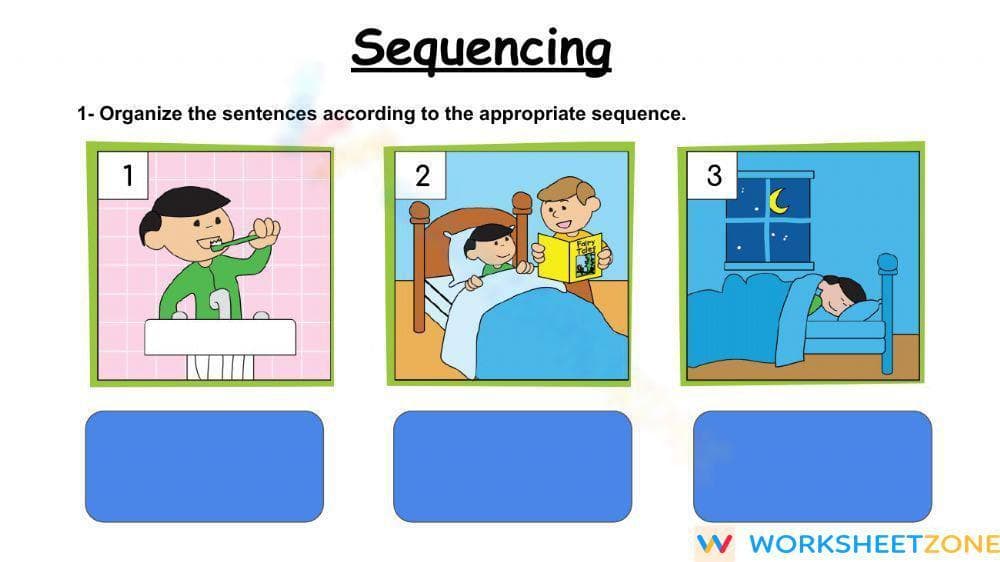


Grade 1 Sequencing — Printable No-Prep Worksheet

Paste this activity's link or code into your existing LMS (Google Classroom, Canvas, Teams, Schoology, Moodle, etc.).
Students can open and work on the activity right away, with no student login required.
You'll still be able to track student progress and results from your teacher account.
This printable sequencing worksheet provides first and second-grade students with essential practice in ordering narrative events. Through two clear, illustrated tasks, learners will arrange pictures to form logical stories, strengthening their comprehension and foundational skills for retelling. It’s a perfect resource for developing narrative competence and logical thinking.
At a Glance
- Grade: 1–2 · Subject: ELA
- Standard:
CCSS.ELA-LITERACY.RL.1.2— Retell stories, including key details, to show understanding.- Skill Focus: Story Sequencing, Narrative Logic
- Format: 1 page · 2 problems · No answer key needed · PDF
- Best For: Independent practice, ELA centers, substitute plans
- Time: 5–10 minutes
What's Inside
This single-page PDF contains two distinct sequencing activities. The first task presents a three-step daily routine, while the second features a four-step event narrative. Each problem uses clear, simple illustrations to depict the events, and students are prompted to organize them in the correct sequence. The clean layout and visual cues make the worksheet highly accessible for young learners.
A Zero-Prep Workflow
Designed for the busy classroom, this worksheet follows a simple, zero-prep workflow that saves valuable instructional time.
- Print (under 1 minute): The resource is a single, easy-to-print PDF, requiring no complex assembly or cutting.
- Distribute (under 1 minute): Hand out the worksheet to students for immediate use as an independent activity, in a small group, or as a quick formative assessment.
- Review (2 minutes): Quickly review the correct sequence with the class by pointing to the pictures or having students share their answers. The visual nature makes for a fast and effective check for understanding.
With a total teacher prep time of less than two minutes, it's an ideal choice for substitute lesson plans or an efficient addition to any ELA block.
Standards Alignment
This worksheet is directly aligned with Common Core State Standard CCSS.ELA-LITERACY.RL.1.2, which requires students to "Retell stories, including key details, and demonstrate understanding of their central message or lesson." By correctly sequencing the illustrated events, students demonstrate a foundational ability to comprehend and reconstruct a narrative. This skill supports the broader goal of retelling. Both standard codes can be copied directly into lesson plans, IEP goals, or district curriculum mapping tools.
How to Use It
This versatile worksheet can be used as a warm-up before a reading lesson to activate students' understanding of story structure. It also serves as an excellent independent practice activity for ELA centers after direct instruction on sequencing. For a quick formative assessment, observe which students can complete the tasks quickly versus those who struggle to identify the logical order of events. Expected completion time is between 5 and 10 minutes.
Who It's For
This resource is designed for first and second-grade students who are developing their narrative comprehension skills. The clear illustrations provide strong support for English learners and students who benefit from visual aids. For differentiation, you can have students orally describe each picture before sequencing. Pair this worksheet with a read-aloud of a simple picture book, asking students to identify the beginning, middle, and end.
Mastering story sequence is a critical component of early literacy, directly supporting a student's ability to meet standards like CCSS.ELA-LITERACY.RL.1.2. This foundational skill enables learners to retell stories with key details, a precursor to more complex comprehension tasks. Research consistently shows that explicit instruction in text structure, including temporal order, yields significant improvements in reading comprehension. Worksheets that provide focused, visual practice on ordering events, like this one, give students a concrete method for internalizing the logical flow of narratives. This structured practice is essential for building the mental models needed to understand and create coherent stories.


