


























Views
Downloads
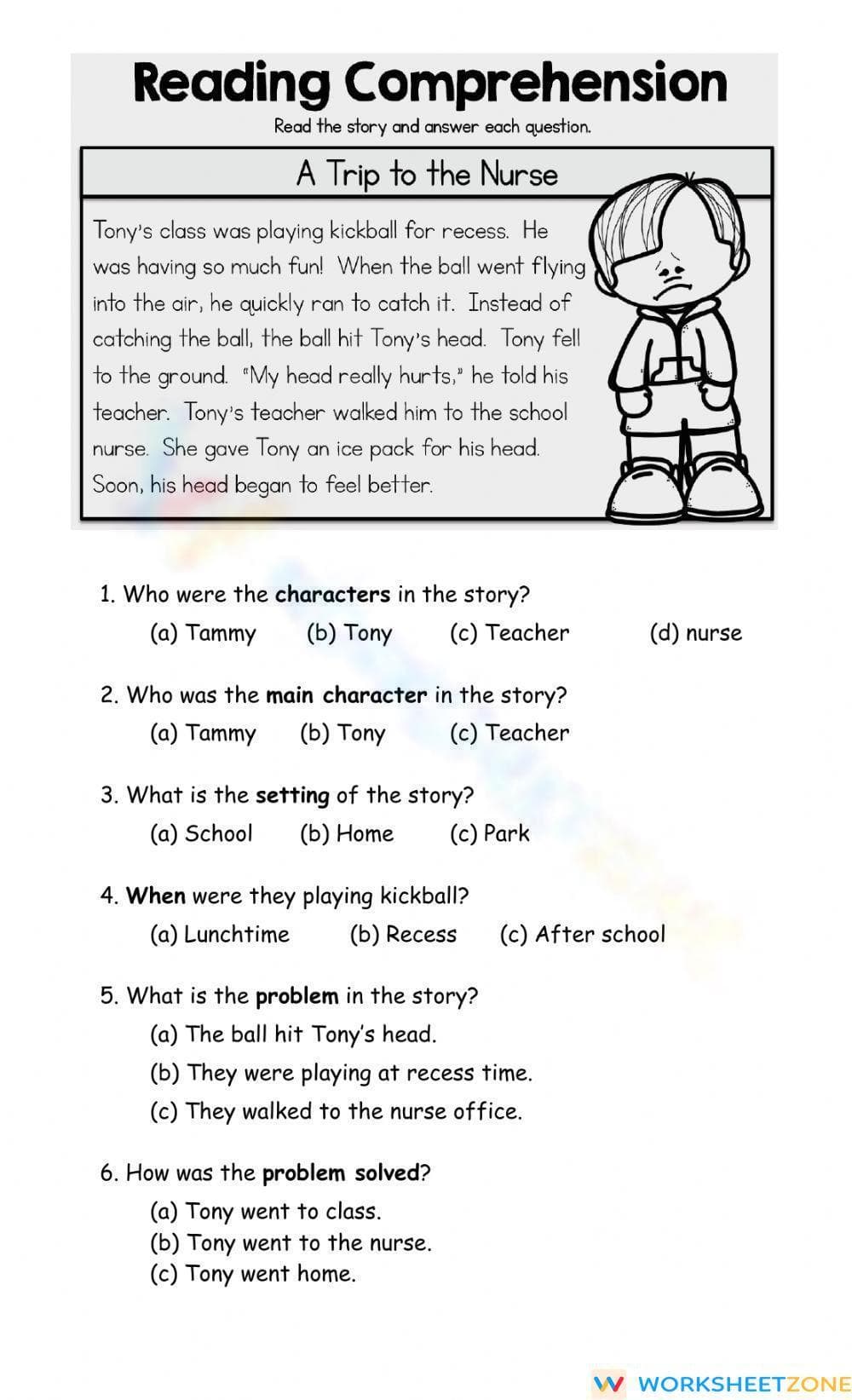

Printable Story Elements Worksheet | Grades 2-4 ELA
Paste this activity's link or code into your existing LMS (Google Classroom, Canvas, Teams, Schoology, Moodle, etc.).
Students can open and work on the activity right away, with no student login required.
You'll still be able to track student progress and results from your teacher account.
Identifying key story elements is a foundational step in reading comprehension for elementary learners. This worksheet, "A Trip to the Nurse," provides a clear, relatable narrative that allows students to practice isolating characters, setting, and plot structure. By answering targeted questions about Tony's recess mishap, students build the analytical skills necessary for deeper literary interpretation and narrative mastery.
At a Glance
- Grade: 2 · Subject: English Language Arts (ELA)
- Standard:
CCSS.ELA-LITERACY.RL.2.3— Describe how characters in a story respond to major events and challenges- Skill Focus: Story Elements (Character, Setting, Problem, Solution)
- Format: 1 page · 6 problems · Answer key included · PDF
- Best For: Independent reading practice or formative assessment
- Time: 15–20 minutes
What's Inside
Inside this resource, teachers will find a concise narrative followed by six multiple-choice questions. The text features clear font and white space for accessibility. Each question targets a different story element, including identifying characters, the main character, the physical setting, time, the central problem, and the solution. A full answer key is provided for efficient grading.
Skill Progression
- Guided Practice: The teacher reads the story aloud, modeling how to highlight key details related to the characters and setting using the first two questions.
- Supported Practice: Students work in pairs to identify the "when" and "where" of the story, discussing evidence to justify their choices.
- Independent Practice: Learners independently solve the final questions, which require understanding of the story's conflict and resolution.
Standards Alignment
This worksheet is primarily aligned with CCSS.ELA-LITERACY.RL.2.3: "Describe how characters in a story respond to major events and challenges." Additionally, it supports CCSS.ELA-LITERACY.RL.2.1 by requiring students to answer who, what, where, when, and why questions to demonstrate understanding of key details. Both standard codes can be copied directly into lesson plans, IEP goals, or district curriculum mapping tools.
How to Use It
Use this worksheet as a "cool-down" activity after a direct instruction lesson on story maps or plot diagrams. It serves as an excellent formative assessment tool to gauge whether students can distinguish between characters and the main character. For a quick check, observe students during the "Problem" question to see if they can differentiate between a detail and the central conflict. Expected completion time is approximately 15 minutes.
Who It's For
This resource is designed for Grade 2 students but works well for Grade 3 and 4 learners needing remediation. It is particularly well-suited for English Language Learners due to its clear, sequential plot. Pair this worksheet with a character trait anchor chart or a short reading passage to reinforce the concept of setting.
Reading research consistently highlights the importance of explicit instruction in story grammar for improving overall comprehension. According to Fisher & Frey (2014), the gradual release of responsibility—moving from teacher modeling to independent application—is critical when introducing structural elements like characters, settings, and plot. By isolating these components within a relatable context like "A Trip to the Nurse," students reduce cognitive load and can focus on the mechanics of story analysis. This Grade 2 worksheet aligns with CCSS.ELA-LITERACY.RL.2.3, providing six structured tasks that require students to identify how a character responds to a challenge. Systematic practice with these elements is a proven predictor of later success in complex literary analysis. Teachers can use this data to track progress toward mastery in identifying narrative arcs, ensuring that students develop the necessary schema to interpret more sophisticated texts. This resource provides the evidence-based practice required for classroom-ready instruction.


