


























Views
Downloads

Stonehenge Reading Worksheet | Grade 4 Printable ELA
Paste this activity's link or code into your existing LMS (Google Classroom, Canvas, Teams, Schoology, Moodle, etc.).
Students can open and work on the activity right away, with no student login required.
You'll still be able to track student progress and results from your teacher account.
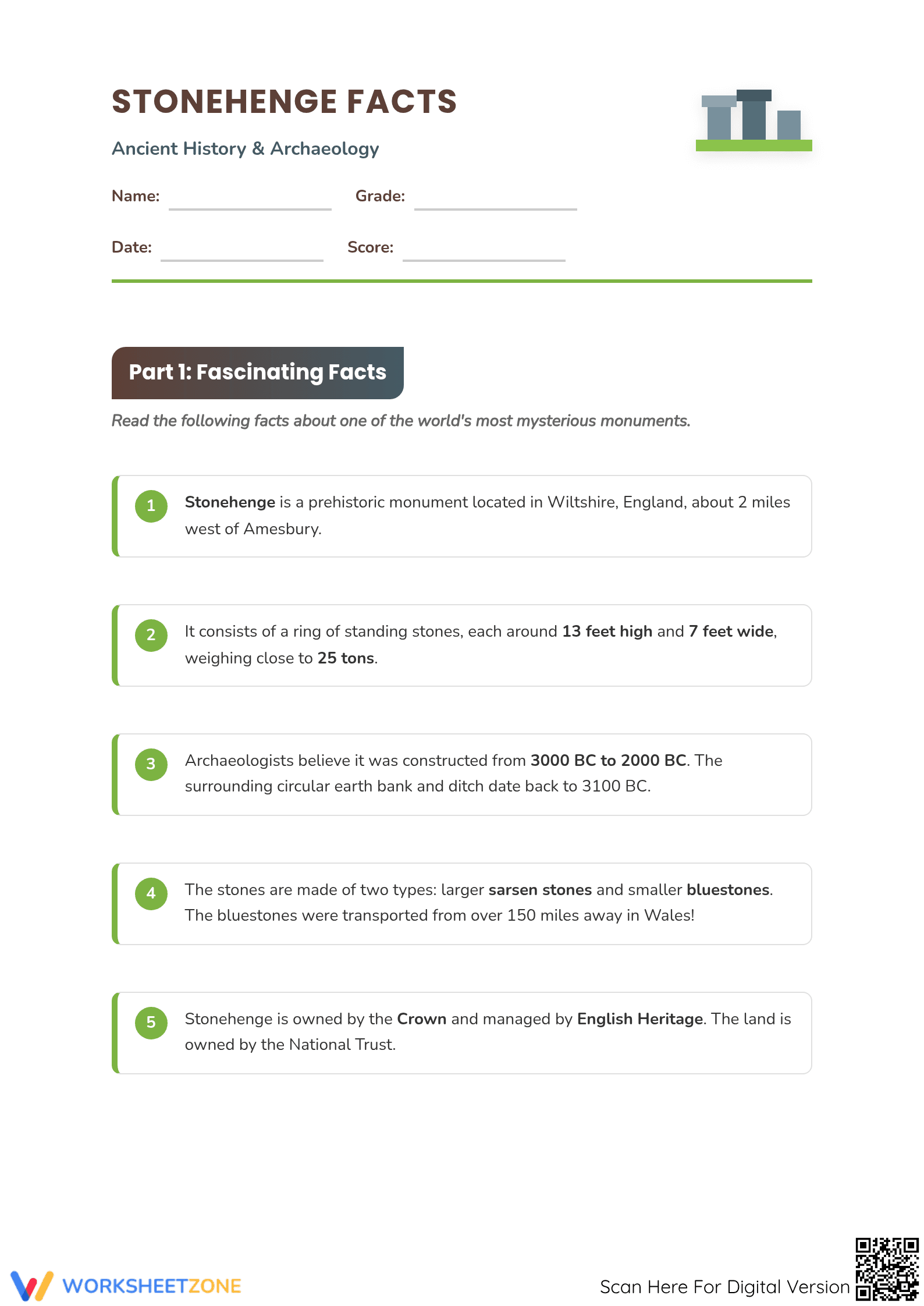
Students explore the mysteries of Stonehenge through a comprehensive nonfiction reading experience designed for Grade 4 learners. This worksheet prioritizes text-dependent analysis, requiring students to extract specific archaeological facts and historical timelines directly from the provided informational text. By engaging with these primary details, students improve their ability to explain complex historical concepts.
At a Glance
- Grade: 4 · Subject: English Language Arts
- Standard:
CCSS.ELA-LITERACY.RI.4.1— Refer to details in a text when explaining explicit facts and inferences- Skill Focus: Nonfiction Reading Comprehension
- Format: 4 pages · 14 problems · Answer key included · PDF
- Best For: Independent Reading and History Centers
- Time: 25–35 minutes
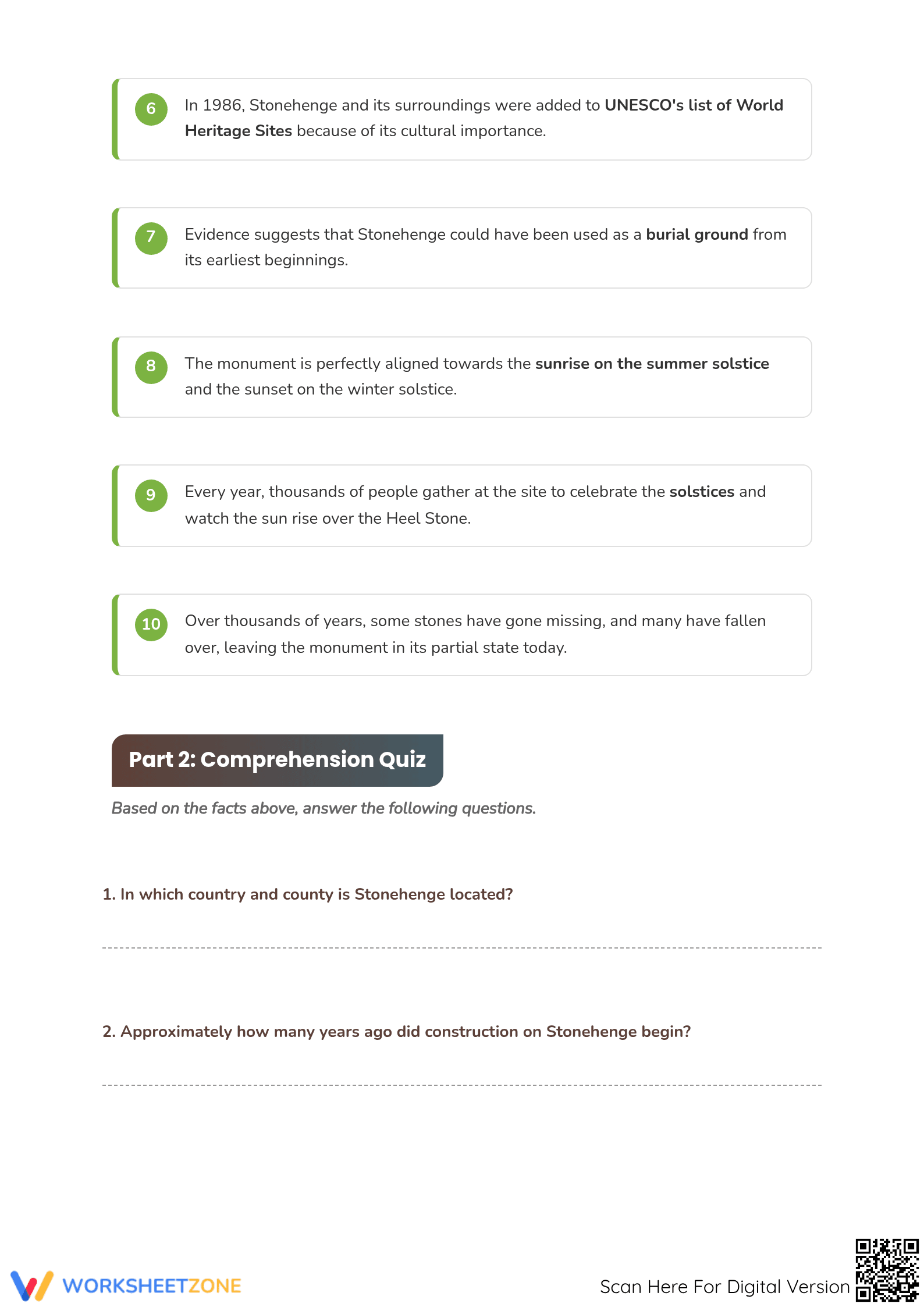
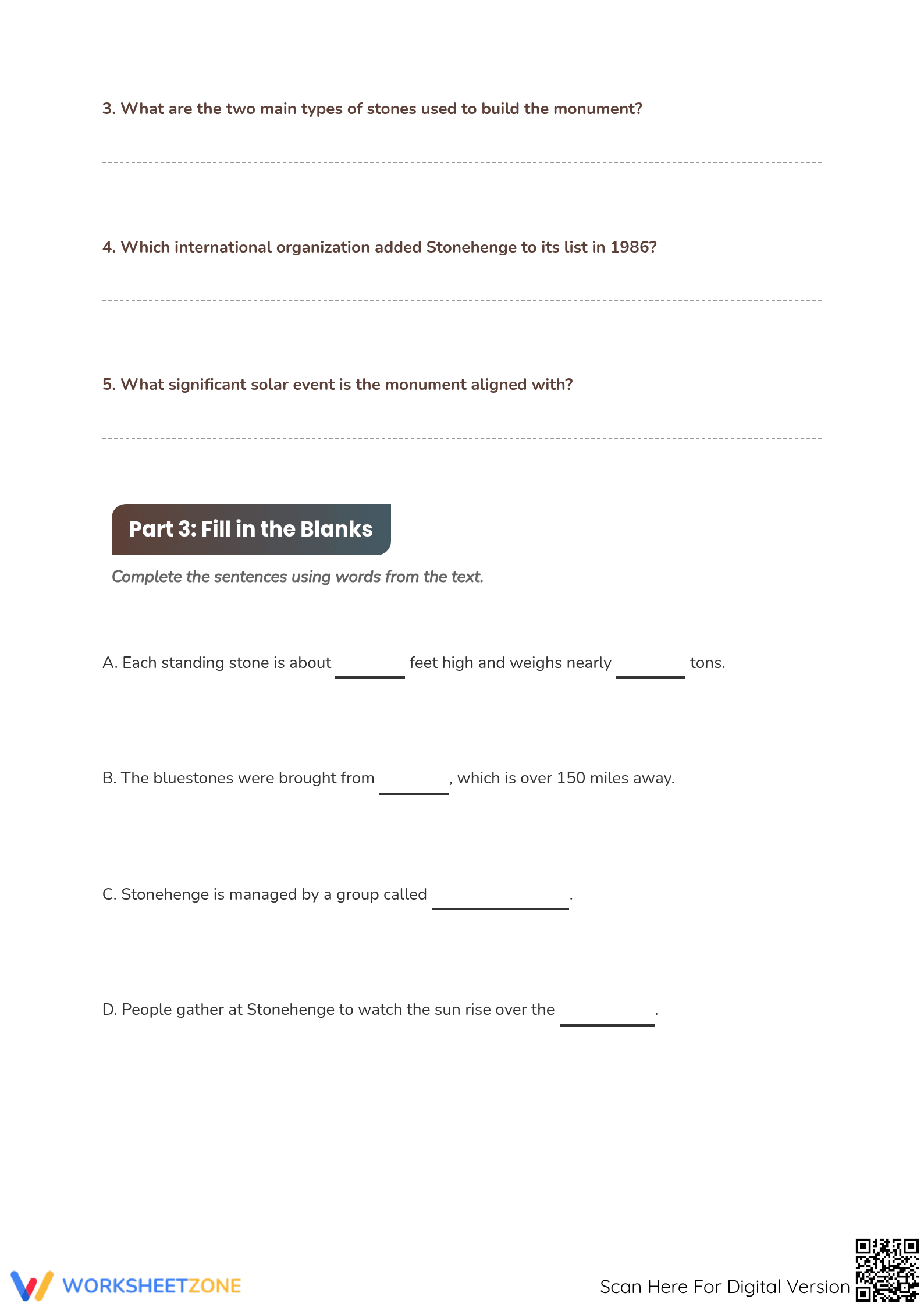
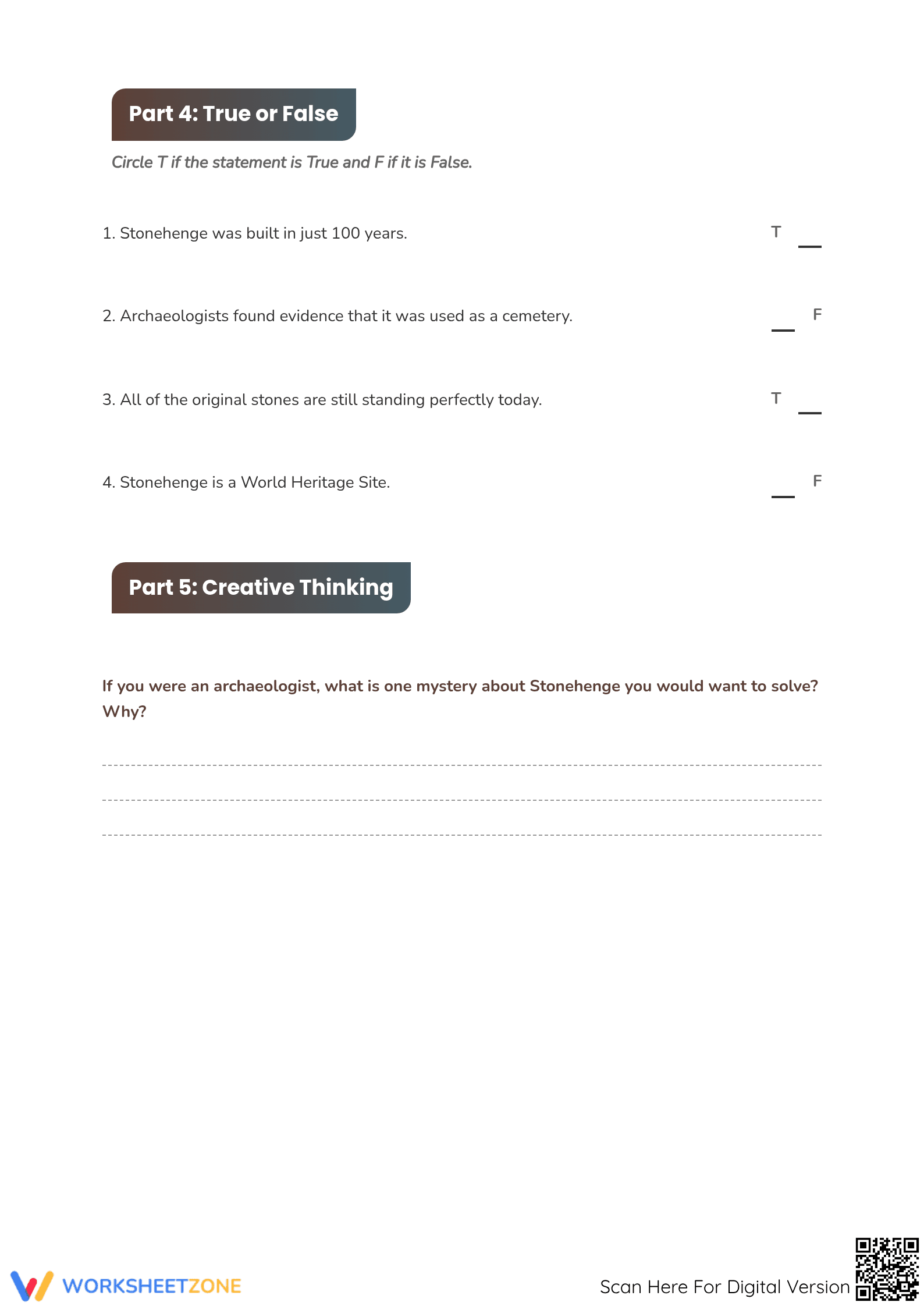
This four-page resource provides a structured learning journey starting with ten numbered facts about the prehistoric monument in Wiltshire, England. Following the reading portion, the worksheet includes a five-question comprehension quiz, a four-item fill-in-the-blanks exercise, and a true-or-false assessment. It concludes with a creative thinking prompt that encourages students to hypothesize about archaeological mysteries. A complete answer key is provided for grading.
The zero-prep workflow for this resource is designed for maximum teacher efficiency. First, print the four-page PDF, which takes less than thirty seconds. Second, distribute the packets to students for independent work or as a detailed sub plan. Third, review student answers using the included key in under two minutes. The total teacher preparation time for this rigorous lesson is less than two minutes.
The primary alignment for this activity is `CCSS.ELA-LITERACY.RI.4.1`. This standard requires students to refer to details and examples in a text when explaining what the text says explicitly. Additionally, the creative thinking prompt supports RI.4.3 by asking students to explain the "why" behind historical events. Both standard codes can be copied directly into lesson plans, IEP goals, or district curriculum mapping tools.
Use this worksheet during the "You Do" phase of a gradual release model following a lesson on informational text features. It functions exceptionally well as a rotations station for literacy centers or as a high-quality substitute teacher packet. While students work, observe whether they flip back to the fact sheets to verify their quiz answers, which is a key indicator of effective evidence-gathering habits.
This resource is tailored for Grade 4 students but serves as an effective scaffold for Grade 5 students who need additional practice with text-evidence retrieval. It pairs naturally with an introductory video about world wonders or a physical map of the United Kingdom. Educators can differentiate the creative thinking section by allowing students to sketch their theories instead of writing them.
According to the National Assessment of Educational Progress (NAEP), proficiency in reading informational texts requires students to identify specific evidence and synthesize data from multiple structural formats. This Stonehenge worksheet applies these findings to CCSS.ELA-LITERACY.RI.4.1 by moving students from literal comprehension (identifying sarsen stones) to inferential reasoning (analyzing the significance of solar alignments). The inclusion of 14 distinct tasks ensures that learners must revisit the text multiple times, reinforcing the cognitive habit of checking evidence before finalizing an answer. By isolating 10 numbered facts, the worksheet reduces the cognitive load of scanning dense paragraphs, allowing Grade 4 students to focus on the accuracy of their responses. This design aligns with research on retrieval practice, which indicates that varied question formats like true/false and fill-in-the-blanks improve long-term retention of nonfiction content more effectively than single-format assessments.


