


























Views
Downloads

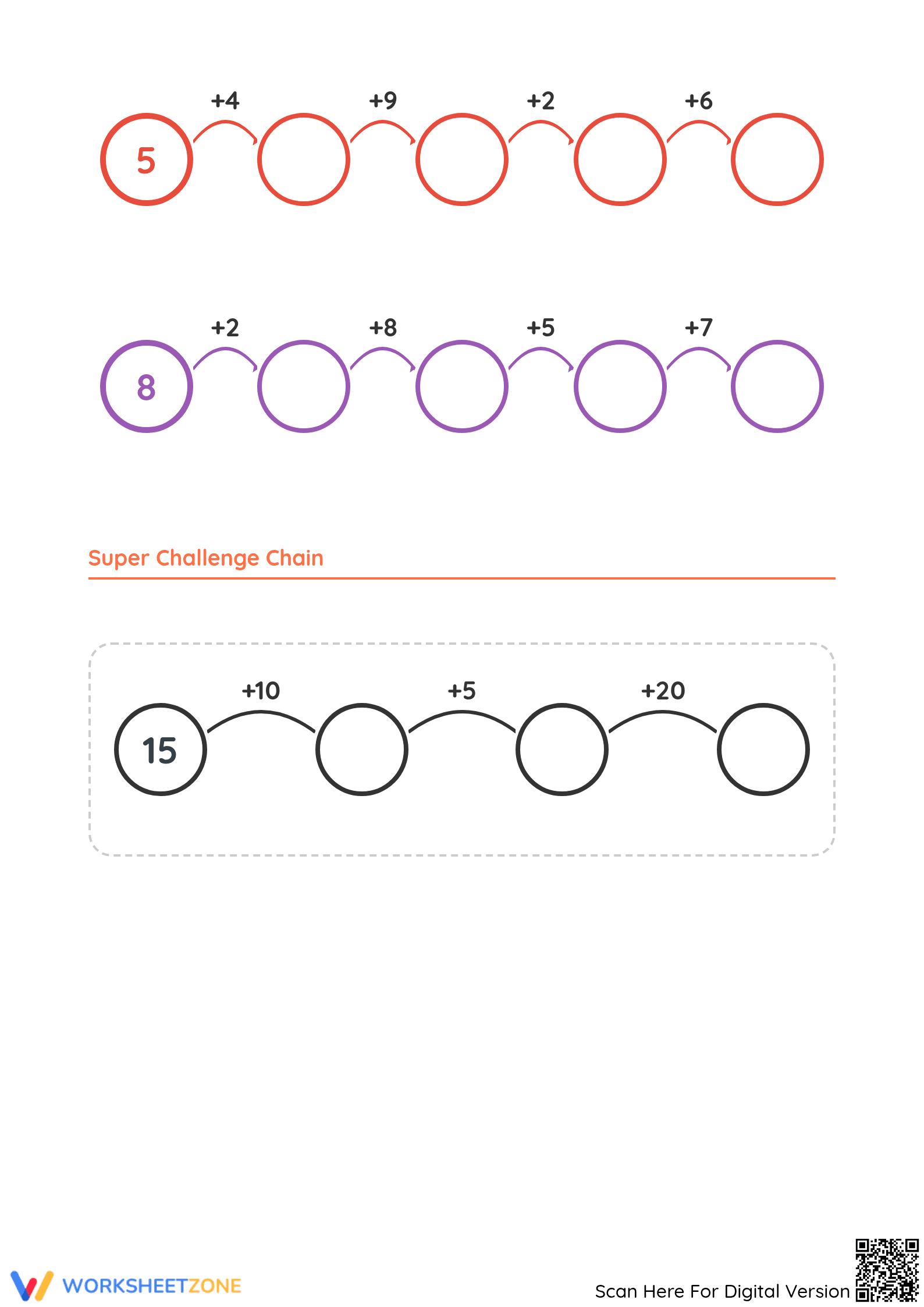

Step-by-Step Addition Worksheet | Essential Grade 2 Math
Paste this activity's link or code into your existing LMS (Google Classroom, Canvas, Teams, Schoology, Moodle, etc.).
Students can open and work on the activity right away, with no student login required.
You'll still be able to track student progress and results from your teacher account.
This Grade 2 math worksheet helps students develop mental math fluency through engaging sequential addition chains. Students perform 23 total operations, building their confidence as they navigate colorful paths from start to finish. It provides an immediate sense of accomplishment while reinforcing core arithmetic skills necessary for mathematical mastery and progression.
At a Glance
- Grade: 2 · Subject: Mathematics
- Standard:
CCSS.MATH.CONTENT.2.NBT.B.5— Fluently add and subtract within 100 using various mental strategies- Skill Focus: Sequential addition and mental math
- Format: 2 pages · 23 problems · Answer key included · PDF
- Best For: Daily warm-ups or independent math centers
- Time: 15–20 minutes
This two-page PDF features five primary addition chains and one "Super Challenge Chain" for advanced practice. Each chain utilizes a visual arrow-based system to guide students through a series of four consecutive additions. The document includes a comprehensive answer key, allowing for quick self-correction or efficient teacher grading in any classroom setting.
To use this resource, simply print the two pages (30 seconds), distribute them to your students (1 minute), and review the completed work using the provided key (under 1 minute). This streamlined process requires less than two minutes of total teacher preparation, making it an ideal choice for sudden sub plans or transition periods.
The primary focus is CCSS.MATH.CONTENT.2.NBT.B.5, which requires students to fluently add and subtract within 100 using strategies based on place value and properties of operations. The sequential nature of these tasks also supports CCSS.MATH.PRACTICE.MP1 by encouraging persistence in problem-solving. Both standard codes can be copied directly into lesson plans, IEP goals, or district curriculum mapping tools.
Assign this worksheet as a morning warm-up activity to activate students' mathematical thinking before moving into direct instruction. During the activity, observe how students handle the multi-step transitions to identify those who may need additional scaffolding with mental math strategies. Expect most Grade 2 students to complete both pages within 15 to 20 minutes.
This resource is designed for Grade 2 students but serves as an excellent extension for high-performing first graders or a remediation tool for third graders needing extra practice. It pairs naturally with physical manipulatives or a hundreds chart for students who require additional visual support during the multi-step calculation process.
This worksheet aligns with CCSS.MATH.CONTENT.2.NBT.B.5, focusing on building computational fluency through sequential mental math exercises. Research from Fisher & Frey (2014) emphasizes that distributed practice with immediate feedback loops, such as these addition chains, significantly improves long-term retention of arithmetic facts. By engaging in 23 distinct operations across two pages, students reinforce the procedural knowledge required for higher-order mathematical operations. This task structure encourages cognitive flexibility as students must maintain the sum in their working memory while applying the next numerical transformation. Such activities are vital for transitioning students from counting-based strategies to more sophisticated decomposition and place-value reasoning. This summary identifies the worksheet as a classroom-ready tool for developing the fundamental skills assessed in standard CCSS.MATH.CONTENT.2.NBT.B.5, ensuring students reach the fluency benchmarks expected by year-end assessments.


