


























Views
Downloads
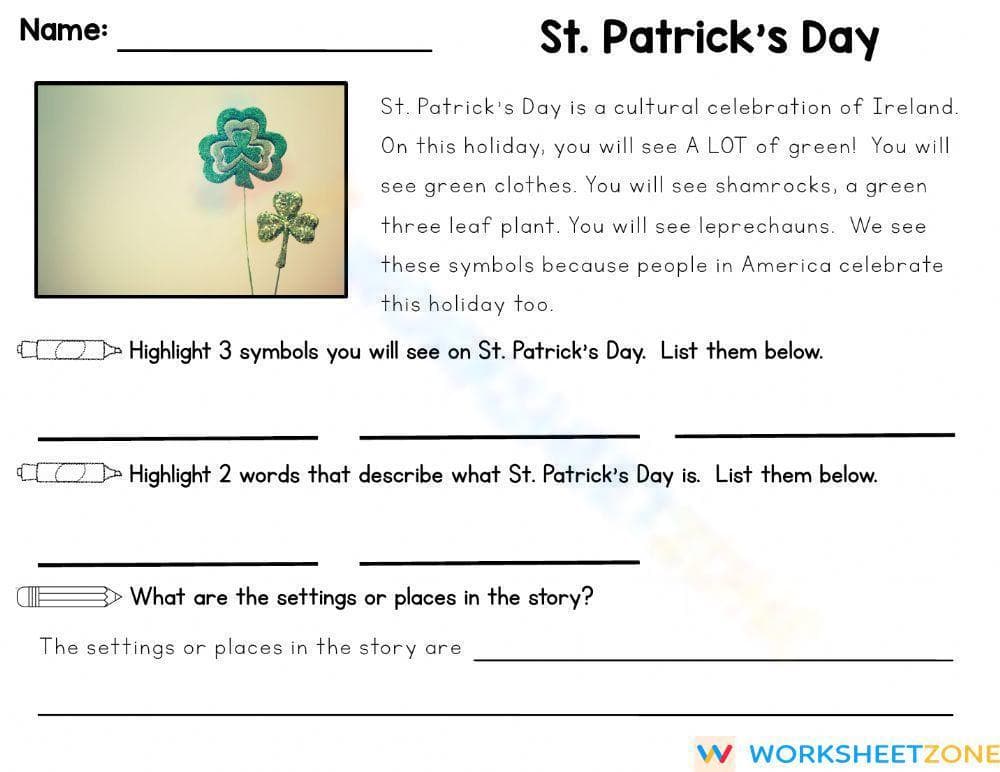

Grade 3-4 St. Patrick's Day — Printable No-Prep Worksheet
Paste this activity's link or code into your existing LMS (Google Classroom, Canvas, Teams, Schoology, Moodle, etc.).
Students can open and work on the activity right away, with no student login required.
You'll still be able to track student progress and results from your teacher account.
This ready-to-use worksheet helps third and fourth-grade students practice key reading comprehension skills with a timely St. Patrick's Day theme. The informational text and targeted questions guide learners to locate and cite textual evidence, identify important symbols, and understand vocabulary in context, building foundational literacy with a fun, seasonal passage.
At a Glance
- Grade: 3–4 · Subject: ELA / Reading
- Standard:
CCSS.ELA-LITERACY.RI.3.1— Ask and answer questions using explicit details from the text.- Skill Focus: Reading Comprehension, Finding Text Evidence
- Format: 1 page · 3 tasks · Answer key included · PDF
- Best For: Literacy centers, morning work, sub plans
- Time: 10–15 minutes
What's Inside
This single-page resource includes a concise informational passage about the symbols and traditions of St. Patrick's Day. Three distinct tasks follow the reading: one requiring students to highlight and list 3 symbols, a second asking them to identify 2 descriptive words, and a third prompting them to name the story's setting. A complete answer key is provided for quick and easy grading.
Zero-Prep Workflow
Designed for the busy classroom, this worksheet follows a simple three-step workflow. 1) Print: The single PDF is easy to print. 2) Distribute: Clear instructions allow students to work independently. 3) Review: A full answer key enables quick assessment. The entire process takes less than 5 minutes, making it ideal for sub plans or transition activities.
Standards Alignment
This worksheet is directly aligned with a key informational text standard for early elementary students: CCSS.ELA-LITERACY.RI.3.1, which requires students to "Ask and answer questions to demonstrate understanding of a text, referring explicitly to the text as the basis for the answers." The tasks are built to ensure students must return to the passage to find and list specific details, reinforcing the core skill of using textual evidence. The standard code can be copied directly into lesson plans, IEP goals, or district curriculum mapping tools.
How to Use It
This worksheet is effective as an independent practice activity in a literacy center or as a warm-up task. It serves as a valuable formative assessment after a lesson on finding text evidence; teachers can quickly scan student work to see if they are locating information from the passage. The 10 to 15-minute completion time fits easily into any class period.
Who It's For
Created for third and fourth-graders developing non-fiction reading skills, this resource is accessible for diverse learners. The straightforward layout and clear tasks support students as they learn to navigate informational text. For a complete lesson, pair this worksheet with an anchor chart defining "text evidence" or a short video about the history of St. Patrick's Day.
This reading comprehension resource provides focused practice on CCSS.ELA-LITERACY.RI.3.1, a foundational skill for academic success. By requiring students to ask and answer questions by referring explicitly to a text, the worksheet builds the habit of evidence-based reasoning. This approach is supported by extensive research highlighting the importance of close reading and text-dependent questions in developing literacy. According to a comprehensive analysis by Fisher & Frey (2014), instructional routines that guide students back into the text to support their claims are critical for improving comprehension across all subject areas. The worksheet's structure—a short, high-interest passage followed by targeted tasks—provides a scaffolded experience that allows students to practice this essential skill in a low-stakes format. This targeted practice is crucial for building the analytical skills needed for more complex texts in later grades.


