


























Views
Downloads


Printable Estimating Square Roots Worksheet | Grade 6-7 Math
Paste this activity's link or code into your existing LMS (Google Classroom, Canvas, Teams, Schoology, Moodle, etc.).
Students can open and work on the activity right away, with no student login required.
You'll still be able to track student progress and results from your teacher account.
This comprehensive math worksheet empowers middle school students to master the estimation of non-perfect square roots without the use of a calculator. By progressing from whole number approximations to decimal precision, students develop a deep conceptual understanding of irrational numbers and their relative positions on the real number line.
At a Glance
- Grade: 6-7 · Subject: Math
- Standard:
CCSS.MATH.CONTENT.8.NS.A.2— Use rational approximations to compare, locate, and estimate values of irrational numbers.- Skill Focus: Square Root Estimation
- Format: 4 pages · 40 problems · Answer key included · PDF
- Best For: Middle school number system mastery
- Time: 45–60 minutes
The packet spans four high-quality pages featuring 40 distinct exercises. Students engage with whole number estimation, decimal approximations to the nearest tenth, and visual mapping on number lines. The resource also includes comparison drills and complex word problems that apply these skills to real-world contexts like geometry and construction. A detailed answer key ensures quick grading and immediate feedback.
Skill Progression
- Guided Practice (16 problems): Students identify the two consecutive whole numbers a square root falls between and determine the closest integer value.
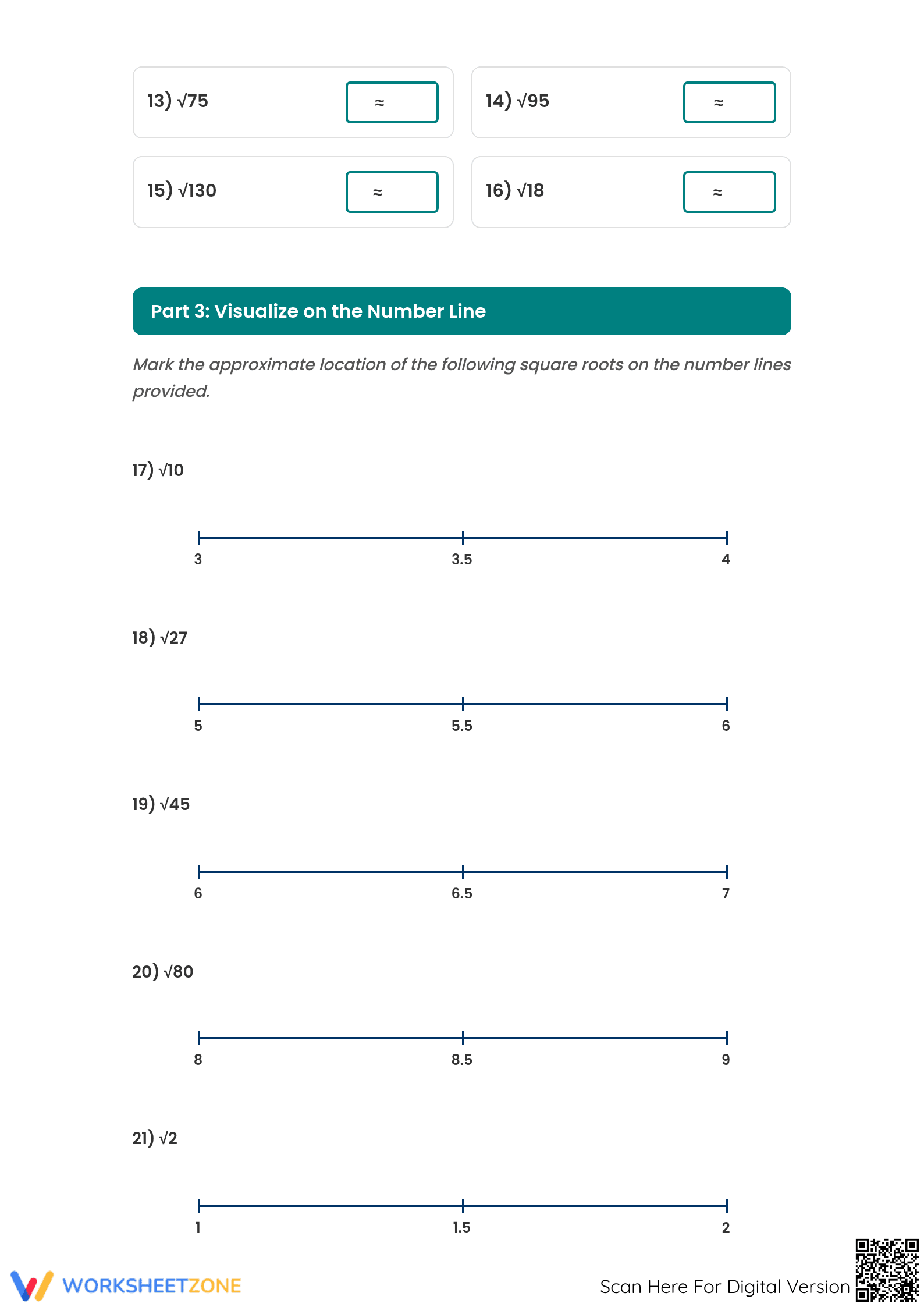
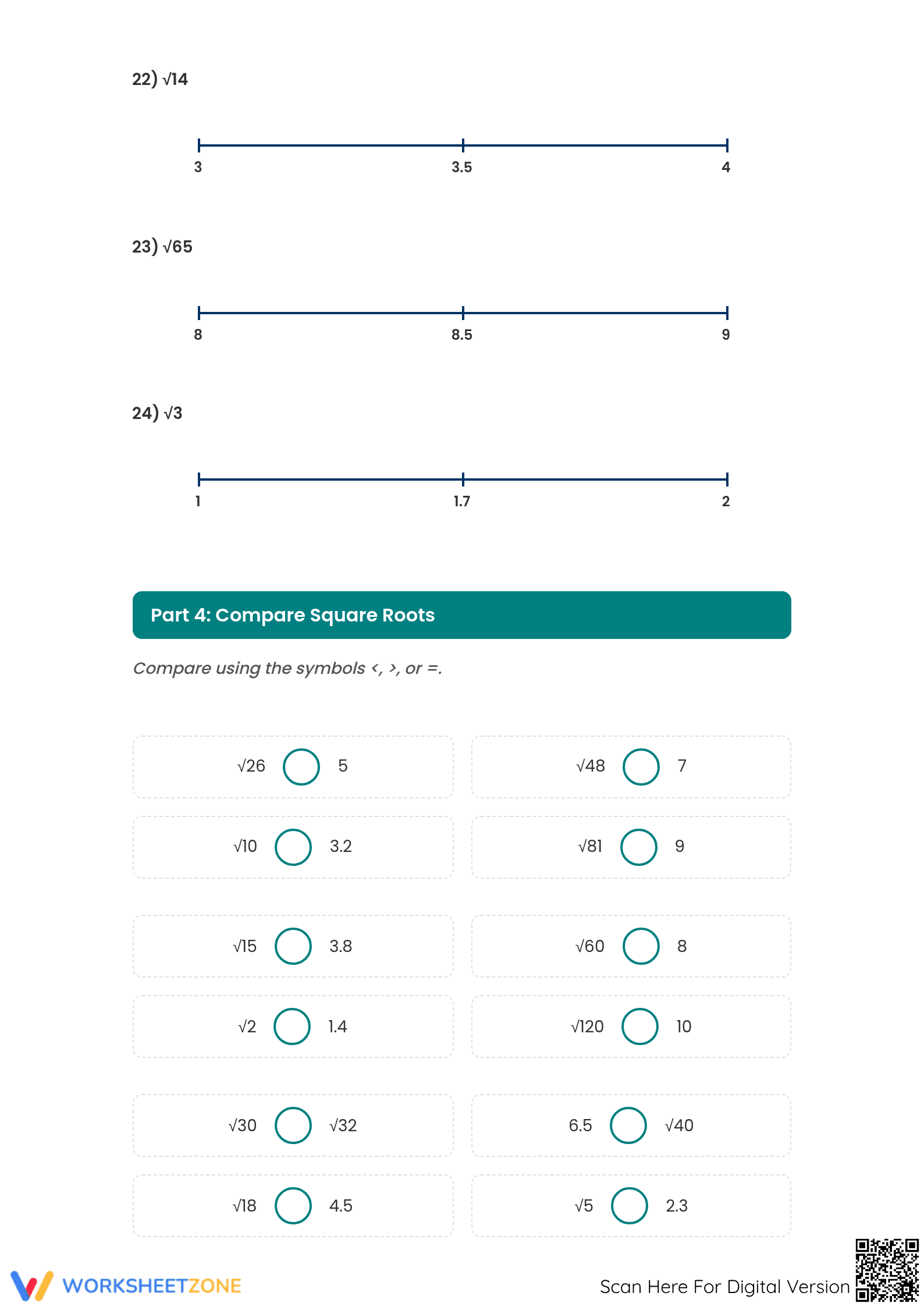
- Supported Practice (20 problems): Learners refine their estimates to the nearest tenth and translate these values onto visual number line diagrams for spatial reinforcement.
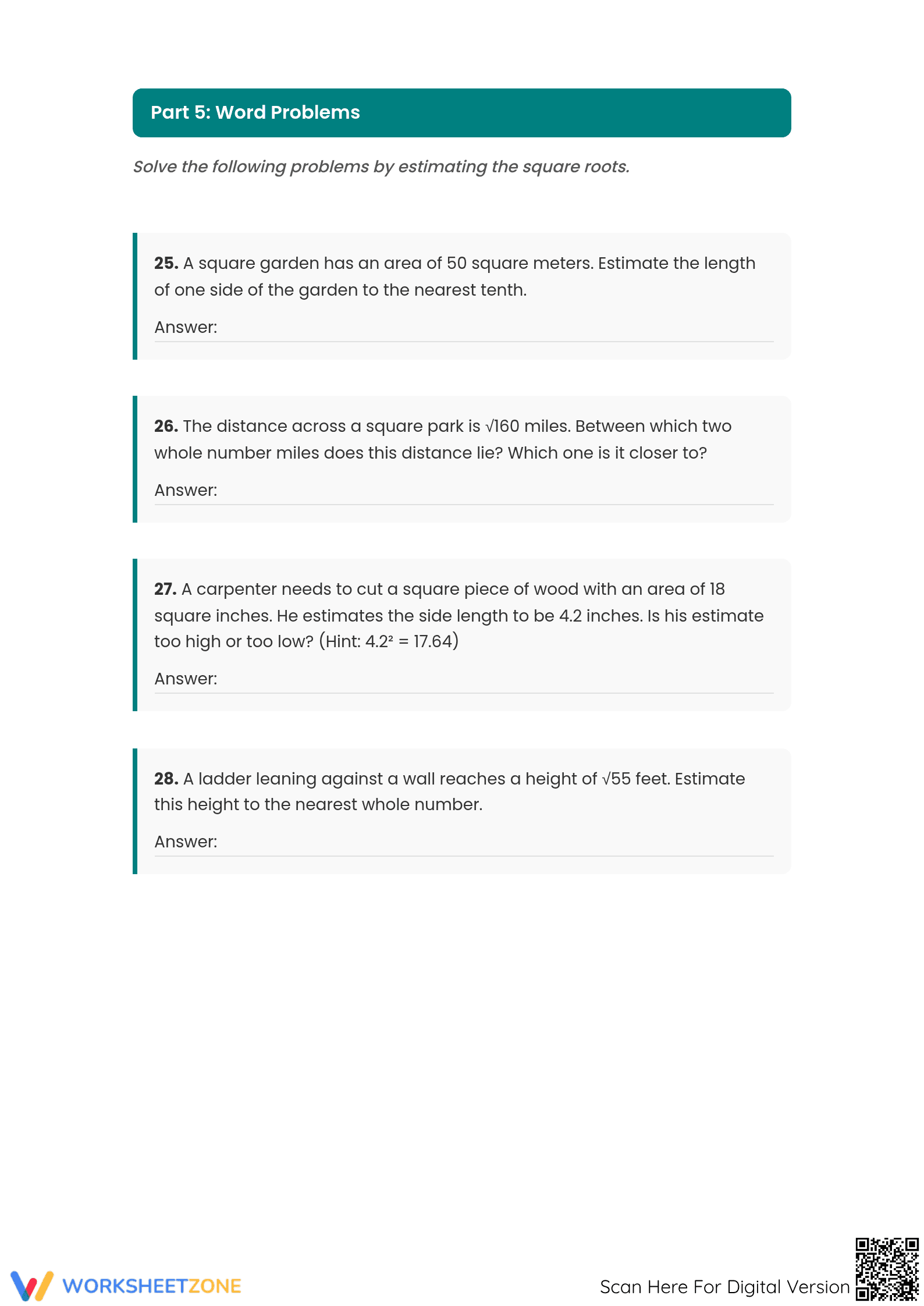
- Independent Practice (4 problems): Multi-step word problems require students to apply square root estimation to determine side lengths of square plots and heights of leaning objects.
Standards Alignment
The primary focus is `CCSS.MATH.CONTENT.8.NS.A.2`, which requires students to use rational approximations of irrational numbers to compare sizes and locate them approximately on a number line. This worksheet directly supports this by asking for decimal estimates and number line placement. This standard code can be copied directly into lesson plans, IEP goals, or district curriculum mapping tools.
How to Use It
This resource is ideal for the "We Do" phase of direct instruction. After modeling estimation techniques, work through the number line section as a class to visualize value placements. Alternatively, use the comparison section as a formative assessment at the end of a unit. Monitor student work for common errors, such as confusing square roots with division by two, to identify where further remediation is needed.
Who It's For
Designed for Grade 6 and Grade 7 students, this worksheet is particularly effective for those transitioning from perfect squares to irrational number sets. The visual number lines provide excellent support for ELL and IEP students who benefit from spatial representations of abstract mathematical concepts. It pairs naturally with anchor charts showing common perfect squares from 1 to 225.
Rigorous practice with rational approximations is a cornerstone of middle school numeracy, bridging the gap between basic arithmetic and algebraic reasoning. According to a RAND AIRS 2024 analysis, students who engage in scaffolded estimation tasks demonstrate higher retention rates for irrational number properties compared to those who rely solely on procedural computation. This worksheet targets CCSS.MATH.CONTENT.8.NS.A.2 by requiring students to explain the reasoning behind their approximations, moving beyond simple guessing. By integrating visual number line mapping with real-world word problems, the resource ensures that the plain-English skill of estimating roots becomes a durable component of the student's mathematical toolkit. This alignment with evidence-based instructional design promotes cognitive flexibility, allowing learners to navigate complex geometric calculations and higher-order algebraic expressions with greater accuracy and conceptual confidence in later secondary education levels.


