


























Views
Plays
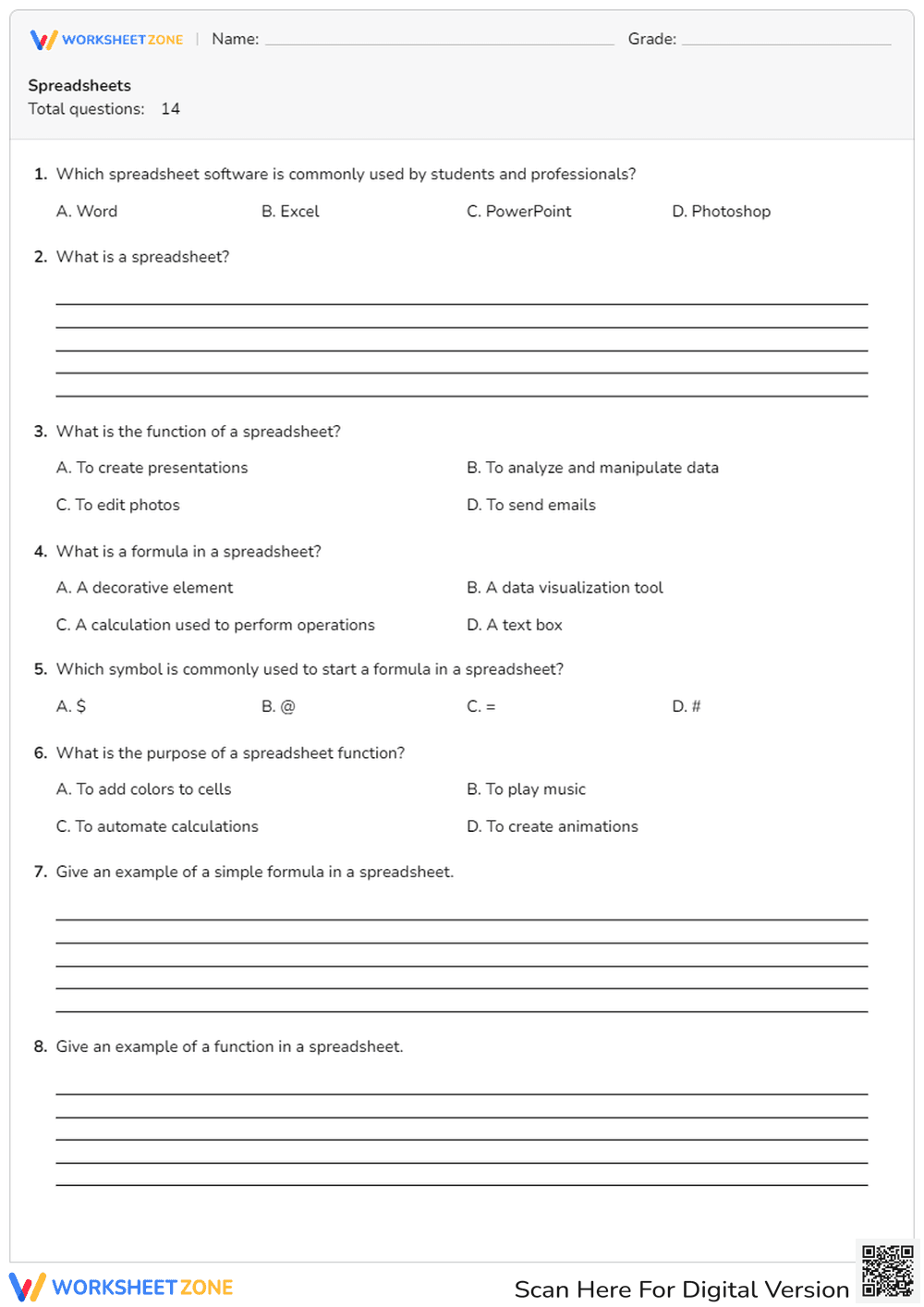


Essential Spreadsheets Worksheet | Grade 9 Computer Science
Paste this activity's link or code into your existing LMS (Google Classroom, Canvas, Teams, Schoology, Moodle, etc.).
Students can open and work on the activity right away, with no student login required.
You'll still be able to track student progress and results from your teacher account.
This Grade 9 spreadsheets worksheet provides a comprehensive assessment of digital literacy skills. Students demonstrate their understanding of data organization, formula construction, and advanced functions like COUNTIF. By completing these 14 targeted questions, learners solidify their ability to manipulate and analyze data sets effectively within modern spreadsheet software environments.
At a Glance
- Grade: 9 · Subject: Computer Science
- Standard:
CSTA.3A.DA.11— Collect and transform data using computational tools for analysis- Skill Focus: Spreadsheet Fundamentals & Data Management
- Format: 2 pages · 14 problems · Answer key included · PDF
- Best For: Formative assessment or sub plans
- Time: 20–30 minutes
What's Inside
This two-page PDF features a balanced mix of 10 multiple-choice questions and 4 open-ended short-answer prompts. The assessment covers critical vocabulary, formula syntax (including the "=" symbol), and specific tools like pivot tables and data validation. A clear layout ensures students have ample space to write out formula examples and explain the differences between rows and columns.
Zero-Prep Workflow
- Print: Generate the two-page document in less than 30 seconds.
- Distribute: Hand out the assessment to students in approximately 1 minute.
- Review: Utilize the structured format for rapid grading using the included answer key.
Total teacher preparation time is under 2 minutes, making it an ideal choice for emergency sub plans or end-of-unit checks.
Standards Alignment
The primary focus is `CSTA.3A.DA.11`, which requires students to "collect data using computational tools and transform the data to make it more useful and reliable." This worksheet directly supports this by testing the mechanics of data transformation through functions and formatting. This standard code can be copied directly into lesson plans, IEP goals, or district curriculum mapping tools.
How to Use It
Use this worksheet as a mid-unit formative assessment to identify misconceptions about formula syntax before moving into complex projects. During the session, observe if students struggle with the distinction between formulas and functions in the short-answer section. Expect completion within 20 to 30 minutes depending on prior software exposure.
Who It's For
This resource is tailored for Grade 9 students in introductory Computer Science or Business Technology courses. It provides necessary scaffolding for English Language Learners through clear multiple-choice options. It pairs naturally with a live software demonstration or an introductory anchor chart detailing basic spreadsheet terminology.
According to the RAND AIRS 2024 report, proficiency in computational tools like spreadsheets is a primary indicator of post-secondary career readiness. This Grade 9 worksheet addresses this need by evaluating student mastery of CSTA.3A.DA.11, focusing on the essential student action of transforming raw data into organized information. Research from Fisher & Frey (2014) emphasizes that structured assessments with a mix of retrieval practice (multiple choice) and generative tasks (short answer) significantly improve long-term retention of technical vocabulary. By requiring students to define functions and construct formulas, this resource moves beyond rote memorization toward functional literacy. The 14-question format provides a statistically significant sample of student understanding for data-driven instruction. Educators can utilize these results to bridge the gap between theoretical knowledge and practical application in digital environments, ensuring students meet national standards for data analysis and computational thinking.


