


























Views
Downloads

Printable 'S' Words Spelling Worksheet | Grade 1 ELA
Paste this activity's link or code into your existing LMS (Google Classroom, Canvas, Teams, Schoology, Moodle, etc.).
Students can open and work on the activity right away, with no student login required.
You'll still be able to track student progress and results from your teacher account.
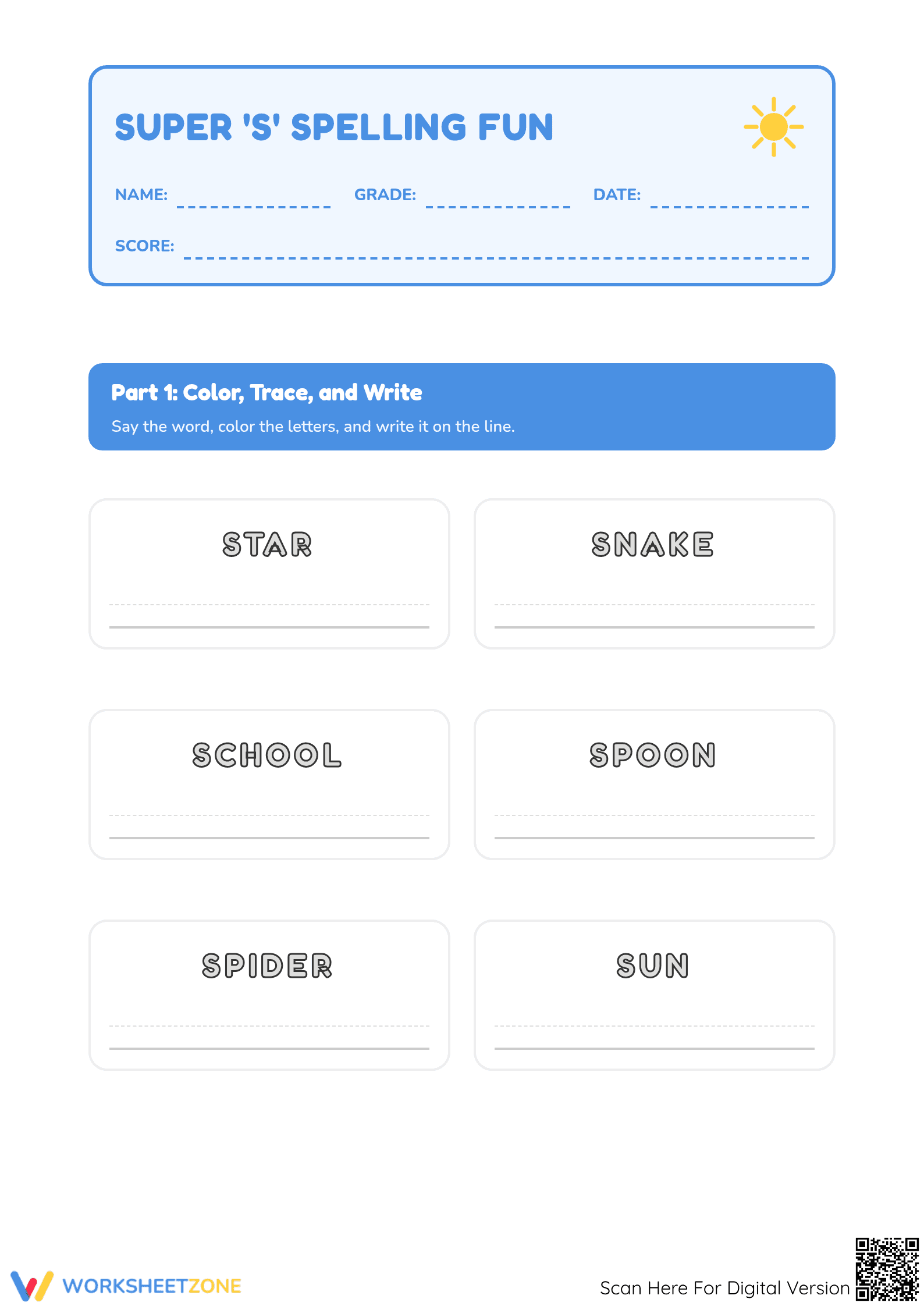
This comprehensive Grade 1 spelling resource focuses on words beginning with the letter 'S', providing students with multiple ways to engage with new vocabulary. By combining visual, kinesthetic, and cognitive tasks, the worksheet ensures that learners move beyond rote memorization toward genuine orthographic awareness and phonetic mastery in early literacy development.
At a Glance
- Grade: 1 · Subject: Spelling
- Standard:
CCSS.ELA-LITERACY.L.1.2.E— Spell untaught words phonetically, drawing on phonemic awareness and spelling conventions- Skill Focus: Initial 'S' phonemes and orthography
- Format: 3 pages · 22 problems · Answer key included · PDF
- Best For: Independent literacy centers or morning work
- Time: 15–25 minutes
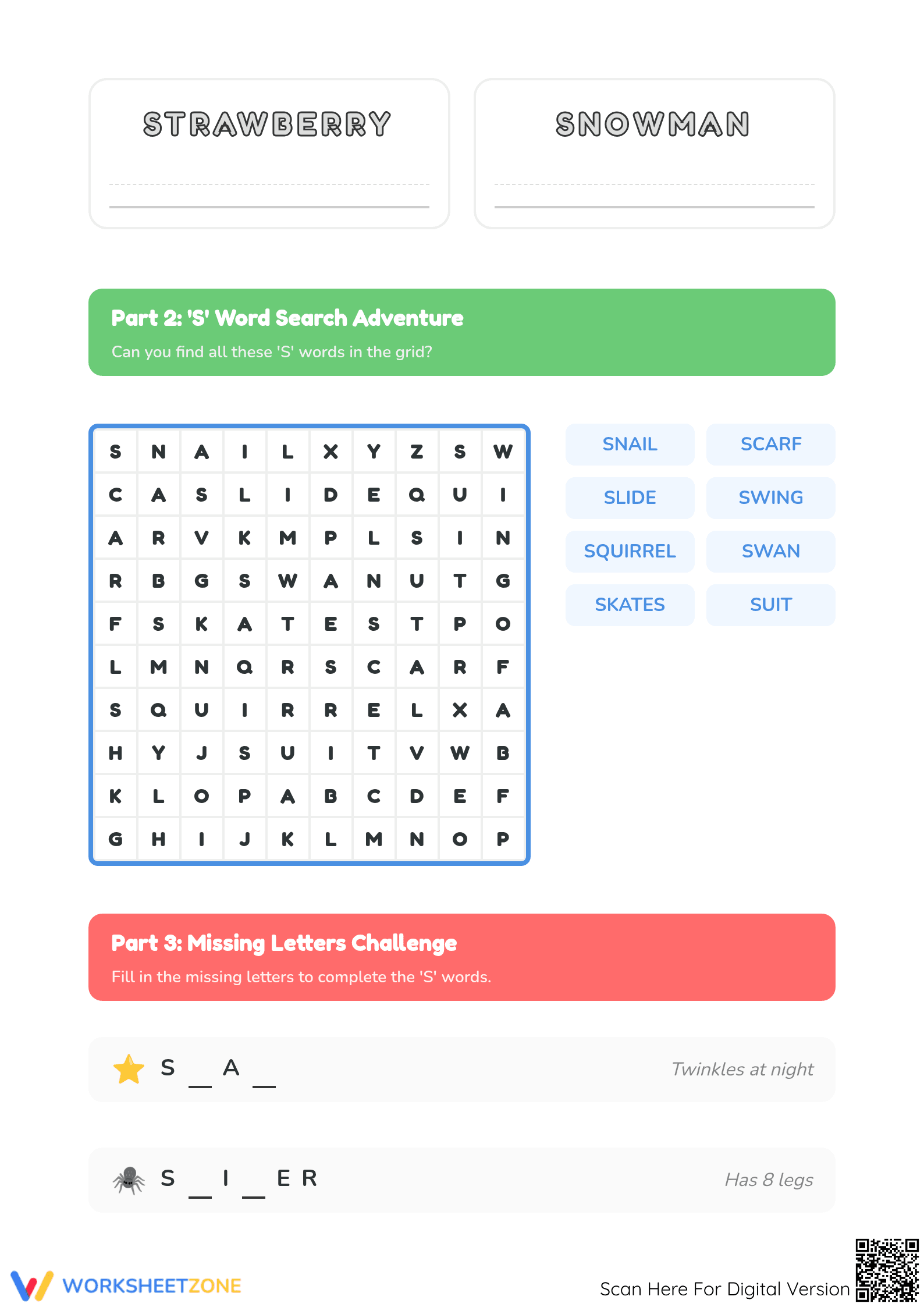
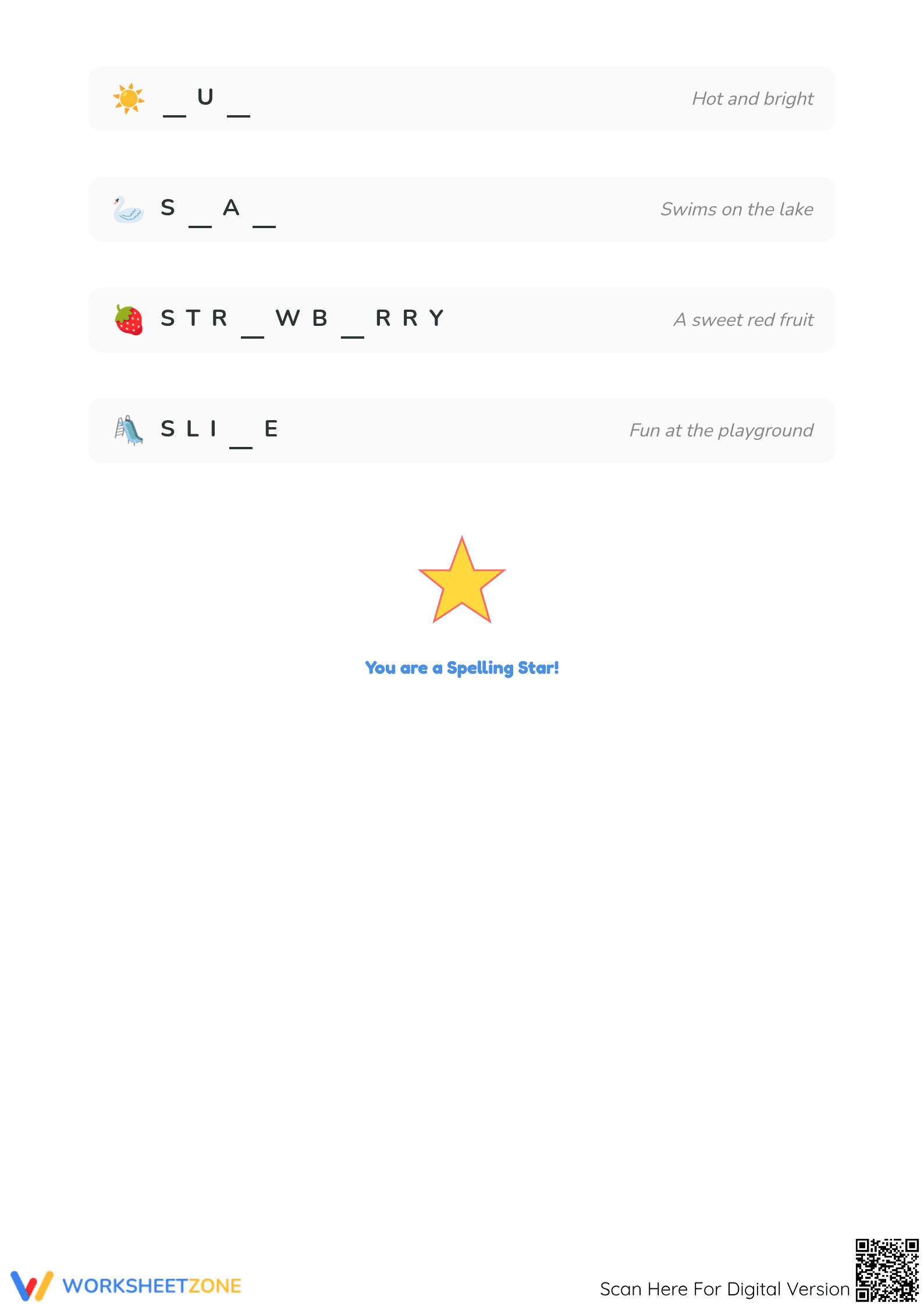
Across three high-quality pages, students encounter 22 distinct tasks designed to reinforce word recognition. Part one features eight words for coloring, tracing, and independent writing, including high-frequency terms like "School" and "Sun." Part two introduces an eight-word search puzzle to build visual scanning skills. Part three concludes with six "Missing Letters" challenges that use context clues and icons to prompt correct spelling and letter placement.
Zero-Prep Workflow
- Print: Generate the three-page PDF and answer key in under 30 seconds.
- Distribute: Hand out the packets during your literacy block or as a transition activity with zero teacher setup required.
- Review: Use the included answer key for a quick five-minute peer-review session or whole-class check to provide immediate feedback.
This workflow is specifically designed to fit into busy classroom schedules or serve as a reliable emergency sub plan.
The primary focus is CCSS.ELA-LITERACY.L.1.2.E, which requires students to spell untaught words phonetically, drawing on phonemic awareness and spelling conventions. By isolating the 'S' sound across various word lengths and complexities, the worksheet supports phonological development. Both standard codes can be copied directly into lesson plans, IEP goals, or district curriculum mapping tools.
Assign this packet as a standalone morning work activity to settle students as they enter the classroom. Alternatively, use it during small-group literacy centers as a formative assessment tool. Observe how students handle the "Missing Letters" section to identify who may need additional support with vowel placement or consonant blends. Completion typically takes 15–25 minutes depending on student proficiency.
This resource is ideal for Kindergarten through Grade 2 students, particularly those working on initial consonant sounds. It serves as an excellent scaffold for English Language Learners (ELLs) due to the heavy use of pictorial support for every vocabulary word. Pair this worksheet with a "Letter S" anchor chart or a shared reading passage featuring sibilant alliteration for a complete lesson.
Research by Fisher & Frey (2014) emphasizes the importance of the gradual release of responsibility in literacy instruction, moving from modeled tracing to independent problem-solving. This worksheet mirrors that pedagogical shift by transitioning students from guided tracing to independent word search identification and finally to context-based spelling completion. By engaging with CCSS.ELA-LITERACY.L.1.2.E through three distinct modalities, students are significantly more likely to retain the orthographic patterns of the target phoneme compared to single-task worksheets. The inclusion of visual cues alongside the 'S' words provides the necessary scaffolding for early readers to bridge the gap between phonemic awareness and written expression. This structured approach ensures that Grade 1 learners develop the foundational spelling stamina required for more complex writing tasks in later primary years.


