


























Views
Downloads



Essential Letter U-X Spelling Worksheet | Preschool ELA
Paste this activity's link or code into your existing LMS (Google Classroom, Canvas, Teams, Schoology, Moodle, etc.).
Students can open and work on the activity right away, with no student login required.
You'll still be able to track student progress and results from your teacher account.
Equip your preschool students with the essential skills needed for early reading success with this comprehensive five-page spelling and vocabulary worksheet. By focusing on initial letter sounds for U, V, W, and X, this resource provides nine engaging visual matching tasks that strengthen phonetic awareness and letter recognition in a fun format.
At a Glance
- Grade: Preschool · Subject: ELA Alphabet
- Standard:
CCSS.ELA-LITERACY.RF.PK.3.a— Associate many letters with their names and their most frequent sounds- Skill Focus: Initial letter sounds and spelling vocabulary
- Format: 5 pages · 9 problems · Answer key included · PDF
- Best For: Literacy centers and morning work practice
- Time: 15–20 minutes
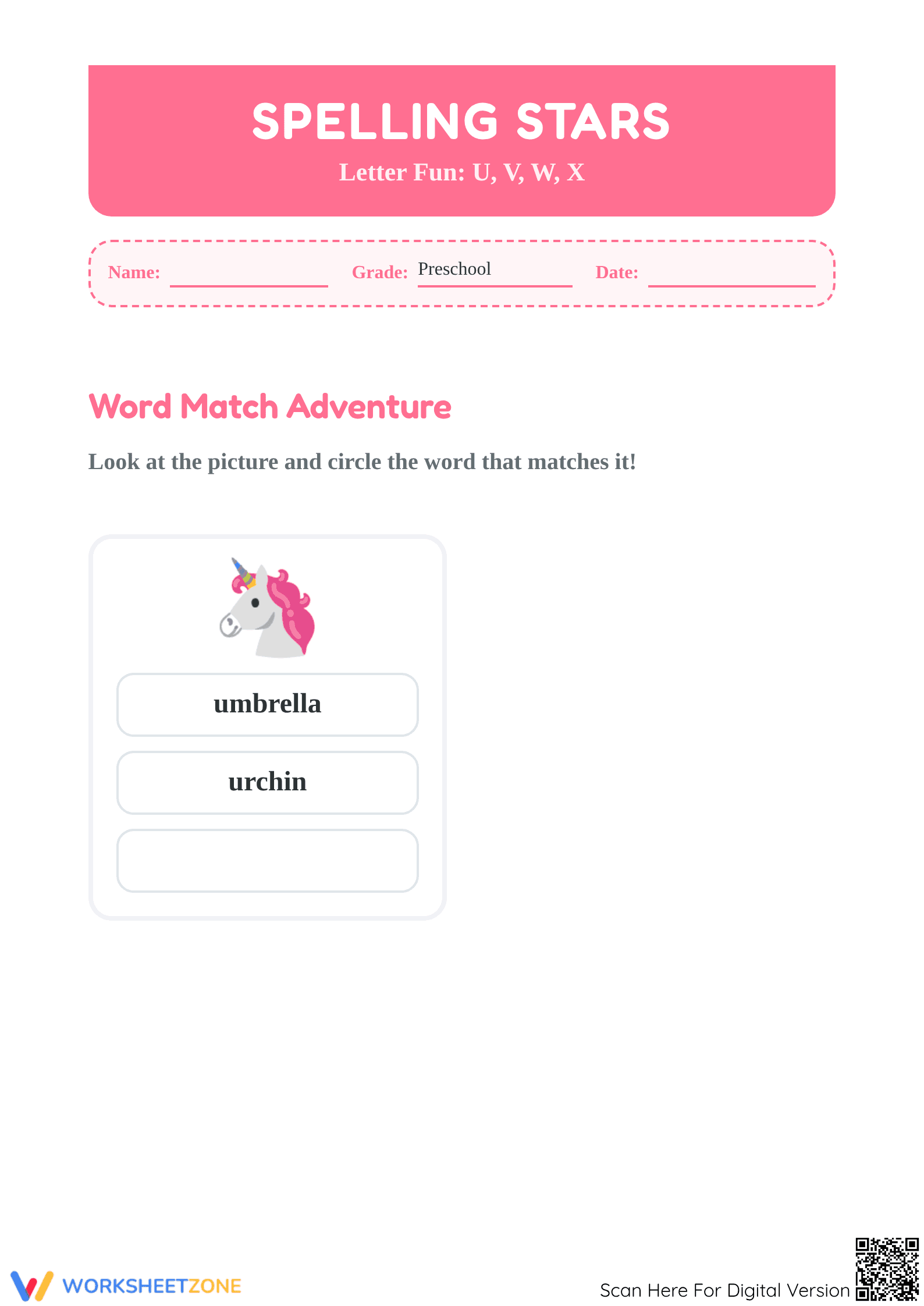
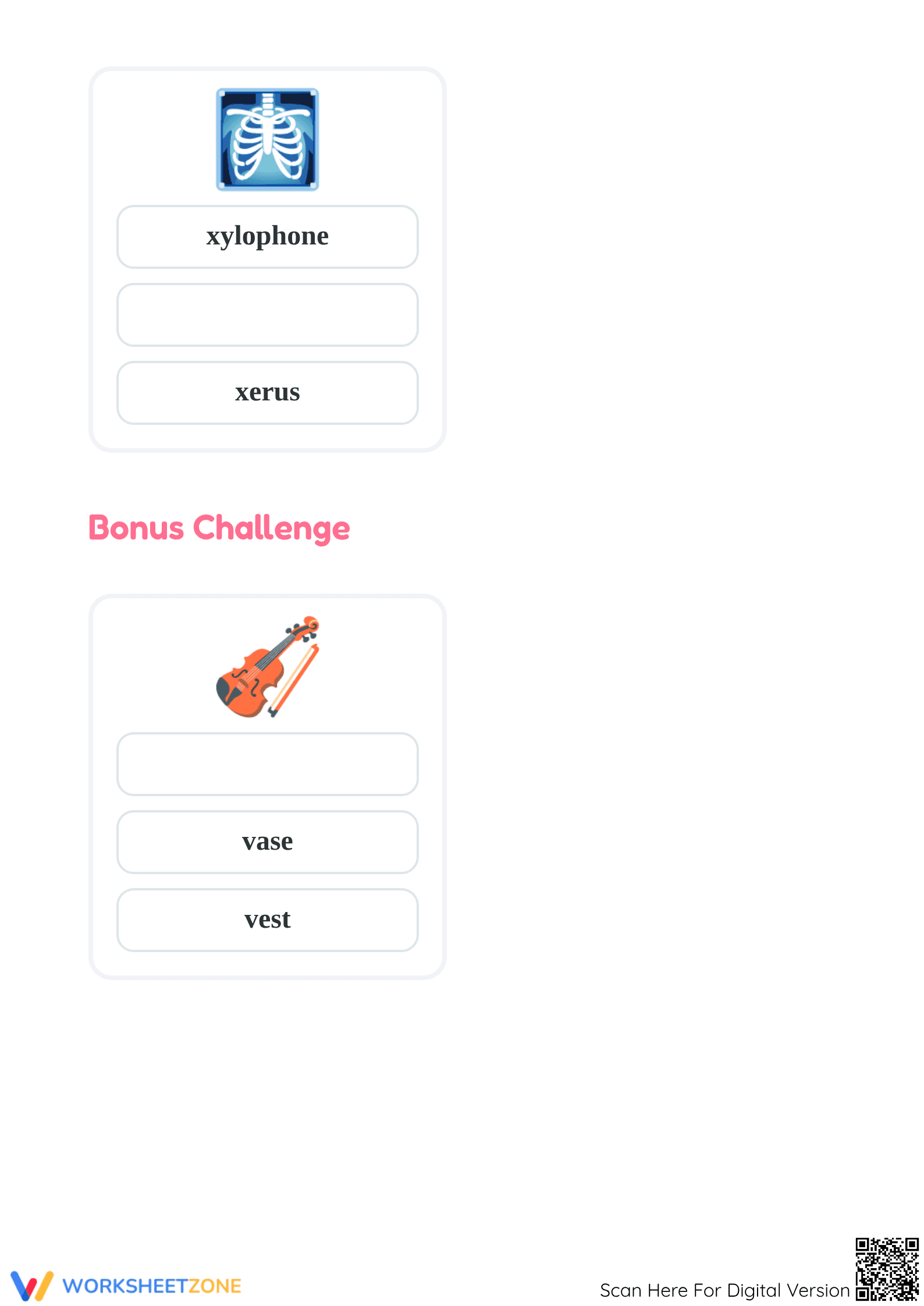
This printable PDF packet contains five distinct pages of high-quality spelling activities. Each page features vibrant illustrations—such as unicorns, whales, and x-rays—paired with multiple-choice word options. Students must look at the visual cue and circle the corresponding word from three choices. The clean layout is ideal for young learners with developing fine motor skills.
- Guided Practice: Early pages use recognizable imagery like a unicorn to help students identify the correct initial sound through direct matching.
- Supported Practice: Intermediate tasks introduce unique vocabulary like "xerus" and "walrus," encouraging students to look closely at word structures to find the match.
- Independent Practice: The "Bonus Challenge" sections require students to differentiate between similar-looking words to identify the correct spelling for the illustrated object.
This sequence follows the gradual-release model, shifting cognitive load to the learner as they progress through the five-page set.
Standards Alignment
This resource is aligned with `CCSS.ELA-LITERACY.RF.PK.3.a`, requiring students to associate letters with their names and sounds. By targeting phonemes for letters U through X, the worksheet provides evidence of a student's ability to map sounds to written symbols. This code can be copied into lesson plans or IEP goals.
How to Use It
Use this packet during small-group literacy rotations for targeted phonics intervention. It is effective as a formative assessment where teachers observe students' elimination processes. Note if they use the initial letter alone or attempt to blend the full word. Most students will complete the full set in approximately 15 to 20 minutes.
Who It's For
This worksheet is designed for preschool students beginning to explore letter-sound relationships. It is an excellent fit for English Language Learners needing visual support for foundational vocabulary. Pair this resource with an alphabet anchor chart to create a multi-sensory learning experience that caters to diverse styles and instructional needs.
Foundational literacy research, such as the RAND AIRS 2024 report, emphasizes that consistent exposure to letter-sound correspondence is the strongest predictor of later reading proficiency. This Preschool ELA worksheet aligns with these findings by providing nine structured opportunities for students to practice the CCSS.ELA-LITERACY.RF.PK.3.a standard, specifically focusing on initial letter sounds for U, V, W, and X. By integrating high-interest visual cues with spelling recognition, the resource helps move students from simple letter identification to the alphabetic principle phase. According to Fisher & Frey (2014), scaffolded practice using visual-word associations significantly enhances the retention of new phonemes in early childhood settings. This tool offers the exact type of low-stakes practice recommended for developing phonetic mastery. Educators can reliably use this packet as a standalone assessment or reinforcement tool within a broader phonological awareness curriculum.


