


























Views
Downloads

Printable Alphabet Spelling Worksheet | Preschool ELA
Paste this activity's link or code into your existing LMS (Google Classroom, Canvas, Teams, Schoology, Moodle, etc.).
Students can open and work on the activity right away, with no student login required.
You'll still be able to track student progress and results from your teacher account.
This preschool spelling worksheet helps early learners connect visual animal cues with their corresponding written names. By identifying animals like elephants and giraffes, students strengthen their phonemic awareness. This printable resource provides a foundational step in literacy development, encouraging children to recognize letter patterns in a familiar, engaging context.
At a Glance
- Grade: Preschool · Subject: English Language Arts
- Standard:
CCSS.ELA-LITERACY.RF.K.3.A— Produce the primary sound for consonants and match sounds to letters- Skill Focus: Initial letter sounds and animal vocabulary
- Format: 3 pages · 4 problems · Answer key included · PDF
- Best For: Early literacy centers and homework practice
- Time: 10–15 minutes
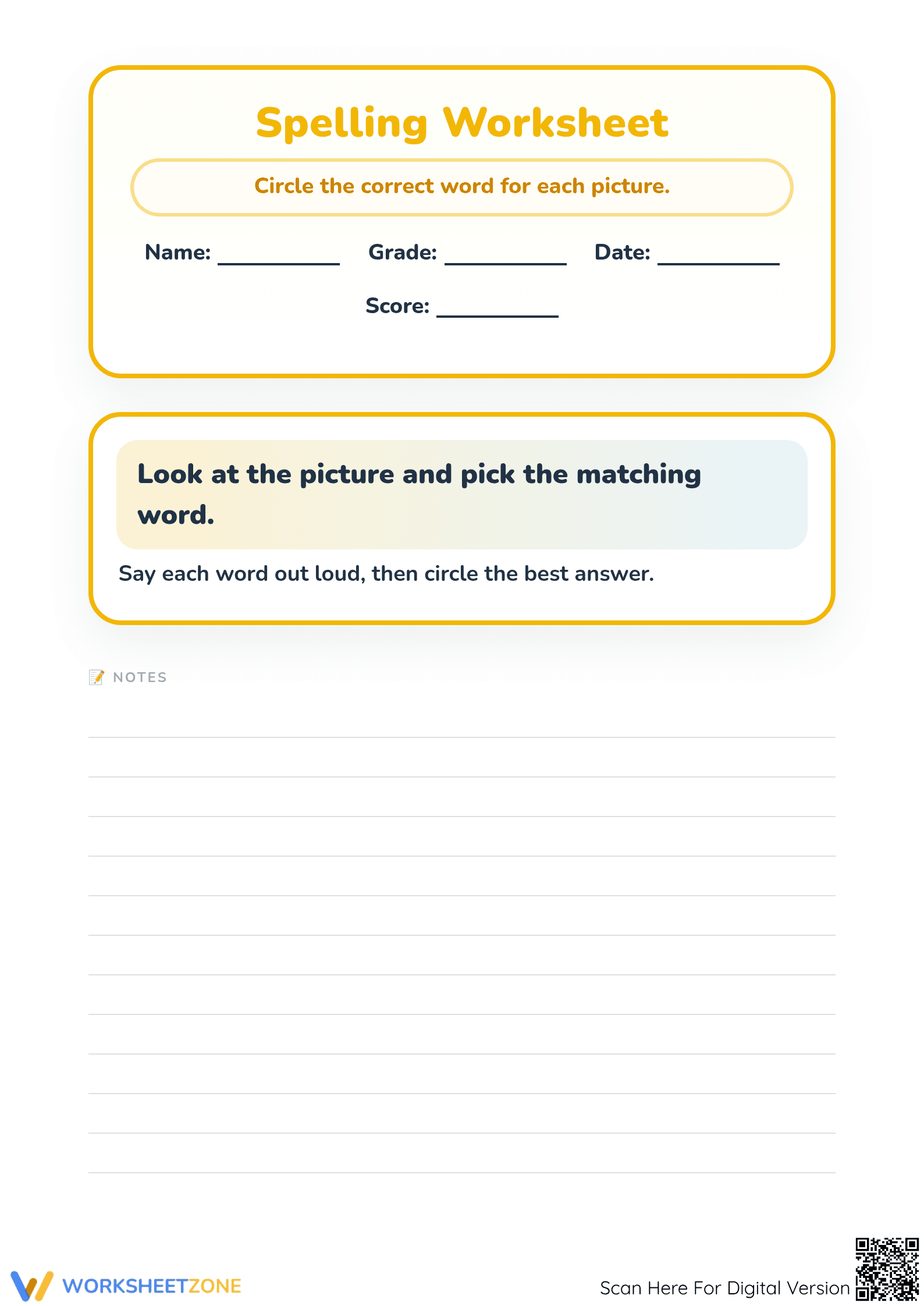
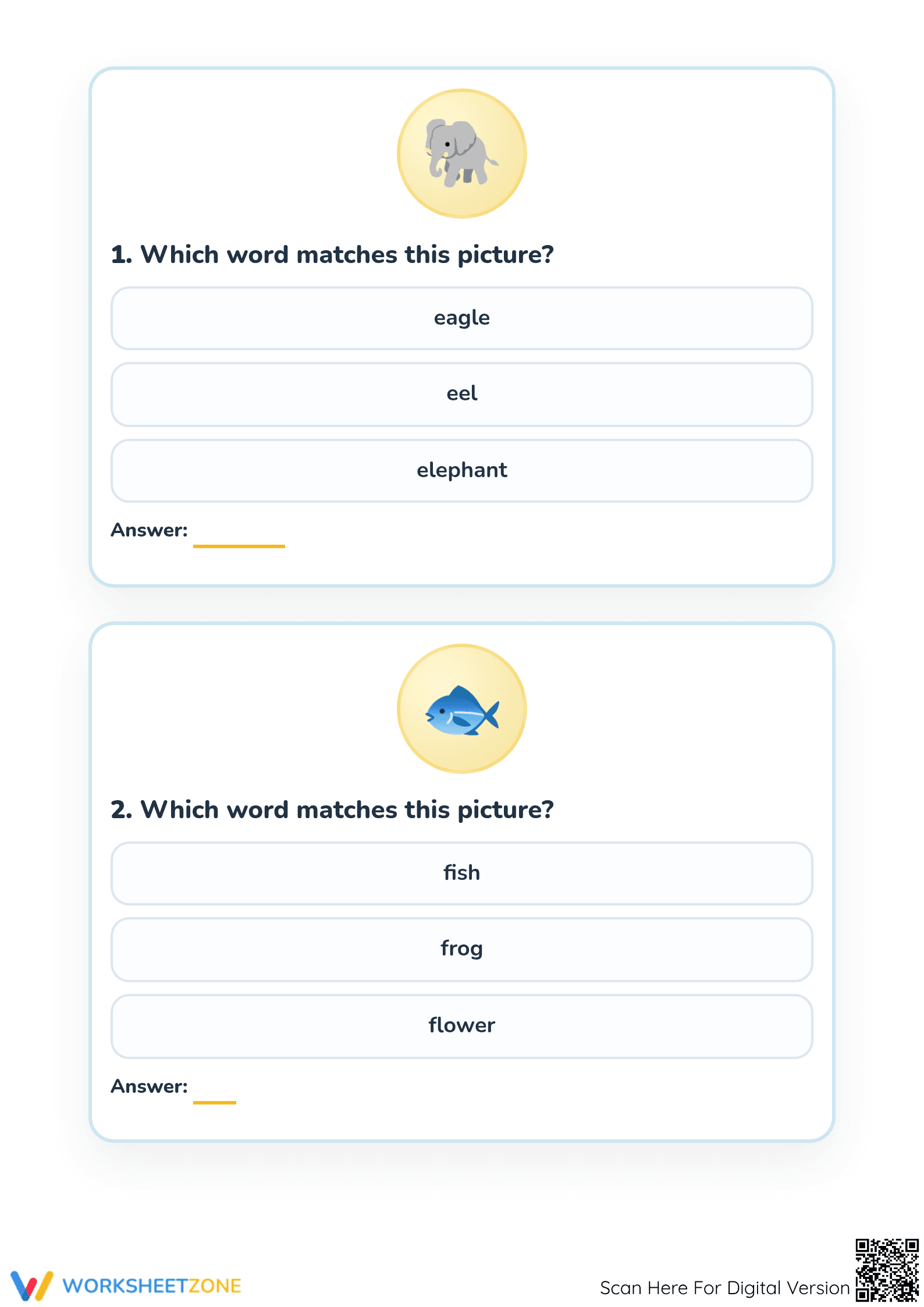
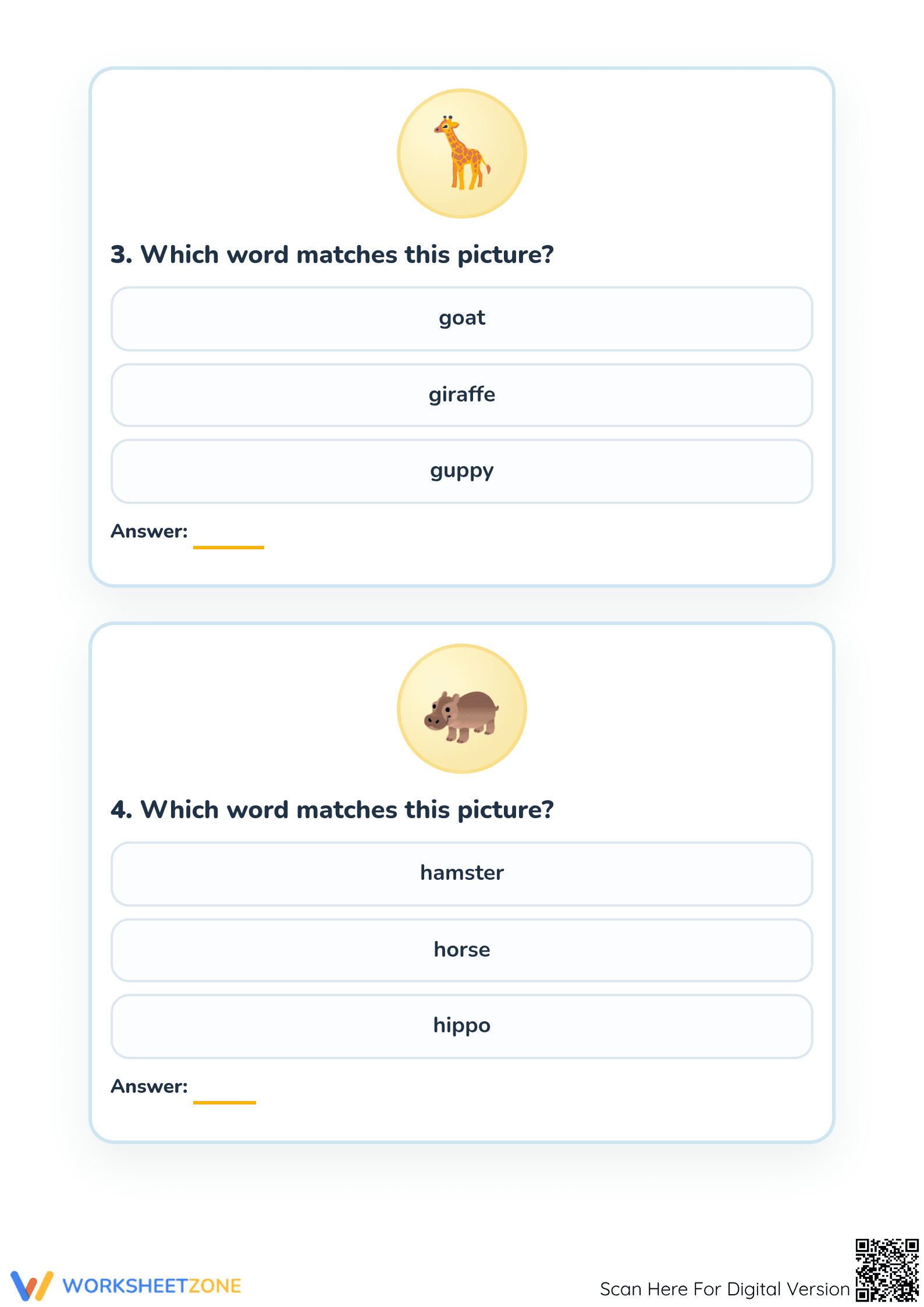
This 3-page PDF features a student-friendly layout designed for the preschool attention span. The first page contains instructional headers and a large notes section for teacher observations. Pages two and three present four distinct animal matching tasks, each featuring high-quality illustrations of an elephant, fish, giraffe, and hippo paired with three word choices to challenge phonetic recognition.
The classroom ready design ensures a quick transition from printing to practice. First, print the 3-page document (30 seconds). Second, distribute the worksheets and read the verbal instructions aloud (1 minute). Finally, students complete the four tasks while the teacher monitors for correct pronunciation. The total teacher preparation time is under two minutes, making it ideal for busy mornings.
This worksheet aligns with `CCSS.ELA-LITERACY.RF.K.3.A`, which requires students to demonstrate basic knowledge of one-to-one letter-sound correspondences. By choosing between similar-looking words like "eagle" and "elephant," students must attend to the specific phonemes that distinguish each animal name. This standard code can be copied directly into lesson plans, IEP goals, or district curriculum mapping tools to ensure instructional rigor.
Use this worksheet during a literacy block after introducing the letters E, F, G, and H. Read the animal names together to model the workflow. As a formative assessment, observe if students use the initial letter sound to eliminate incorrect choices, such as noticing that "fish" starts with 'f' while "frog" also does, requiring them to look closer at the spelling.
This resource is tailored for preschool students beginning their phonics journey and English Language Learners who need visual support for vocabulary. It serves as an excellent natural pairing for animal-themed picture books or alphabet anchor charts that emphasize consonant sounds during direct instruction.
Effective literacy instruction in the early years depends on the integration of visual stimuli and phonological awareness. According to the RAND AIRS 2024 report on foundational skills, children who engage in multi-modal tasks—such as saying words aloud while matching them to images—show a 22% higher retention rate in word recognition compared to text-only methods. This worksheet specifically addresses CCSS.ELA-LITERACY.RF.K.3.A by requiring students to isolate the primary consonant sounds of common animals. By focusing on four distinct tasks across two pages, the resource prevents cognitive overload while providing enough repetition to solidify the connection between spoken sounds and written symbols. Educators can confidently cite this tool as an evidence-based approach to early vocabulary acquisition and phonemic decoding. This structural alignment supports long-term reading fluency by bridging the gap between pictorial representation and literal decoding in the preschool classroom.


