


























Views
Downloads

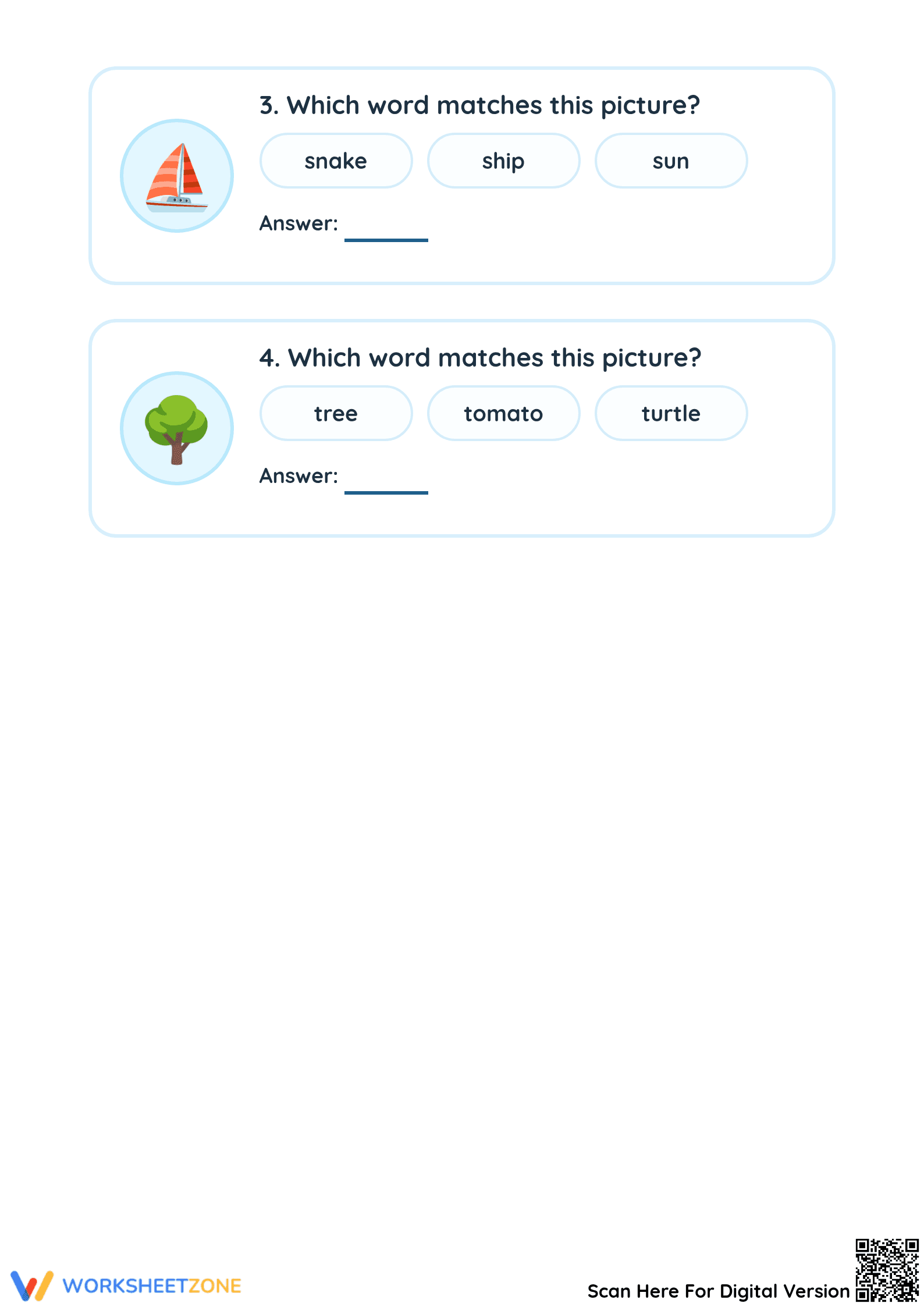

Essential Preschool Spelling & Word Match Worksheet
Paste this activity's link or code into your existing LMS (Google Classroom, Canvas, Teams, Schoology, Moodle, etc.).
Students can open and work on the activity right away, with no student login required.
You'll still be able to track student progress and results from your teacher account.
This Preschool spelling worksheet helps early learners connect visual images with their corresponding written words. By identifying familiar objects like a queen or a rocket, students develop critical phonemic awareness and early literacy skills. This resource provides a structured way for children to recognize initial sounds and letter patterns in a fun, engaging format.
At a Glance
At a Glance
- Grade: Preschool · Subject: ELA
- Standard:
CCSS.ELA-LITERACY.RF.K.3.A— Demonstrate basic knowledge of one-to-one letter-sound correspondences- Skill Focus: Picture-word matching
- Format: 2 pages · 4 problems · Answer key included · PDF
- Best For: Early literacy centers and phonics practice
- Time: 10–15 minutes
What's Inside
This 2-page PDF features 4 distinct matching tasks. Each problem presents a high-quality emoji-style illustration alongside three word choices. Students are prompted to point to the picture, say the word aloud, and circle the correct spelling. The layout is clean and uncluttered, specifically designed for young learners who are still developing fine motor skills and visual tracking abilities.
Zero-Prep Workflow
- Print: Send the two pages to your printer in seconds.
- Distribute: Hand out the sheets and provide a brief verbal instruction on circling the correct word (1 minute).
- Review: Use the included answer key to provide instant feedback as a group (2 minutes).
Total teacher preparation time is under two minutes, making it an ideal choice for morning work or emergency sub plans.
Standards Alignment
The primary focus is `CCSS.ELA-LITERACY.RF.K.3.A`, which requires students to demonstrate knowledge of letter-sound correspondences. This worksheet supports this by asking students to distinguish between words starting with similar letters. Both standard codes can be copied directly into lesson plans, IEP goals, or district curriculum mapping tools.
How to Use It
Use this worksheet during small-group literacy rotations after a lesson on initial letter sounds. As students work, observe if they are sounding out the words or simply guessing based on the first letter. This serves as an excellent formative assessment for phonics readiness. Completion typically takes 10 to 15 minutes depending on the student's familiarity with the vocabulary.
Who It's For
This resource is tailored for preschool and early kindergarten students who are beginning to recognize that printed words represent spoken language. It is particularly effective for English Language Learners (ELLs) who benefit from the strong visual support provided by the illustrations. Pair this with an alphabet anchor chart or a letter-of-the-week lesson for maximum instructional impact.
According to the RAND AIRS 2024 report, early exposure to multisensory literacy activities—such as combining visual cues with written text—is a significant predictor of later reading fluency. This worksheet addresses the foundational requirements of CCSS.ELA-LITERACY.RF.K.3.A by requiring students to map phonemes to graphemes through picture-word association. Research from Fisher & Frey (2014) emphasizes that the gradual release of responsibility begins with clear, scaffolded tasks like these, which allow students to practice word recognition in a low-stakes environment. By engaging with 4 specific vocabulary terms across 2 pages, learners build the cognitive pathways necessary for decoding more complex texts. This printable resource provides the necessary repetition for preschool students to master initial sound identification, ensuring they meet early literacy benchmarks. The inclusion of an answer key allows for immediate corrective feedback, a practice proven to enhance retention in early childhood education settings.


