


























Views
Downloads

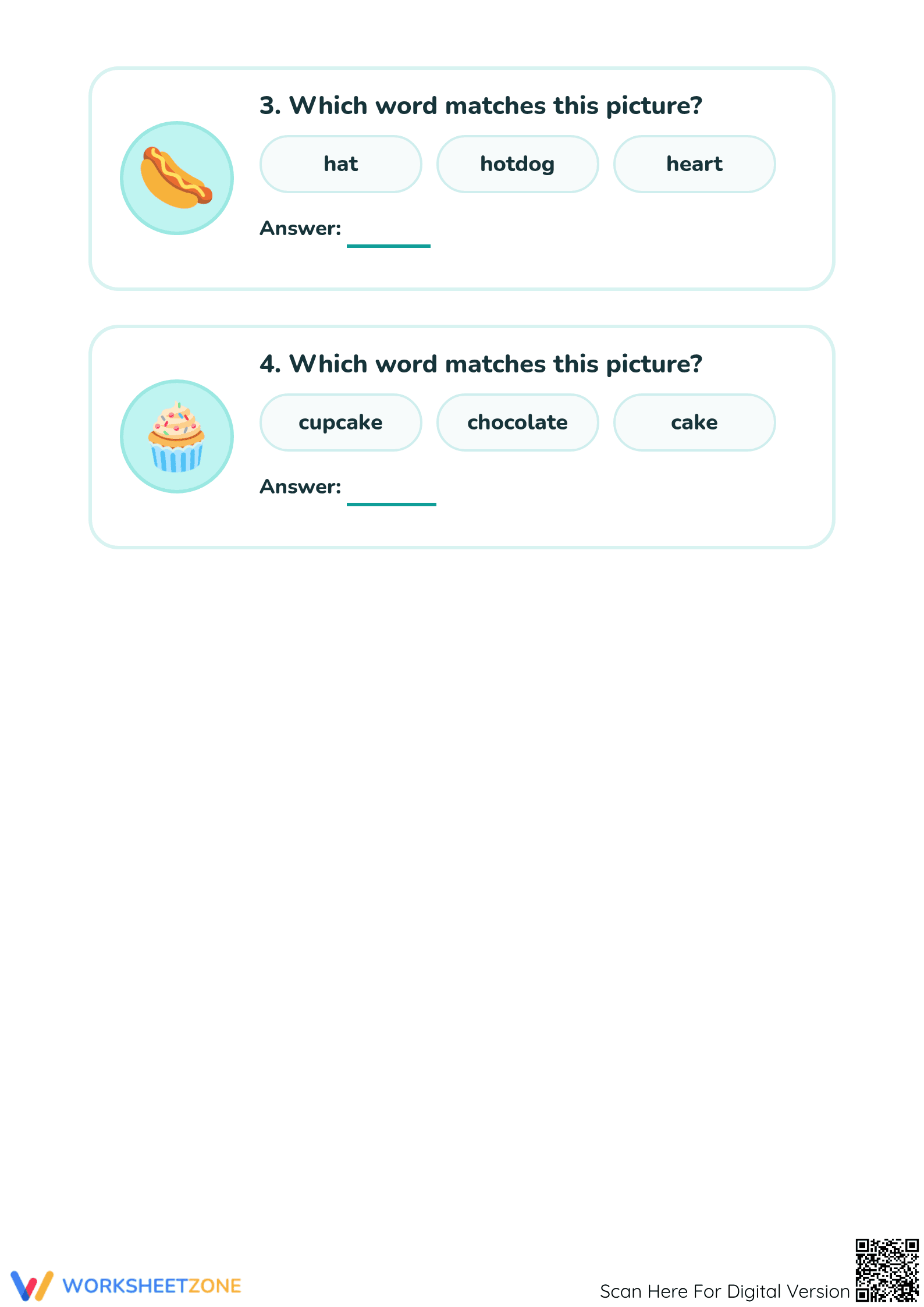

Printable Preschool Spelling Worksheet: Picture Matching
Paste this activity's link or code into your existing LMS (Google Classroom, Canvas, Teams, Schoology, Moodle, etc.).
Students can open and work on the activity right away, with no student login required.
You'll still be able to track student progress and results from your teacher account.
This Printable Preschool Spelling Worksheet provides a foundational approach to early literacy by engaging young learners in visual-verbal association. Students observe familiar images and identify the corresponding written word, bridging the gap between pictorial recognition and phonetic spelling. This essential activity fosters confidence in beginning readers through structured and successful outcomes.
At a Glance
- Grade: Preschool · Subject: ELA
- Standard:
CCSS.ELA-LITERACY.L.K.2— Demonstrate command of the conventions of standard English capitalization, punctuation, and spelling when writing- Skill Focus: Early visual word recognition and phonetic spelling association
- Format: 2 high-quality pages · 4 targeted problems · Full answer key included · PDF format
- Best For: Independent practice, literacy center rotations, or morning warm-up activities
- Time: 10–15 minutes of focused instruction
What's Inside
The PDF contains two pages featuring four distinct matching tasks. Each problem presents a colorful illustration—such as a banana, strawberry, hotdog, or cupcake—paired with three word choices. This design challenges students to look closely at spelling patterns rather than guessing. A complete answer key is provided for rapid checking and assessment.
Zero-Prep Workflow
- Print: Select the two activity pages and the answer key (under 30 seconds).
- Distribute: Hand out the sheets during a literacy block or as a morning warm-up (under 1 minute).
- Review: Use the provided answer key for immediate feedback or student self-correction (under 1 minute).
Total preparation time is less than two minutes, making this an ideal resource for substitute folders or spontaneous instruction.
Standards Alignment
Aligned to `CCSS.ELA-LITERACY.L.K.2`, this resource focuses on demonstrating command of English spelling conventions. It addresses the developmental step of recognizing correct word forms for common objects through visual discrimination. This standard code can be copied directly into lesson plans, IEP goals, or district curriculum mapping tools to ensure instructional continuity.
How to Use It
Use this worksheet during independent practice to assess progress in word recognition. It serves as a formative assessment tool; observe if students sound out words or guess based on images. Expected completion is 10 to 15 minutes, making it a perfect fit for literacy centers or transition activities between larger lessons.
Who It's For
This activity is suited for preschool students beginning to explore letter-sound relationships. It is also an effective intervention resource for students working on functional vocabulary or spelling goals. Pair this worksheet with a classroom anchor chart displaying these high-frequency words to support emerging readers and visual learners.
Early orthographic development in preschool-aged children is heavily reliant on the "Look, Read, and Circle" method of visual association. By linking high-frequency phonemes found in words like "banana" or "cupcake" with concrete visual representations, students begin the transition from pre-communicative to semi-phonetic spelling stages. Research by Fisher & Frey (2014) indicates that these structured visual-verbal scaffolds reduce cognitive load during the initial acquisition of letter-sound correspondence. This specific worksheet provides four targeted opportunities for students to discriminate between words sharing the same initial letter, which is a critical precursor to phonetic decoding. Mastery of CCSS.ELA-LITERACY.L.K.2 standards at the preschool level ensures that learners enter kindergarten with the foundational ability to identify correct word structures within a closed set, directly supporting long-term reading fluency and writing confidence in early childhood education.


