


























Views
Downloads


Printable Spelling Worksheet: Initial Sounds — Preschool
Paste this activity's link or code into your existing LMS (Google Classroom, Canvas, Teams, Schoology, Moodle, etc.).
Students can open and work on the activity right away, with no student login required.
You'll still be able to track student progress and results from your teacher account.
Building foundational literacy skills requires consistent practice with phonics and letter-sound correspondence. This preschool spelling worksheet provides a structured way for young learners to connect visual images with their corresponding written words and initial sounds. By engaging with familiar objects, students develop the essential decoding skills needed for future reading success.
At a Glance
At a Glance
- Grade: Preschool · Subject: English Language Arts
- Standard:
CCSS.ELA-LITERACY.RF.K.3.A— Demonstrate basic knowledge of one-to-one letter-sound correspondences by producing the primary sound- Skill Focus: Phonics and Initial Sounds
- Format: 2 pages · 8 problems · Answer key included · PDF
- Best For: Early literacy centers and phonics practice
- Time: 10–15 minutes
What's Inside
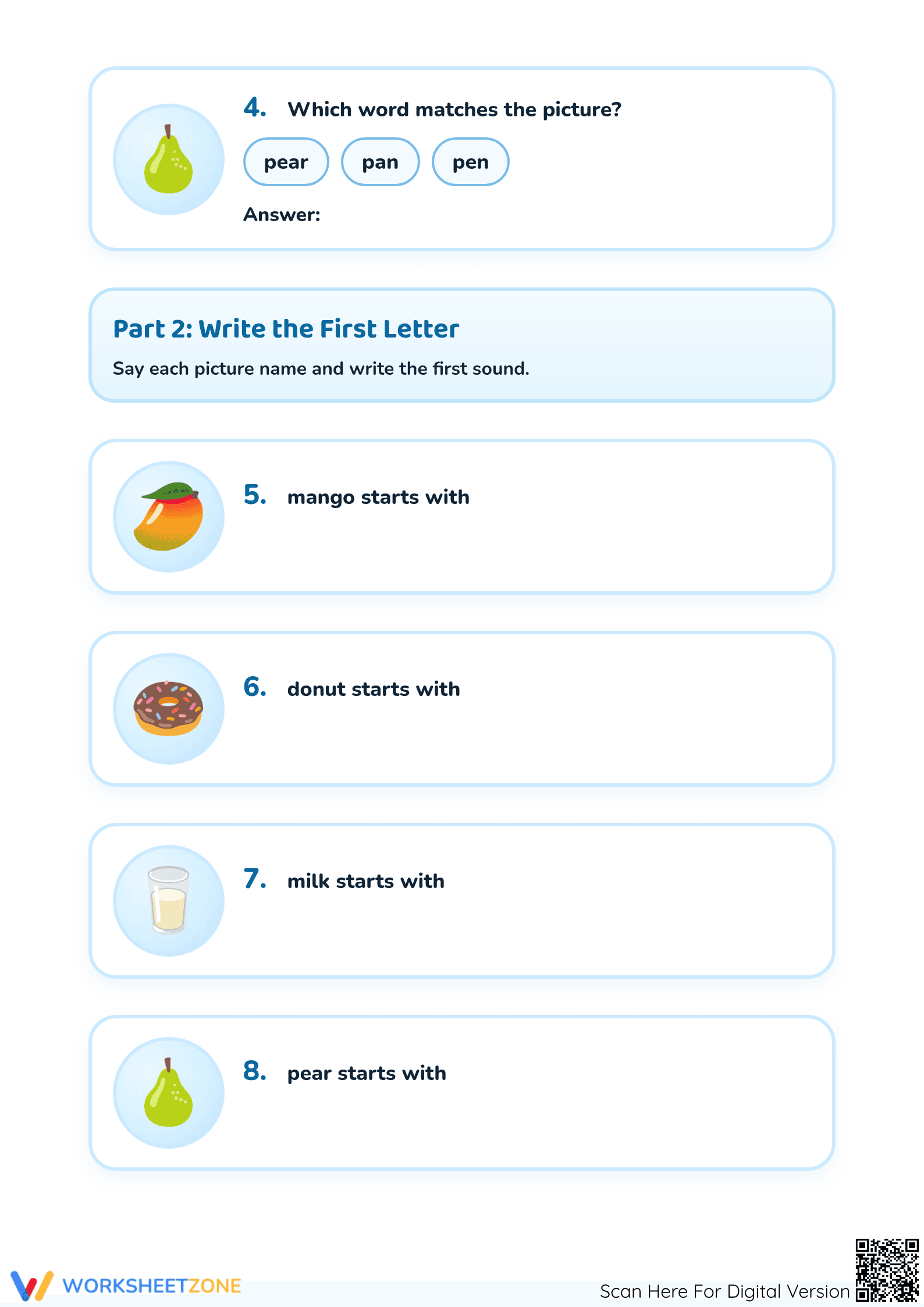
This two-page PDF includes eight interactive tasks divided into two distinct parts. The first page features four word-picture matching problems where students circle the correct word from a choice of three. The second page transitions to writing, challenging students to identify and write the initial letter for four familiar objects, including mangoes, donuts, milk, and pears.
Zero-Prep Workflow
Teachers can integrate this resource into their daily routine with minimal effort. First, print the two-page document for your class, which takes less than one minute. Next, distribute the sheets and explain the simple circling and writing tasks. Finally, use the provided answer key to review student work during small group instruction or as a quick check for understanding. Total teacher prep time is targeted at under two minutes.
Standards Alignment
This resource aligns primarily with `CCSS.ELA-LITERACY.RF.K.3.A`, which requires students to demonstrate basic knowledge of one-to-one letter-sound correspondences. It also supports `CCSS.ELA-LITERACY.L.PK.2.C` as students attempt to write letters associated with familiar words. Both standard codes can be copied directly into lesson plans, IEP goals, or district curriculum mapping tools to ensure instructional consistency and progress tracking across early childhood education levels.
How to Use It
Introduce this worksheet during a direct instruction lesson on initial sounds as a guided practice activity. Observe how students differentiate between similar-looking words to gauge their visual discrimination skills. For an extension, have students verbalize the name of each object before writing the letter. The entire activity is designed for completion within 15 minutes, making it an ideal choice for literacy centers or quick formative assessments during the school day.
Who It's For
This worksheet is specifically designed for preschool students and early kindergarteners who are beginning their phonics journey. It provides necessary scaffolding for English Language Learners and students requiring extra support with letter recognition. Pair this resource with a letter-sound anchor chart or a short reading passage featuring the target vocabulary words to reinforce the connection between isolated sounds and meaningful text.
Foundational literacy research emphasizes the importance of phonological awareness and letter-sound correspondence in early childhood education. This spelling worksheet specifically targets these domains by requiring students to recognize words and produce initial sounds for common objects. According to Fisher & Frey (2014), the gradual release of responsibility model is most effective when students are provided with clear visual cues and structured practice opportunities that bridge the gap between spoken and written language. By focusing on `CCSS.ELA-LITERACY.RF.K.3.A`, this activity ensures that students build the orthographic mapping necessary for automatic word recognition. The inclusion of both matching and writing tasks supports the Science of Reading framework by integrating phonics instruction with fine motor development. Educational practitioners can utilize these 8 targeted tasks to gather empirical evidence of student mastery within a printable, zero-prep format that aligns with 2024 instructional standards and NAEP expectations.


