


























Views
Downloads
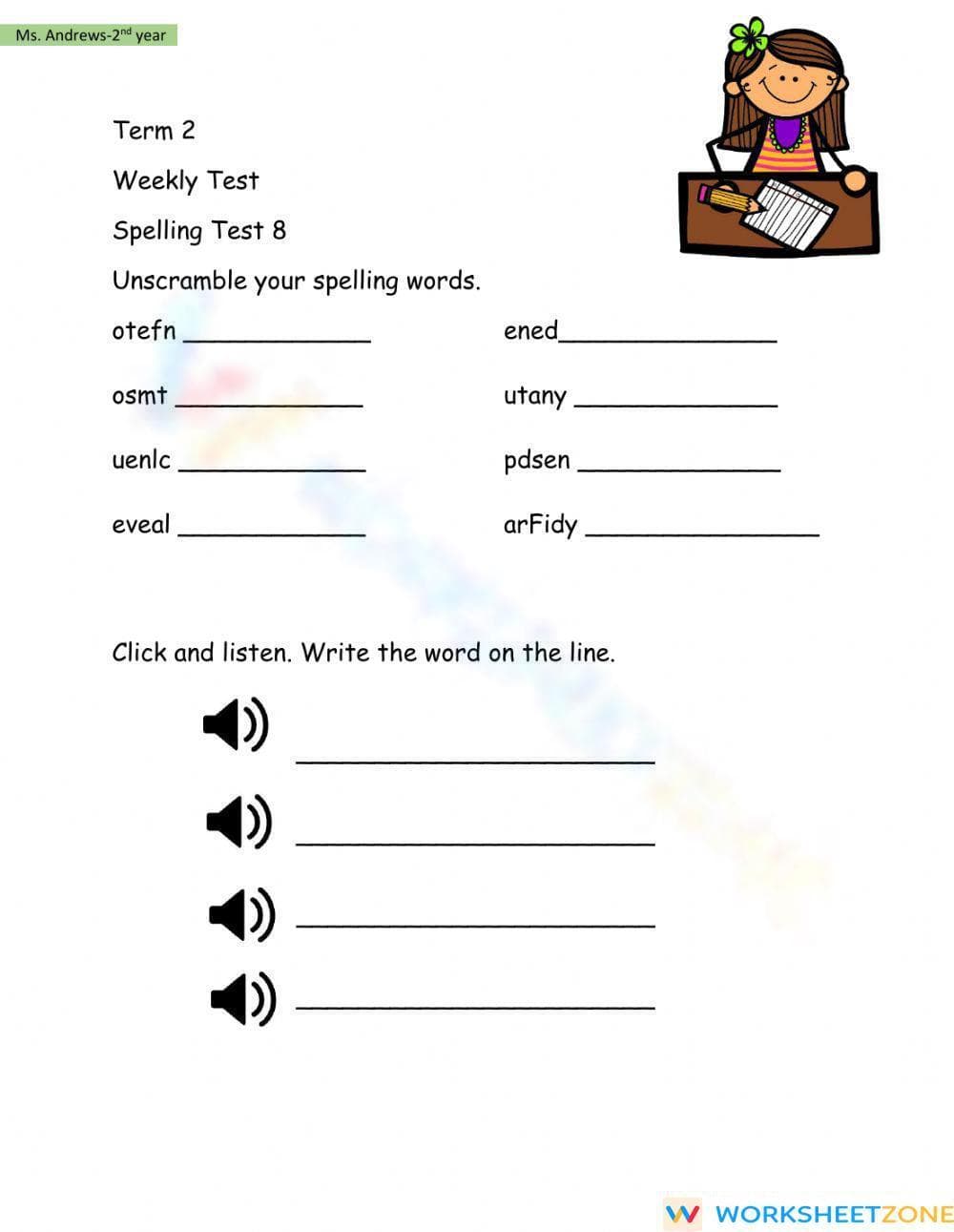

Essential Grade 2 Spelling Test 8: Printable Phonics Task
Paste this activity's link or code into your existing LMS (Google Classroom, Canvas, Teams, Schoology, Moodle, etc.).
Students can open and work on the activity right away, with no student login required.
You'll still be able to track student progress and results from your teacher account.
This Grade 2 spelling assessment provides a comprehensive way for students to demonstrate mastery of essential vocabulary. By combining word unscrambling with auditory recognition, the worksheet ensures students move beyond rote memorization toward deep orthographic awareness. It is designed to evaluate Term 2 weekly progress efficiently while maintaining high engagement for young learners.
At a Glance
- Grade: 2 · Subject: English Language Arts (ELA)
- Standard:
CCSS.ELA-LITERACY.L.2.2.D— Generalize learned spelling patterns and spell high-frequency words correctly- Skill Focus: Spelling, Word Unscrambling, Phonics
- Format: 1 page · 12 problems · Answer key included · PDF
- Best For: Weekly formative spelling assessments and morning work
- Time: 15–20 minutes
What's Inside
This single-page assessment features two distinct sections designed to test visual and auditory spelling skills. The top section contains 8 scrambled spelling words, including high-frequency terms like "often" and "Friday," requiring students to apply phonemic blending. The bottom section includes 4 interactive audio-icon prompts where students must listen and write, ensuring they can translate spoken phonemes into written graphemes.
Zero-Prep Workflow
- Print: Generate the single-page PDF for your class (30 seconds).
- Distribute: Hand out the worksheets and briefly explain the unscramble and auditory sections (1 minute).
- Review: Use the included answer key for quick grading or student self-correction (5 minutes).
Standards Alignment
This resource is rigorously aligned to `CCSS.ELA-LITERACY.L.2.2.D`, which requires Grade 2 students to generalize learned spelling patterns when writing words. By challenging students to unscramble irregular high-frequency words and respond to auditory cues, it directly supports the standard's goal of orthographic mastery. This standard code can be copied directly into lesson plans or district curriculum mapping tools to ensure instructional consistency.
How to Use It
Use this worksheet as a formal weekly assessment at the end of a unit to gauge student mastery of vocabulary. Alternatively, it serves as an excellent bell-ringer activity to provide immediate data on which students need phonics intervention. During the auditory section, observe students' ability to initiate writing quickly after the cue to identify potential gaps in processing or letter-sound correspondence.
Who It's For
This resource is specifically tailored for Grade 2 students but is highly effective for Grade 1 students ready for extension or Grade 3 students requiring remedial support. It is particularly beneficial for English Language Learners who need the extra scaffolding provided by the auditory modality. Pair this worksheet with a high-frequency word wall for supported practice during independent writing transitions.
The integration of auditory and visual processing in spelling instruction is critical for developing fluent writing skills in early elementary learners. According to Fisher & Frey (2014), providing structured opportunities to apply phonemic awareness in diverse contexts, such as the unscramble and dictation tasks in this Grade 2 assessment, are essential for student growth. Research from NAEP suggests that mastering high-frequency spelling patterns early leads to higher reading comprehension scores. This worksheet specifically addresses `CCSS.ELA-LITERACY.L.2.2.D` by requiring students to synthesize their letter-sound knowledge to produce correct spellings. By utilizing a zero-prep format that yields high-signal data, educators can efficiently monitor progress and adjust instruction to meet student needs. This assessment serves as a reliable tool for verifying that students meet grade-level benchmarks for orthographic competence and literacy development.


