


























Views
Downloads
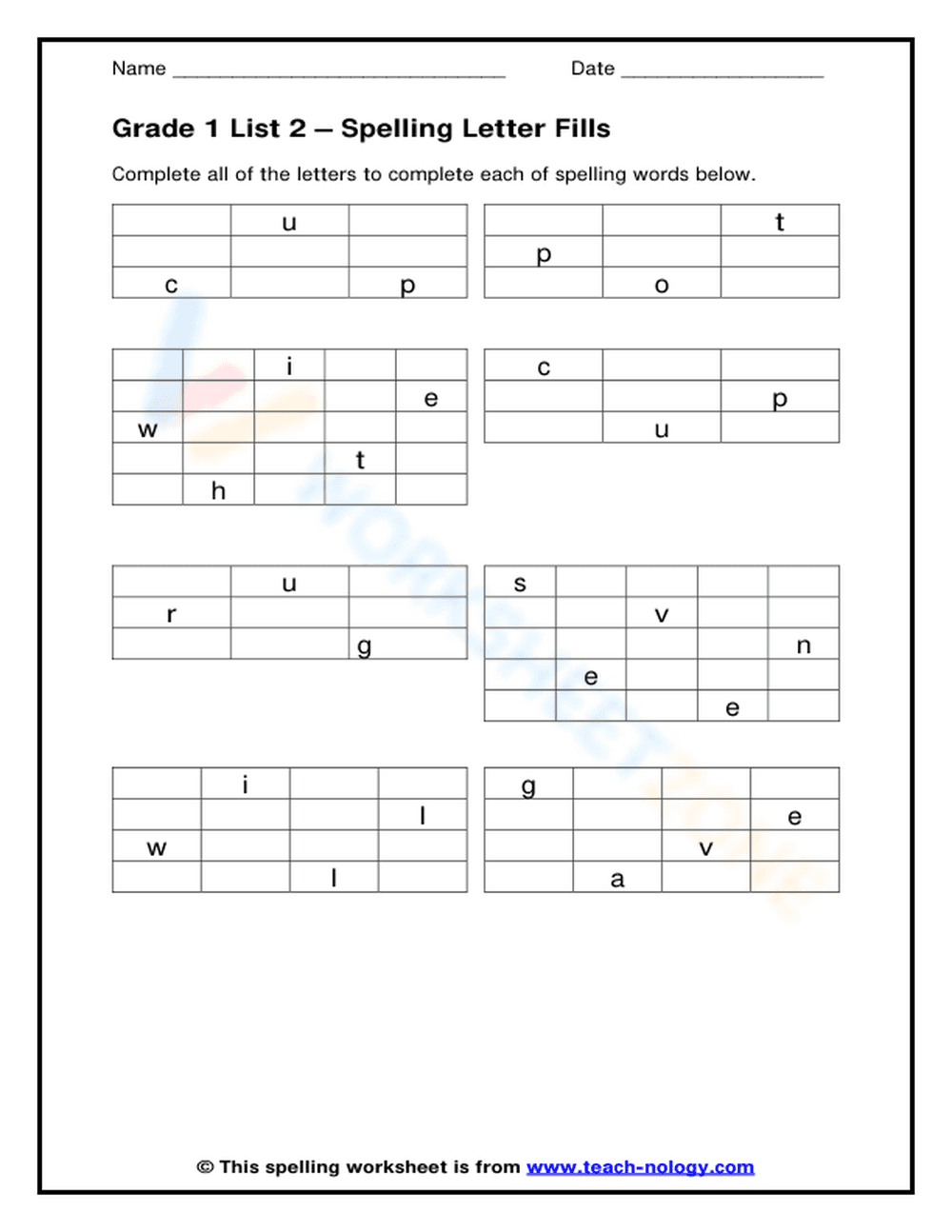

Grade 1 Spelling Letter Fills: Essential Worksheet
Paste this activity's link or code into your existing LMS (Google Classroom, Canvas, Teams, Schoology, Moodle, etc.).
Students can open and work on the activity right away, with no student login required.
You'll still be able to track student progress and results from your teacher account.
This Grade 1 Spelling Letter Fills worksheet helps students master foundational spelling patterns through an engaging grid-based completion task. By filling in missing letters for common vocabulary words, learners strengthen their phonemic awareness and orthographic mapping skills. This essential resource provides immediate reinforcement for spelling list retention and letter-sound correspondence in a clear, accessible format for young students.
At a Glance
- Grade: 1 · Subject: English Language Arts
- Standard:
CCSS.ELA-LITERACY.L.1.2.E— Spell untaught words phonetically, drawing on phonemic awareness and spelling conventions- Skill Focus: Spelling and Orthographic Mapping
- Format: 1 page · 8 words · Answer key included · PDF
- Best For: Daily spelling practice or morning work
- Time: 10–15 minutes
What's Inside
This worksheet features one page with eight word grids. Each grid presents a spelling word with omitted letters, requiring students to complete the term. The grid structure supports visual tracking and fine motor control. A full answer key is included for teacher review or student self-correction, ensuring a structured approach to rote spelling mastery.
Zero-Prep Workflow
Implement this resource in under two minutes with a three-step workflow. First, print the copies from the PDF (30 seconds). Second, distribute them as a bell-ringer or during literacy centers (30 seconds). Finally, review the grids using the provided key (1 minute). This streamlined process is ideal for emergency sub plans or supplemental homework.
Standards Alignment
This resource aligns to CCSS.ELA-LITERACY.L.1.2.E, requiring first graders to spell phonetically by drawing on phonemic awareness. By isolating letter positions, the task forces students to analyze phoneme-grapheme relationships. This supports goals under CCSS.ELA-LITERACY.L.1.2 for standard English conventions. Both standard codes can be copied directly into lesson plans, IEP goals, or district curriculum mapping tools.
How to Use It
Use this worksheet as a formative assessment during the independent practice phase of a spelling lesson. Assign the letter fills to gauge how students have internalized letter sequences. Observe if students struggle with specific placements to guide targeted intervention. The expected completion time is 12 minutes, making it a perfect fit for a structured literacy rotation.
Who It's For
This printable is designed for Grade 1 students developing primary literacy skills. It is effective for English Language Learners and students requiring scaffolding in phonics. The grid serves as a mnemonic device for visual learners. Pair this resource with a word wall to provide students with environmental print support during their independent practice.
The use of partial-word completion tasks, such as those found in this Spelling Letter Fills worksheet, is supported by instructional research focusing on orthographic mapping and phonological processing. According to the ScienceDirect TpT Analysis, structured rote practice provides the necessary repetition for Grade 1 students to move words from short-term memory into long-term lexical storage. By requiring learners to actively retrieve specific letters within a established frame, the worksheet aligns with evidence-based practices for early literacy development. The inclusion of CCSS.ELA-LITERACY.L.1.2.E ensures that the content remains tethered to nationally recognized benchmarks for phonetic spelling and language conventions. This specific approach to spelling instruction reduces the cognitive load of full-word recall while emphasizing the critical phoneme-to-grapheme connections needed for reading fluency. Educators can confidently integrate this tool into their curriculum, knowing it targets the exact mechanics of word construction emphasized in modern pedagogical frameworks for primary education.


