


























Views
Downloads

Printable Space Ordinal Numbers Worksheet | Grade K-1
Paste this activity's link or code into your existing LMS (Google Classroom, Canvas, Teams, Schoology, Moodle, etc.).
Students can open and work on the activity right away, with no student login required.
You'll still be able to track student progress and results from your teacher account.
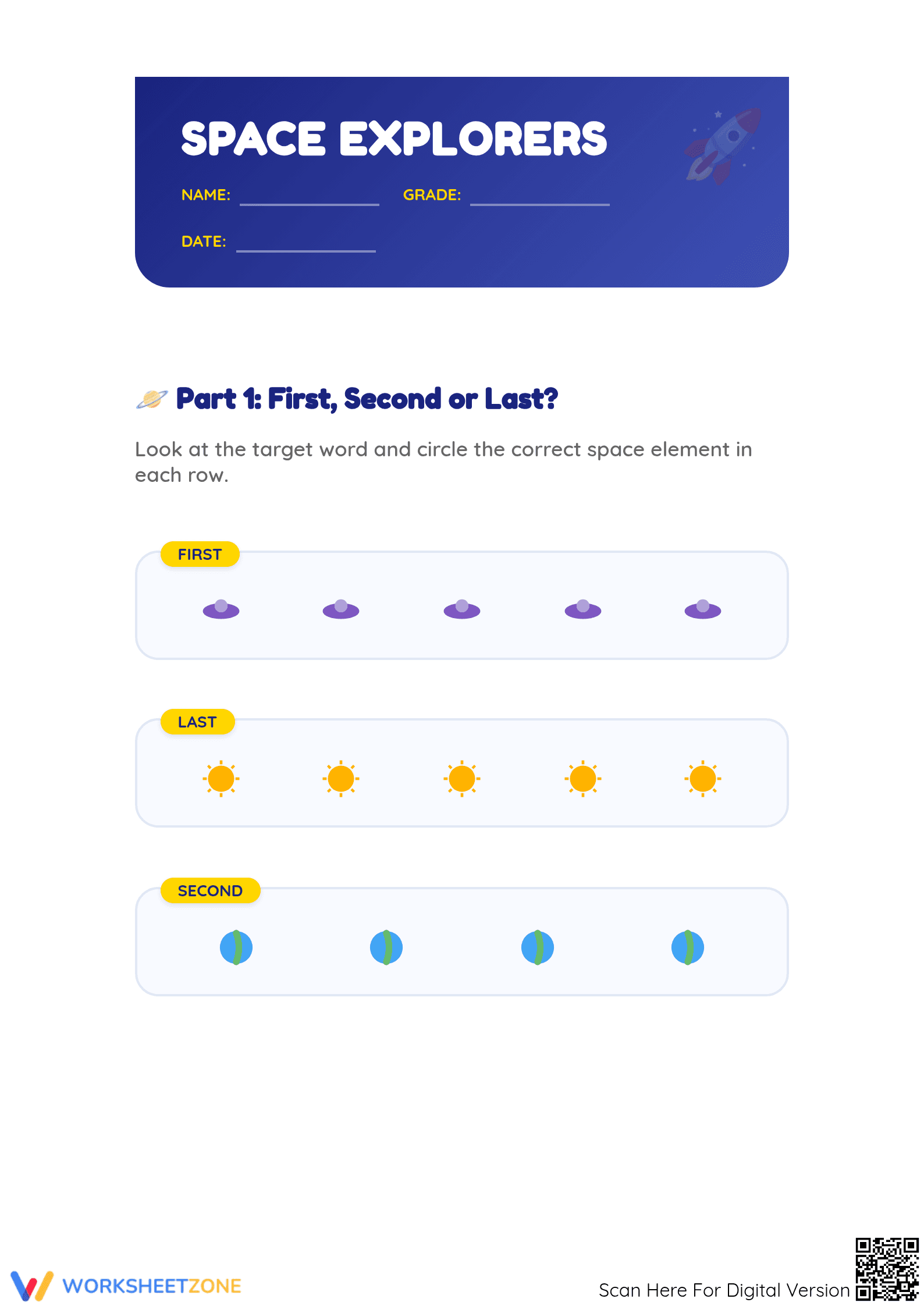
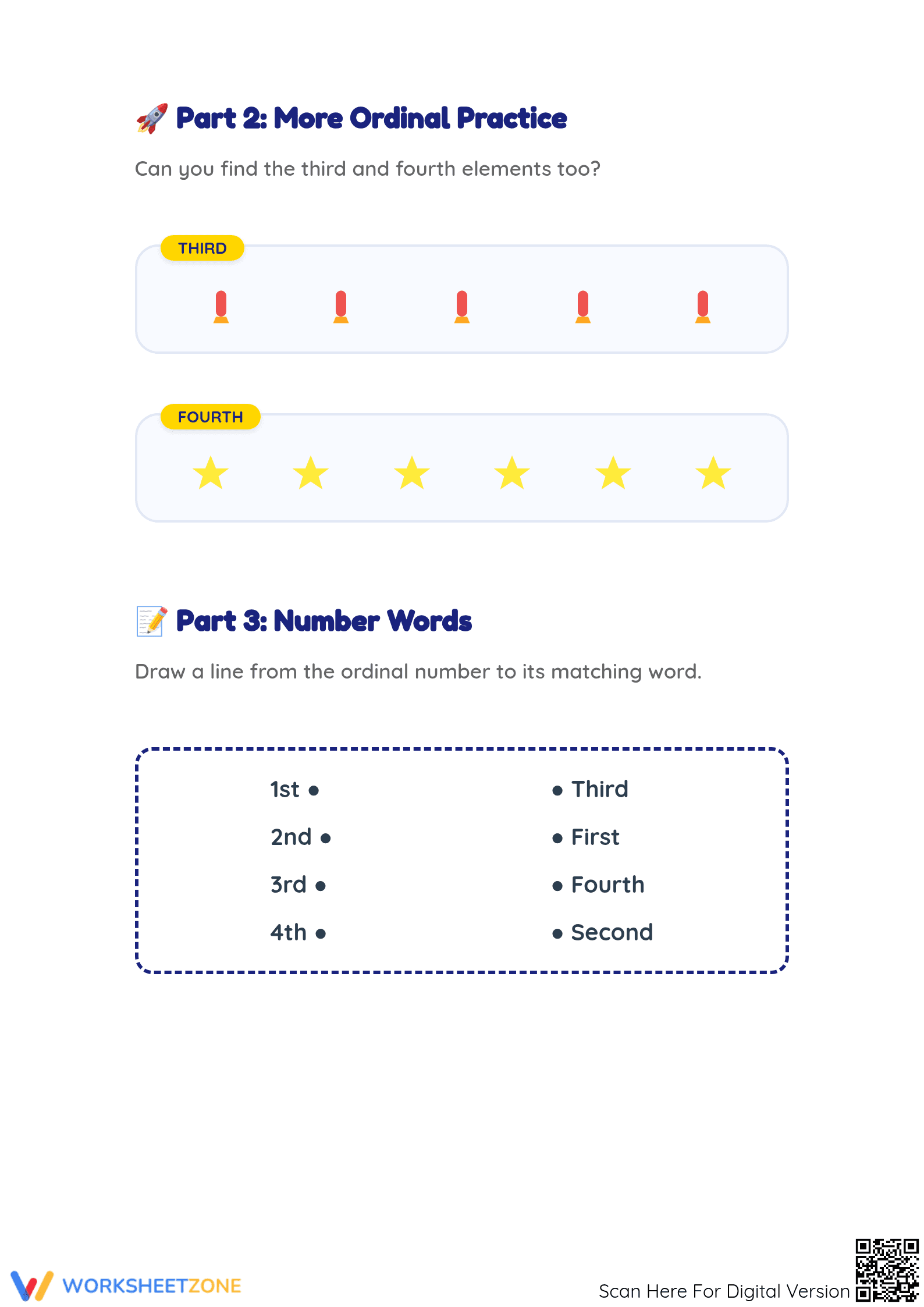
This printable Space Explorers worksheet provides young learners with essential practice in identifying and matching ordinal numbers through the fourth position. Students interact with vibrant space-themed graphics to circle specific elements and connect numeric symbols to their corresponding word forms. Completing these nine targeted tasks helps children solidify their understanding of relative position and sequence in a structured environment.
At a Glance
- Grade: K–1 · Subject: Math
- Standard:
CCSS.MATH.CONTENT.K.CC.B.4— Understand the relationship between numbers and quantities; connect counting to cardinality and position.- Skill Focus: Ordinal Numbers (1st–4th, Last)
- Format: 2 pages · 9 problems · Answer key included · PDF
- Best For: Initial instruction and independent practice
- Time: 15–20 minutes
What's Inside
The two-page PDF features three distinct sections designed to build confidence. Part 1 and Part 2 feature five rows of unique space icons, including UFOs, suns, planets, rockets, and stars, where students circle the icon matching the target ordinal word. Part 3 provides a matching exercise that bridges the gap between numeric notation and written number words. A complete answer key is provided for quick grading.
Skill Progression
- Guided Practice: The worksheet begins with recognizable "First" and "Last" concepts, using large icons to minimize cognitive load during the initial identification phase of three circling tasks.
- Supported Practice: Part 2 expands the sequence to include "Third" and "Fourth" positions, requiring students to count along a horizontal line of five identical objects to locate correct items.
- Independent Practice: The final matching section moves toward abstraction, challenging learners to demonstrate mastery by connecting four numerical abbreviations to their linguistic counterparts without visual icon support.
This progression follows a gradual-release model, moving from concrete visual recognition to abstract symbol-word association.
Standards Alignment
This resource aligns with `CCSS.MATH.CONTENT.K.CC.B.4`, which requires students to understand the relationship between numbers and quantities. By extension, it supports foundational spatial reasoning and sequencing skills necessary for higher-level mathematics. Both standard codes can be copied directly into lesson plans, IEP goals, or district curriculum mapping tools.
How to Use It
Introduce this worksheet during a Math Center rotation or as a follow-up to a read-aloud about space exploration. For a formative assessment tip, observe whether students count from left to right consistently or if they struggle to differentiate between "Second" and "Third." The expected completion time for most Kindergarten students is approximately 15 minutes, making it an excellent independent desk-work activity.
Who It's For
This activity is tailor-made for Kindergarten and early First Grade students developing their number sense and vocabulary. It is particularly useful for English Language Learners who need to pair visual icons with new vocabulary words like "ordinal." The space theme makes it a natural pairing for science units on the solar system or as a companion to an anchor chart reinforcing sequence.
Research conducted by NAEP indicates that early mastery of sequencing and ordinality is a significant predictor of future success in complex arithmetic and problem-solving. This "Space Explorers" worksheet addresses these critical developmental milestones by integrating visual literacy with mathematical vocabulary. By requiring students to identify positions such as "first," "second," and "last," the resource reinforces the principle of stable order, a core component of cardinality as defined in early childhood mathematics standards. The integration of numeric symbols with word forms promotes dual-coding, which Fisher & Frey (2014) suggest enhances long-term retention of new concepts. Educators can rely on this tool for the structured repetition necessary to move beyond simple counting into the nuanced understanding of relative position. This 2-page resource serves as a reliable instrument for both initial skill acquisition and remedial support for learners struggling with sequential logic.


