


























Views
Plays
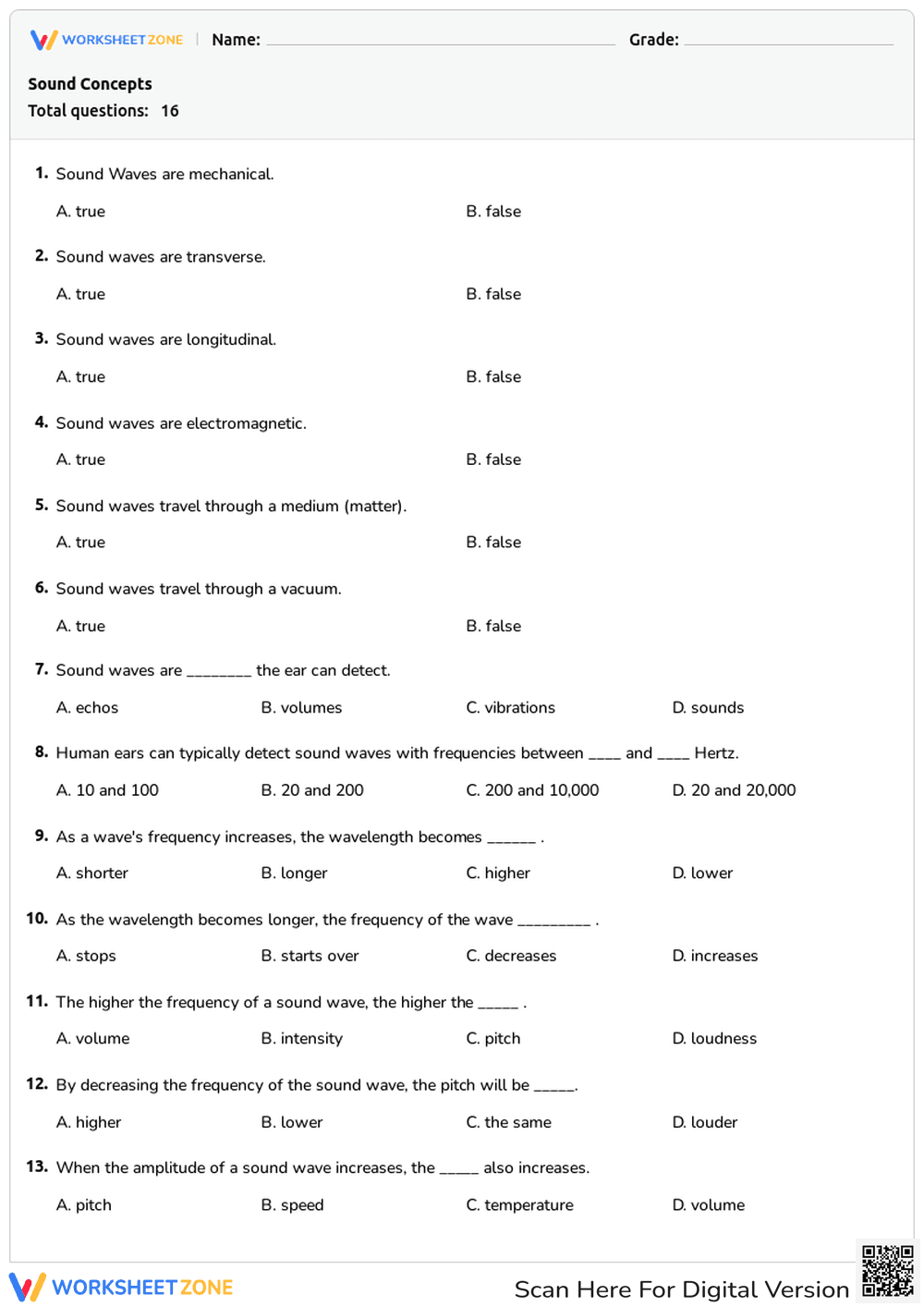


Sound Concepts Worksheet | Essential Grade 4-6 Science
Paste this activity's link or code into your existing LMS (Google Classroom, Canvas, Teams, Schoology, Moodle, etc.).
Students can open and work on the activity right away, with no student login required.
You'll still be able to track student progress and results from your teacher account.
This Grade 4-6 science worksheet provides a comprehensive review of sound wave mechanics, helping students identify the fundamental properties of acoustic energy. By engaging with 16 targeted questions, learners demonstrate their understanding of how sound travels through different mediums and how frequency relates to pitch. It is an effective tool for reinforcing core physics concepts.
At a Glance
- Grade: 4-6 · Subject: Science
- Standard:
4-PS4-1— Describe patterns of waves in terms of amplitude and wavelength- Skill Focus: Sound wave properties
- Format: 2 pages · 16 problems · Answer key included · PDF
- Best For: Formative assessment and sub plans
- Time: 15–20 minutes
The resource consists of two printable pages featuring 16 assessment items. The first section utilizes true-false questions to establish foundational facts about mechanical and longitudinal waves. The subsequent multiple-choice questions challenge students to apply logic to frequency-wavelength relationships and the speed of sound in solids, liquids, and gases. A complete answer key is provided for easy grading.
Teachers can implement this resource in under two minutes. Simply print the two-page PDF, distribute it to the class, and use the included answer key for rapid grading or peer-review sessions. Its self-contained nature makes it an ideal candidate for emergency sub plans or independent study packets where minimal teacher intervention is required for student success.
The primary focus is 4-PS4-1: "Develop a model of waves to describe patterns in terms of amplitude and wavelength and that waves can cause objects to move." It also supports middle school standards regarding the transmission of energy through different materials. Both standard codes can be copied directly into lesson plans, IEP goals, or district curriculum mapping tools.
Use this worksheet as a formative assessment after a hands-on lab involving tuning forks or string telephones. It serves as an excellent exit ticket to gauge student mastery of the relationship between amplitude and volume. Expect students to complete the 16 items within 15 to 20 minutes depending on their prior knowledge and reading speed.
This resource is designed for upper elementary and early middle school students. It is particularly helpful for visual learners who benefit from clear, structured text and defined question blocks. Pair this worksheet with a digital sound wave simulator or an anchor chart detailing the parts of a wave for maximum instructional impact during your physics unit.
The Sound Concepts worksheet aligns with the 4-PS4-1 standard, focusing on the observable patterns of sound waves, including frequency, pitch, and medium-dependent velocity. According to the RAND AIRS 2024 report on science literacy, structured retrieval practice through multiple-choice and true-false formats significantly improves long-term retention of abstract physical science concepts. By requiring students to distinguish between mechanical and electromagnetic waves, the resource builds the prerequisite knowledge necessary for advanced physics. The inclusion of 16 specific tasks ensures broad coverage of the topic without overwhelming the learner. Research indicates that clear, no-prep materials reduce teacher burnout while maintaining high academic expectations. This worksheet provides a reliable method for verifying that students can accurately describe how sound functions as a vibration that travels through matter, a core competency in the NGSS framework for middle-grade physical science education.


