


























Views
Downloads
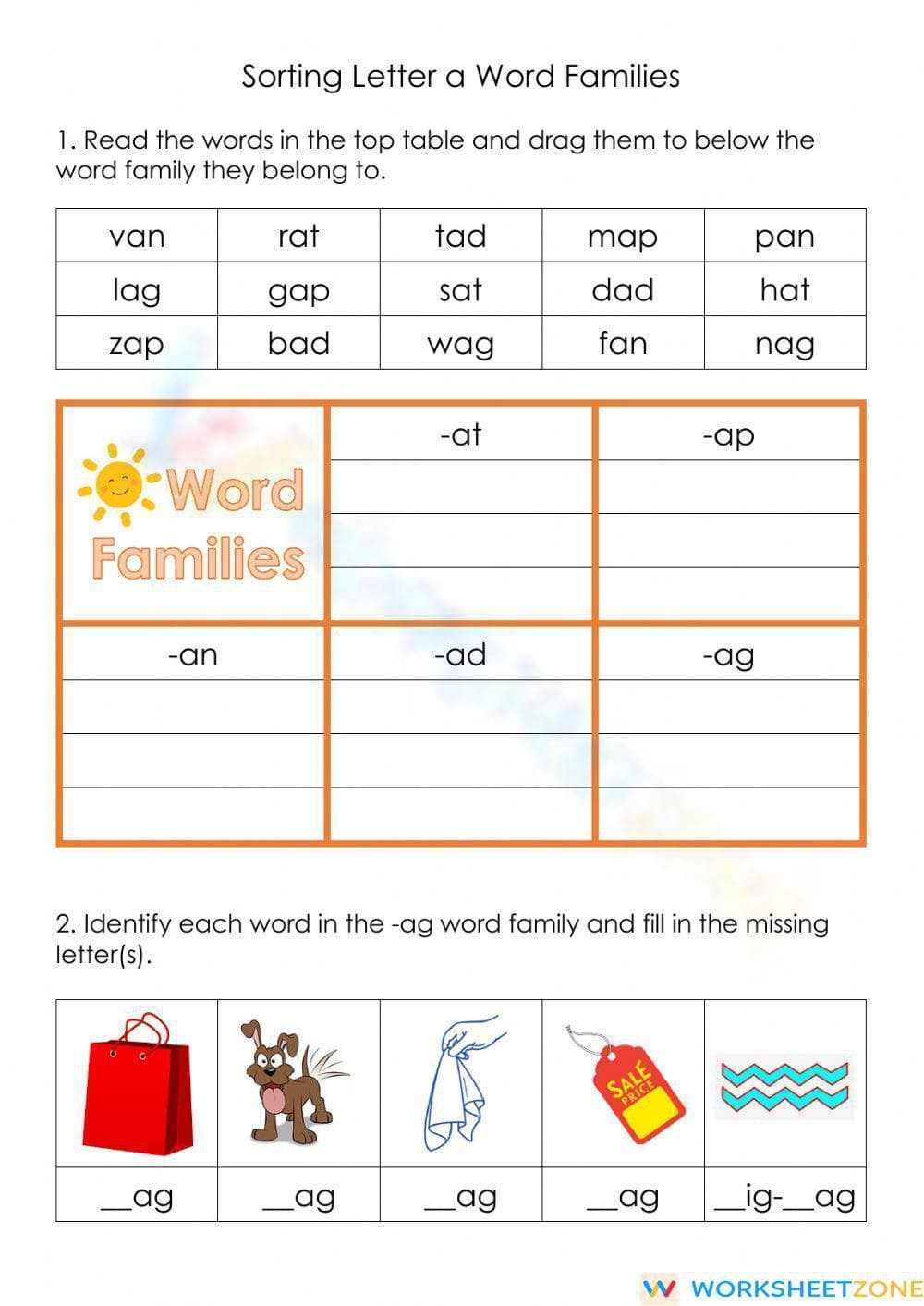

Essential Letter a Word Families Sorting Worksheet | Grade K
Paste this activity's link or code into your existing LMS (Google Classroom, Canvas, Teams, Schoology, Moodle, etc.).
Students can open and work on the activity right away, with no student login required.
You'll still be able to track student progress and results from your teacher account.
This Grade K word family sorting worksheet helps early learners master short "a" phonics through 20 targeted tasks. Students identify, read, and categorize CVC words into specific families like -at, -an, and -ag. By focusing on initial letter sounds and word patterns, students build the foundational decoding skills necessary for reading fluency.
At a Glance
- Grade: Kindergarten · Subject: ELA
- Standard:
CCSS.ELA-LITERACY.RF.K.2.D— Isolate and pronounce initial, medial, and final sounds in CVC words- Skill Focus: Short a Word Families
- Format: 1 page · 20 problems · Answer key included · PDF
- Best For: Literacy centers and phonics practice
- Time: 15–20 minutes
What's Inside
This comprehensive phonics resource features two distinct sections designed to reinforce short "a" vowel patterns. The first section provides a word bank of 15 CVC words for students to sort into five specific word families: -at, -ap, -an, -ad, and -ag. The second section includes a visual identification task where students must look at five pictures and fill in the missing initial letters to complete words in the -ag family. This 1-page PDF includes a clear, self-explanatory layout and a full answer key for easy grading.
Zero-Prep Workflow
To implement this resource, teachers follow a simple three-step workflow. First, print the single-page PDF (30 seconds). Second, distribute the worksheets during small group instruction or literacy centers (1 minute). Finally, review the completed work using the included answer key to identify students needing additional support (30 seconds). Total prep time is under two minutes, making this an ideal solution for substitute plans, morning work, or unexpected instructional gaps.
Standards Alignment
The primary standard addressed is CCSS.ELA-LITERACY.RF.K.2.D, which requires students to isolate and pronounce the initial, medial vowel, and final sounds in three-phoneme words. Additionally, this worksheet supports RF.K.3.A by emphasizing the relationship between letters and sounds in frequently occurring word families. Both standard codes can be copied directly into lesson plans, IEP goals, or district curriculum mapping tools.
How to Use It
Use this worksheet as a summative assessment after introducing short "a" word families to gauge student mastery of CVC patterns. During instruction, observe how students handle the transition from sorting words with visible letters to identifying missing initial sounds in the picture-based task; students who struggle with the latter may require additional phonemic awareness support. This worksheet typically takes 15 to 20 minutes to complete.
Who It's For
This resource is designed for Kindergarten students, though it serves as an excellent challenge for Preschoolers or a helpful review for first graders. It is particularly effective for students requiring extra support with phoneme segmentation and blending. Pair this worksheet with a short "a" anchor chart or a decodable reader to create a cohesive literacy lesson.
According to a NAEP analysis of early literacy success factors, consistent practice with phonemic segmentation and word family patterns is a critical predictor of later reading achievement. This worksheet provides 20 structured opportunities for students to apply CCSS.ELA-LITERACY.RF.K.2.D by isolating initial sounds and recognizing common -at, -ap, -an, -ad, and -ag rimes. By engaging with these CVC words, learners bridge the gap between letter recognition and fluent decoding. Fisher & Frey (2014) emphasize that targeted phonics practice within a gradual release of responsibility framework—moving from the sorting "We Do" model to the independent "You Do" fill-in-the-blank task—significantly improves student retention of phonological rules. This printable resource ensures that early readers develop the automaticity required for complex reading tasks while maintaining a low-barrier, high-impact instructional design for classroom teachers.


