


























Views
Downloads
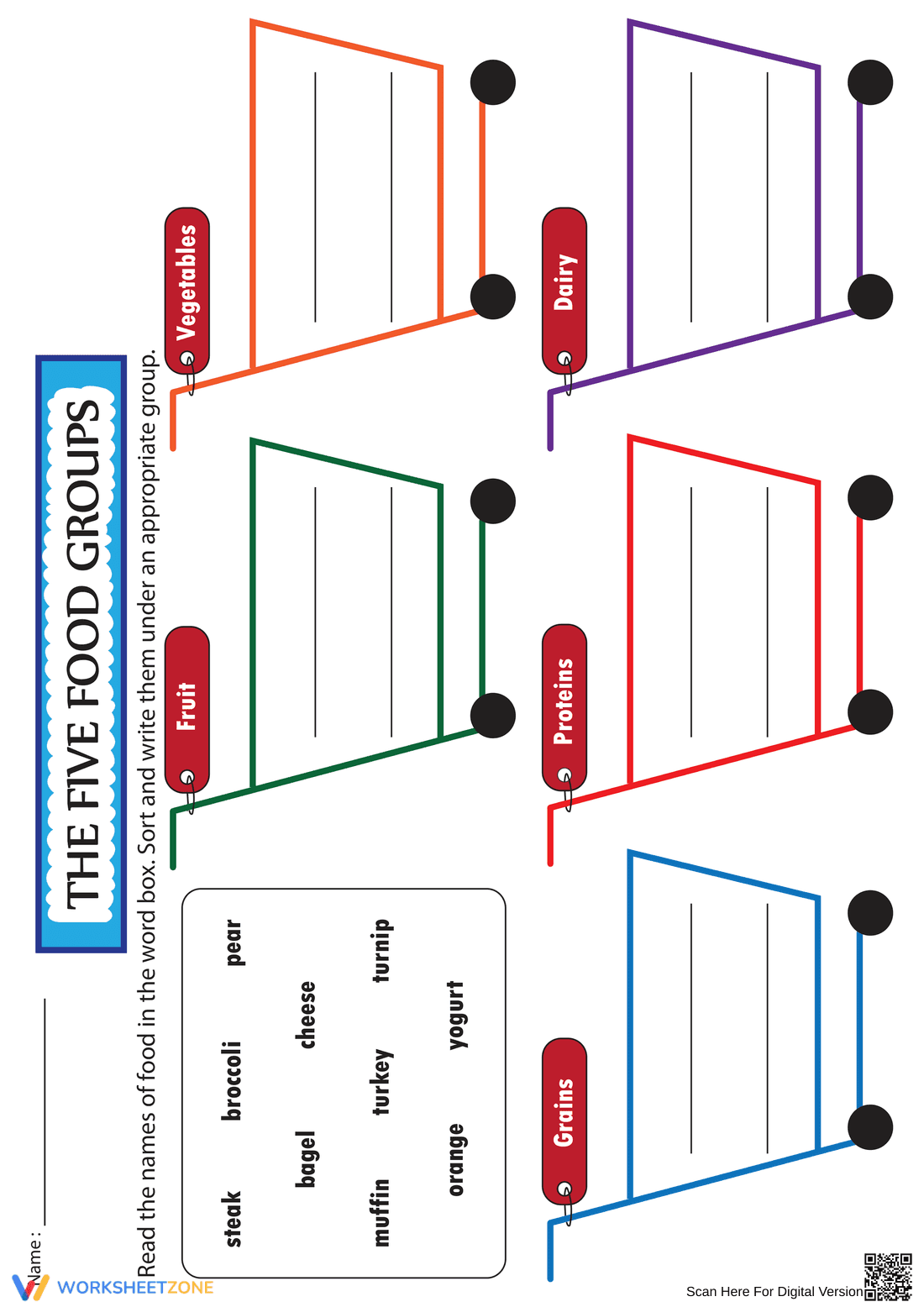

Essential Food Groups Sorting Worksheet | Grade 1-2
Paste this activity's link or code into your existing LMS (Google Classroom, Canvas, Teams, Schoology, Moodle, etc.).
Students can open and work on the activity right away, with no student login required.
You'll still be able to track student progress and results from your teacher account.
This Grade 1 and Grade 2 nutrition worksheet helps students master the five food groups through an engaging sorting activity. By categorizing ten common food items into shopping carts for Fruit, Vegetables, Grains, Proteins, and Dairy, learners build essential vocabulary. This resource provides immediate practice for foundational health awareness and classification skills.
At a Glance
- Grade: 1-2 · Subject: Health / Science
- Standard:
CCSS.ELA-LITERACY.L.1.5.A— Sort words into categories to gain a sense of the concepts- Skill Focus: Categorizing the five food groups
- Format: 1 page · 10 problems · Answer key included · PDF
- Best For: Health lessons or quick review
- Time: 10–15 minutes
What's Inside
This single-page PDF features a "shopping cart" theme designed to make classification intuitive. The worksheet includes a word box with ten items—including "steak," "broccoli," and "muffin." Below, five illustrated shopping carts are labeled with primary food groups. Students read each word and write it in the corresponding cart. A full answer key is included for teacher convenience and rapid student feedback.
Zero-Prep Workflow
The zero-prep design ensures it is ready for immediate use. Educators can follow a three-step workflow: Print (30 seconds), Distribute (1 minute), and Review (5 minutes). Because instructions are self-explanatory, students can begin working independently. This makes it an ideal choice for emergency sub plans, morning work, or a fast-paced assessment at the end of a nutrition unit.
Standards Alignment
The primary alignment for this activity is CCSS.ELA-LITERACY.L.1.5.A, requiring students to sort words into categories. By identifying which foods belong in specific groups, students apply classification skills that bridge Science and ELA. This standard code can be copied directly into lesson plans, IEP goals, or district curriculum mapping tools to document student progress toward foundational benchmarks.
How to Use It
Use this worksheet as a concluding activity after a lesson on MyPlate guidelines. It serves as a formative assessment to check if students can distinguish between categories like proteins and grains. Have students work in pairs to discuss why "cheese" belongs in dairy. Teachers should observe whether students can identify protein items within a 15-minute timeframe.
Who It's For
This resource is tailored for first and second-grade students developing reading fluency and health concepts. It is effective for English Language Learners (ELLs) as it pairs simple vocabulary with clear categories. Teachers can pair this worksheet with a MyPlate anchor chart to provide extra support for students struggling with item recognition during independent work time.
Integrating classification tasks into early childhood curricula is a proven method for enhancing conceptual retention and vocabulary acquisition. Research in the ScienceDirect TpT Analysis (2024) highlights that worksheets utilizing familiar metaphors—such as grocery shopping—reduce cognitive load and increase student engagement in Grade 1 and Grade 2 settings. By aligning this activity with the CCSS.ELA-LITERACY.L.1.5.A standard, educators ensure that students are practicing the specific skill of word sorting within a meaningful health context. The inclusion of ten distinct tasks allows for a reliable measurement of student accuracy in identifying the five food groups. This approach mirrors findings from Fisher & Frey (2014) regarding the importance of scaffolded independent practice in the gradual release of responsibility model. This resource provides the necessary structure for students to demonstrate mastery of essential nutritional categories while reinforcing literacy skills in a classroom-ready format.


