


























Views
Downloads


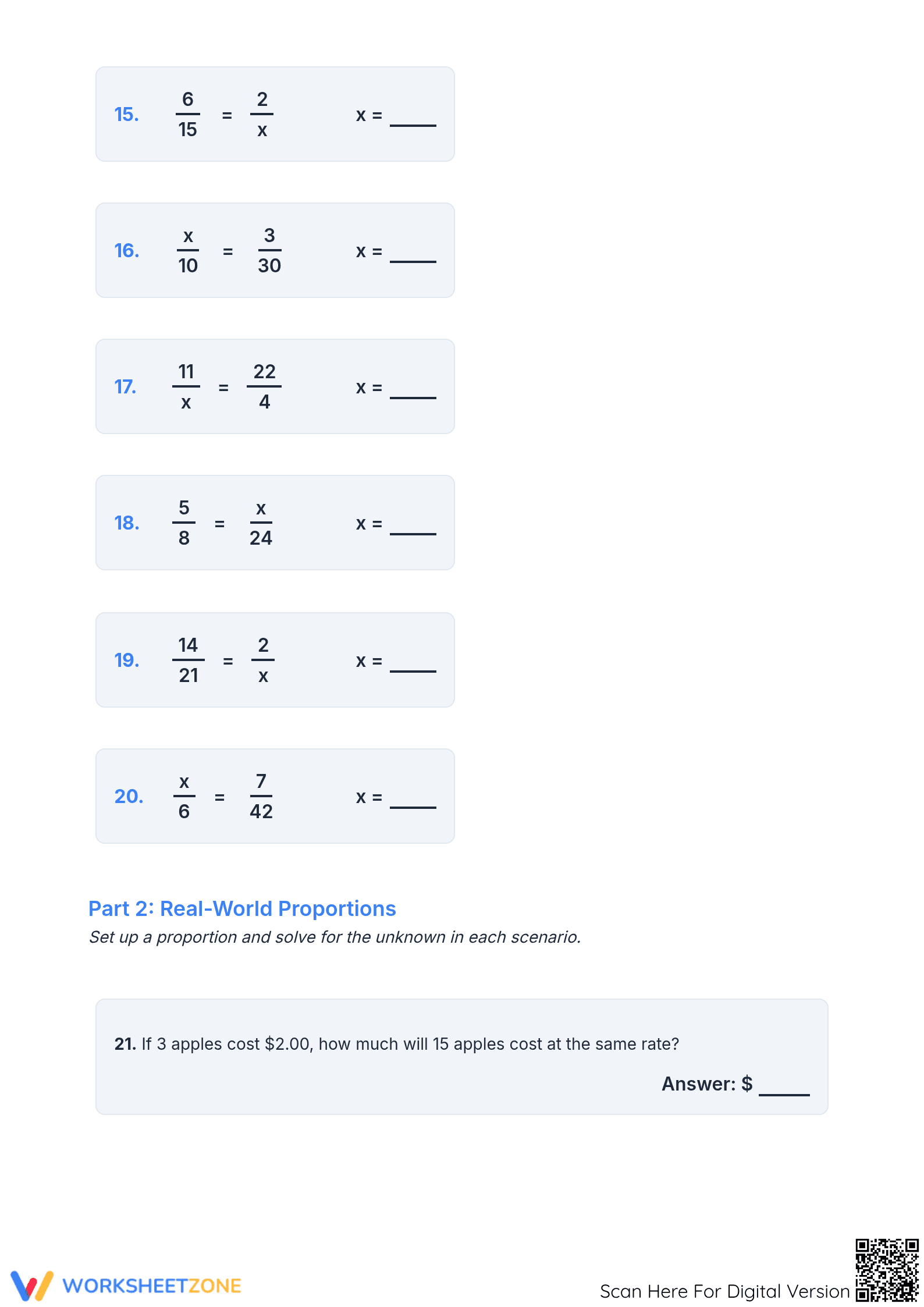


Grade 7 Solving Proportions — Printable No-Prep Worksheet
Paste this activity's link or code into your existing LMS (Google Classroom, Canvas, Teams, Schoology, Moodle, etc.).
Students can open and work on the activity right away, with no student login required.
You'll still be able to track student progress and results from your teacher account.
Solving proportions is a fundamental bridge between arithmetic and algebra. This resource provides students with the structured practice necessary to master equivalent ratios and cross-multiplication. By working through these problems, learners develop the fluency needed for high-school level mathematics, specifically within geometry and physics contexts where proportional reasoning is essential.
At a Glance
- Grade: 7 · Subject: Mathematics
- Standard:
CCSS.MATH.CONTENT.7.RP.A.2— Recognize and represent proportional relationships between quantities- Skill Focus: Solving Algebraic Proportions
- Format: 4 pages · 24 problems · Answer key included · PDF
- Best For: Independent practice and formative assessment
- Time: 30–45 minutes
This comprehensive 4-page PDF includes 24 unique problems divided into two logical sections. Part 1 contains 20 abstract proportions designed to build computational fluency with variable isolation through cross-products. Part 2 shifts to 4 real-world application problems involving unit rates, recipe scaling, fuel efficiency, and map distances. A complete answer key is provided for immediate grading or student self-checking.
Zero-Prep Workflow
Educators can integrate this worksheet into their lesson plans with a three-step workflow that requires zero additional setup. First, print the document directly from the PDF viewer (1 minute). Second, distribute the four-page packets to students during independent work time or as a sub-plan activity (1 minute). Third, review the results using the provided answer key to identify common misconceptions (5 minutes).
Standards Alignment
The primary standard addressed is CCSS.MATH.CONTENT.7.RP.A.2, which focuses on recognizing and representing proportional relationships. This worksheet specifically targets the application of those relationships through equation solving and cross-multiplication. This standard code can be copied directly into lesson plans, IEP goals, or district curriculum mapping tools to ensure instructional continuity and rigor.
How to Use It
This resource is most effective when used as a formative assessment after initial direct instruction on cross-multiplication. Teachers can use the first page of Part 1 as a quick check for understanding to see if students are correctly scaling fractions or applying cross-products. The expected completion time for the entire 24-problem set is approximately 40 minutes, making it a perfect whole-class activity or a rigorous homework assignment.
Who It's For
This worksheet is designed for 7th-grade students mastering proportional reasoning, but it also serves as an excellent remediation tool for 8th-grade students struggling with algebraic equations. It pairs naturally with an anchor chart on cross-products or a direct instruction lesson on unit rates and constant of proportionality.
The ability to solve proportions is a critical indicator of future success in algebra and higher-level STEM coursework. According to the RAND AIRS 2024 report, students who master proportional reasoning in the middle grades show significantly higher proficiency in representing complex functional relationships in high school. This worksheet aligns with CCSS.MATH.CONTENT.7.RP.A.2 by providing 24 opportunities for students to solve algebraic proportions through cross-multiplication and scaling strategies. By including both abstract calculations and real-world word problems involving unit rates and distances, the resource ensures that learners can transfer their skills to practical contexts. This dual-layered approach is supported by EdReports 2024 criteria for instructional rigor, which emphasizes the balance between procedural fluency and conceptual application in mathematics. Teachers can reliably use this data-driven tool to track student progress toward mastery in proportional relationships and foundational algebra.


