


























Views
Downloads



Printable Algebraic Equations Worksheet | Grade 4 Math
Paste this activity's link or code into your existing LMS (Google Classroom, Canvas, Teams, Schoology, Moodle, etc.).
Students can open and work on the activity right away, with no student login required.
You'll still be able to track student progress and results from your teacher account.
Solve algebraic equations through an engaging space-themed mission. This Grade 4 math worksheet challenges students to master one-step and two-step equations across three distinct levels of complexity. By identifying unknown variables in addition, subtraction, multiplication, and division problems, learners build the essential foundation for middle school algebra and higher-order mathematical reasoning.
At a Glance
- Grade: 4 · Subject: Math
- Standard:
CCSS.MATH.CONTENT.4.OA.A.3— Solve multi-step equations and find the value of unknown variables- Skill Focus: Solving one-step and two-step equations
- Format: 5 pages · 28 problems · Answer key included · PDF
- Best For: Independent math centers and homework
- Time: 30–45 minutes
What's Inside
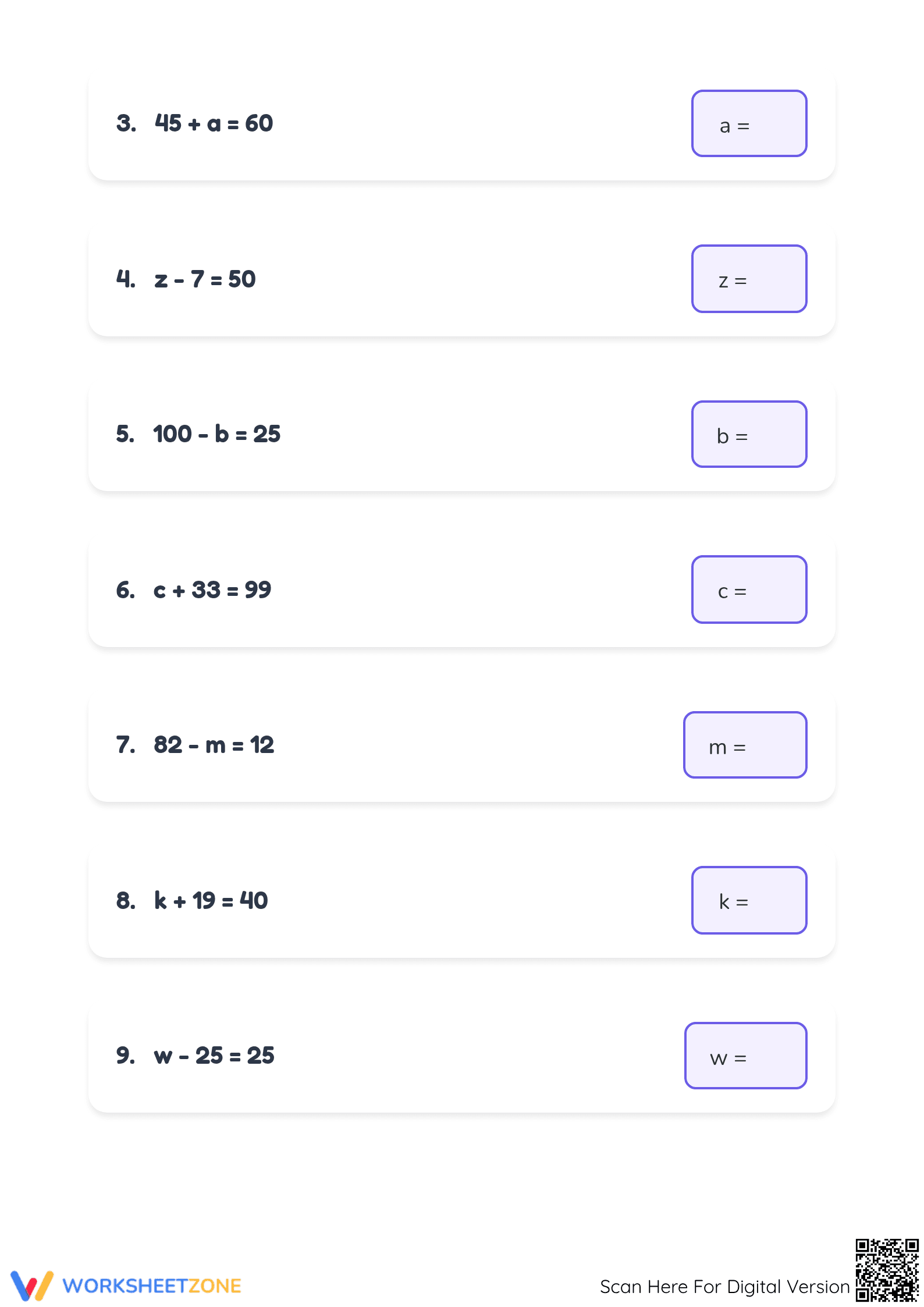
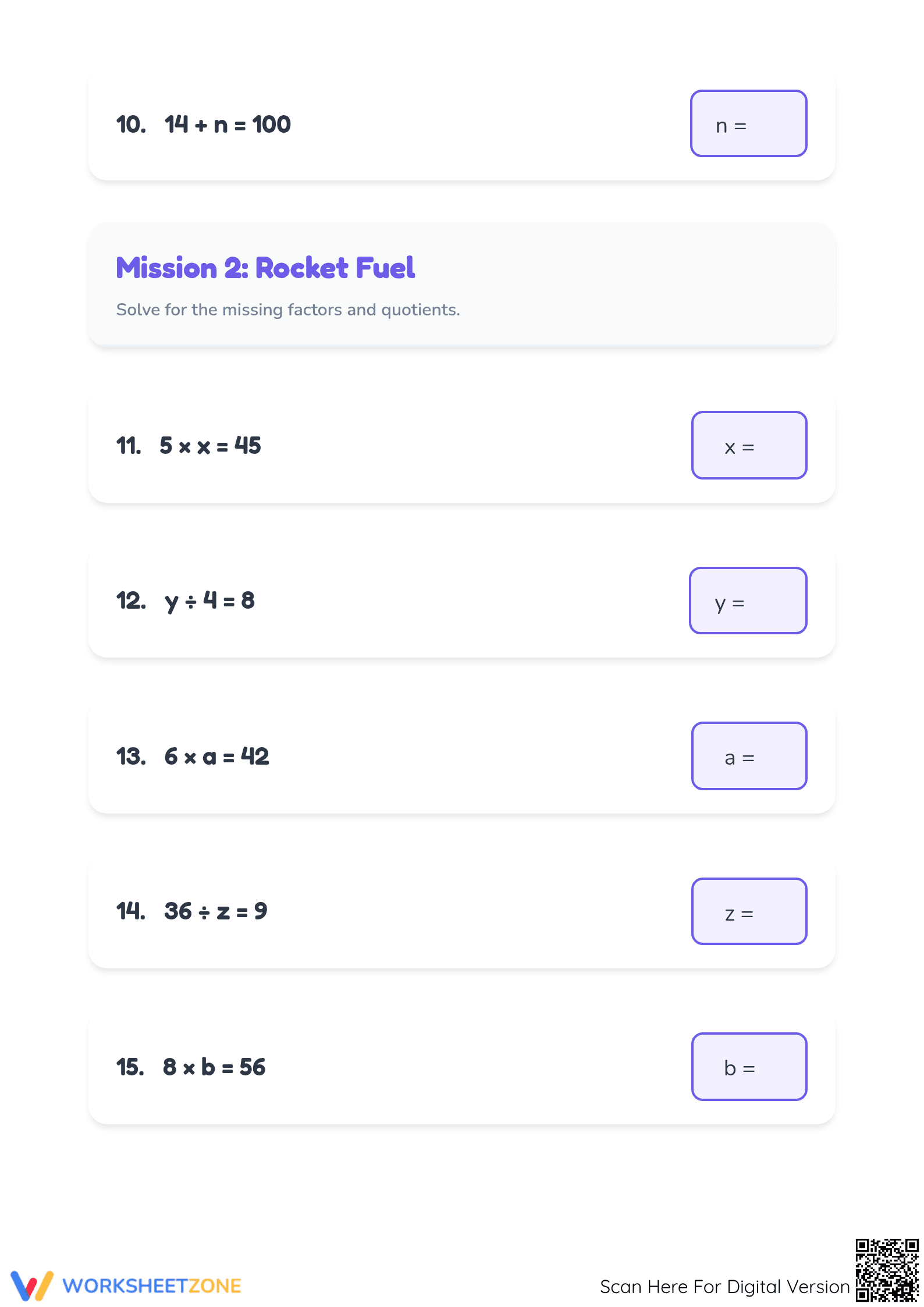
This comprehensive five-page PDF includes 28 structured problems divided into three space missions. Mission 1 focuses on 10 one-step addition and subtraction equations. Mission 2 transitions to 10 multiplication and division unknowns. Mission 3 provides 8 two-step "Hyperspace Logic" equations for advanced practice. A complete answer key is provided for immediate grading or self-correction.
Skill Progression
- Guided Practice: The first 10 problems provide clear, simple variable placement (e.g., x + 12 = 30) to build confidence with inverse operations.
- Supported Practice: Problems 11 through 20 introduce multiplication and division symbols, requiring students to apply mental math or scratchpad calculations to isolate the variable.
- Independent Mastery: The final 8 problems challenge students with two-step logic (e.g., 2x + 10 = 20), requiring them to perform operations in the correct sequence to find the solution.
This mission structure follows a gradual release of responsibility model, ensuring students master basic variable isolation before attempting complex multi-step operations.
Standards Alignment
This resource aligns primarily with `CCSS.MATH.CONTENT.4.OA.A.3`, which requires students to solve multistep problems and represent unknowns with variables. It also supports `CCSS.MATH.CONTENT.3.OA.B.4` by reinforcing the relationship between factors and products. Both standard codes can be copied directly into lesson plans, IEP goals, or district curriculum mapping tools.
How to Use It
Assign this mission during the "You Do" phase of a gradual-release lesson after demonstrating inverse operations. For a formative assessment tip, observe students during Mission 2 to see if they correctly identify whether to multiply or divide based on the variable's position. This packet typically takes 35 minutes to complete in a standard classroom setting.
Who It's For
Designed for Grade 4 general education students, this worksheet is also an excellent intervention tool for Grade 5 learners needing algebraic review. It pairs naturally with a number line or basic operation anchor charts to support students who are still mastering their math facts while learning algebraic concepts.
According to the RAND AIRS 2024 report, exposing elementary students to algebraic variables early significantly reduces math anxiety when transitioning to secondary education. This worksheet utilizes a gamified "mission" structure to deliver 28 rigorous problems aligned to `CCSS.MATH.CONTENT.4.OA.A.3`. By solving one-step and two-step equations, students practice the critical skill of isolating variables, which is a foundational requirement for algebraic literacy. Research from Fisher & Frey (2014) highlights that such structured, scaffolded practice allows for a more effective gradual release of responsibility, ensuring students move from simple additive equations to complex multiplicative relationships without losing conceptual clarity. Educators can confidently integrate this standards-based resource into their daily math rotation, knowing that it provides the volume of practice necessary for procedural fluency while maintaining the high cognitive demand required by state and national standards.


