


























Views
Plays

Snow Math & Science Worksheet | Grade 1 Essential
Paste this activity's link or code into your existing LMS (Google Classroom, Canvas, Teams, Schoology, Moodle, etc.).
Students can open and work on the activity right away, with no student login required.
You'll still be able to track student progress and results from your teacher account.
Snow Science and Geometry Integration
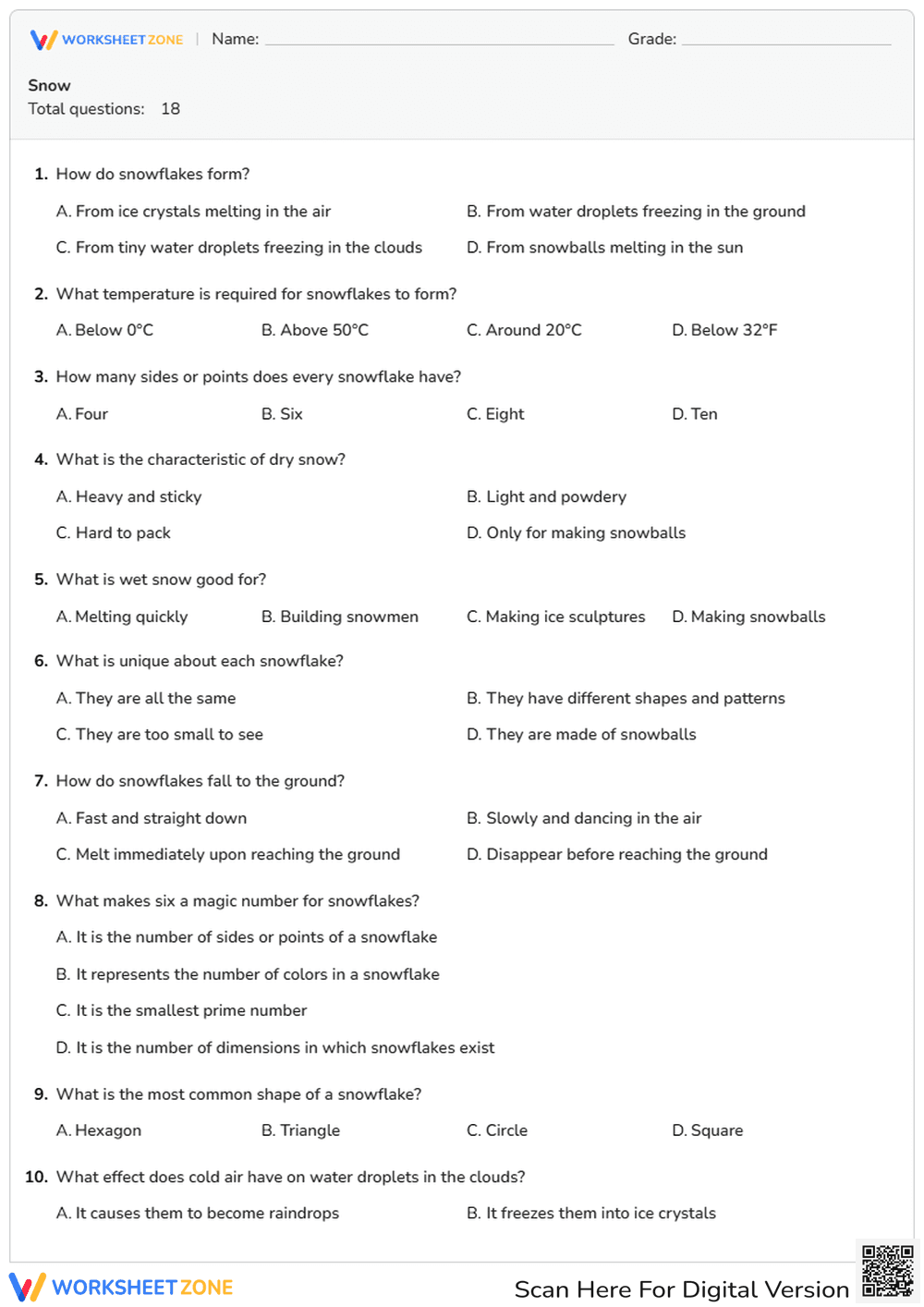
This Grade 1 snow worksheet integrates earth science with foundational math concepts through 18 engaging multiple-choice questions. Students explore the geometry of snowflakes, specifically focusing on the number of sides and hexagonal patterns, while building reading comprehension skills. It provides a comprehensive check for understanding after a winter-themed lesson.
At a Glance
- Grade: 1 · Subject: Math
- Standard:
CCSS.MATH.CONTENT.1.G.A.1— Distinguish between defining attributes versus non-defining attributes of shapes- Skill Focus: Geometric attributes and weather facts
- Format: 2 pages · 18 problems · Answer key included · PDF
- Best For: Winter-themed math and science review
- Time: 15–25 minutes
What's Inside
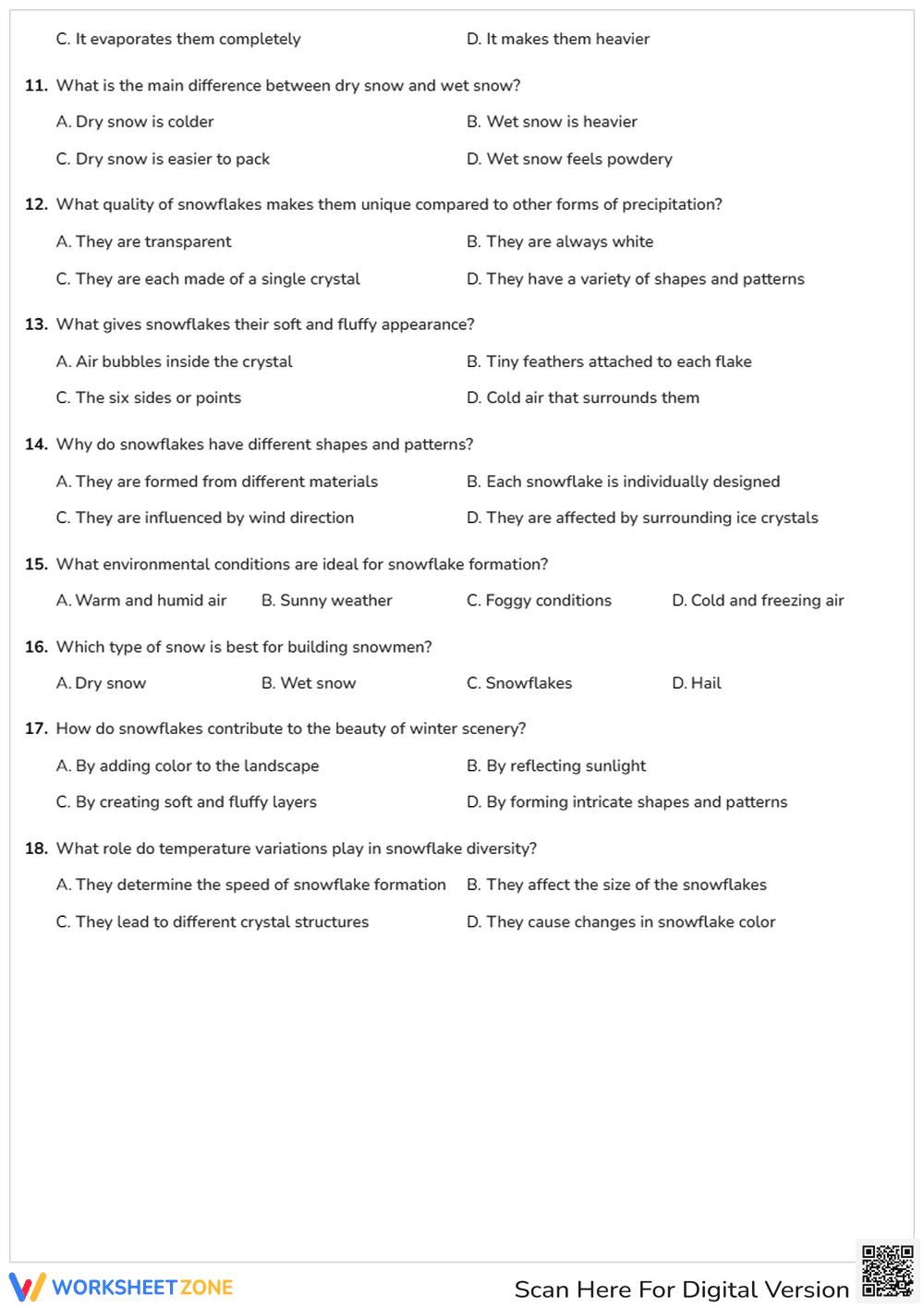
The two-page PDF contains 18 structured multiple-choice questions. Each question offers four distinct options to challenge student recall and reasoning. The content spans from basic weather observations to specific geometric attributes, such as identifying the six-sided nature of ice crystals. A clear layout ensures readability for young learners, with ample spacing between questions to prevent visual overwhelm.
Zero-Prep Workflow
- Print: Send the two-page document to your printer (30 seconds).
- Distribute: Hand out the sheets for independent work, a center activity, or a formal quiz (15-20 minutes).
- Review: Use the included answer key for rapid grading or a whole-class review session to discuss the science behind the math (5 minutes).
Total teacher preparation time is under two minutes, making this an ideal resource for busy mornings or unexpected sub plans.
Standards Alignment
The primary alignment is `CCSS.MATH.CONTENT.1.G.A.1`, which requires students to distinguish between defining attributes (like the number of sides) versus non-defining attributes (like color or size) of shapes. By identifying the "magic number" six and the hexagonal shape of snowflakes, students apply geometric reasoning to natural objects. This standard code can be copied directly into lesson plans, IEP goals, or district curriculum mapping tools.
How to Use It
Use this as a summative assessment following a unit on winter weather or 2D shapes. It serves as an excellent formative check during a science-math integration block. Teachers should observe if students can connect the word "hexagon" to the physical description of a snowflake. Completion typically takes 15 to 25 minutes depending on reading proficiency.
Who It's For
This is ideal for first-grade students, including English Language Learners who benefit from the clear, repetitive question structure. It pairs naturally with a classroom anchor chart about 2D shapes or a read-aloud book about Wilson Bentley’s snowflake photography. The content is accessible for students working at grade level while providing enough complexity for advanced learners to discuss crystal formation.
Research from Fisher & Frey (2014) emphasizes the importance of cross-curricular integration to solidify student understanding of abstract concepts like geometry. By placing math within the context of a "Snow" theme, this worksheet leverages situational interest to increase engagement and retention. The 18 tasks are calibrated for Grade 1 cognitive loads, ensuring that the reading level does not overshadow the mathematical and scientific inquiry. According to the RAND AIRS 2024 report, high-quality supplemental materials that align with `CCSS.MATH.CONTENT.1.G.A.1` significantly improve a student's ability to recognize defining attributes in complex, real-world patterns. This resource provides the necessary repetition for mastery while maintaining a low-barrier entry for diverse learners. It is a reliable tool for teachers seeking to bridge the gap between seasonal themes and rigorous academic standards.


