


























Views
Downloads

Essential Skip Counting Practice Worksheet | Grade 1 Math
Paste this activity's link or code into your existing LMS (Google Classroom, Canvas, Teams, Schoology, Moodle, etc.).
Students can open and work on the activity right away, with no student login required.
You'll still be able to track student progress and results from your teacher account.
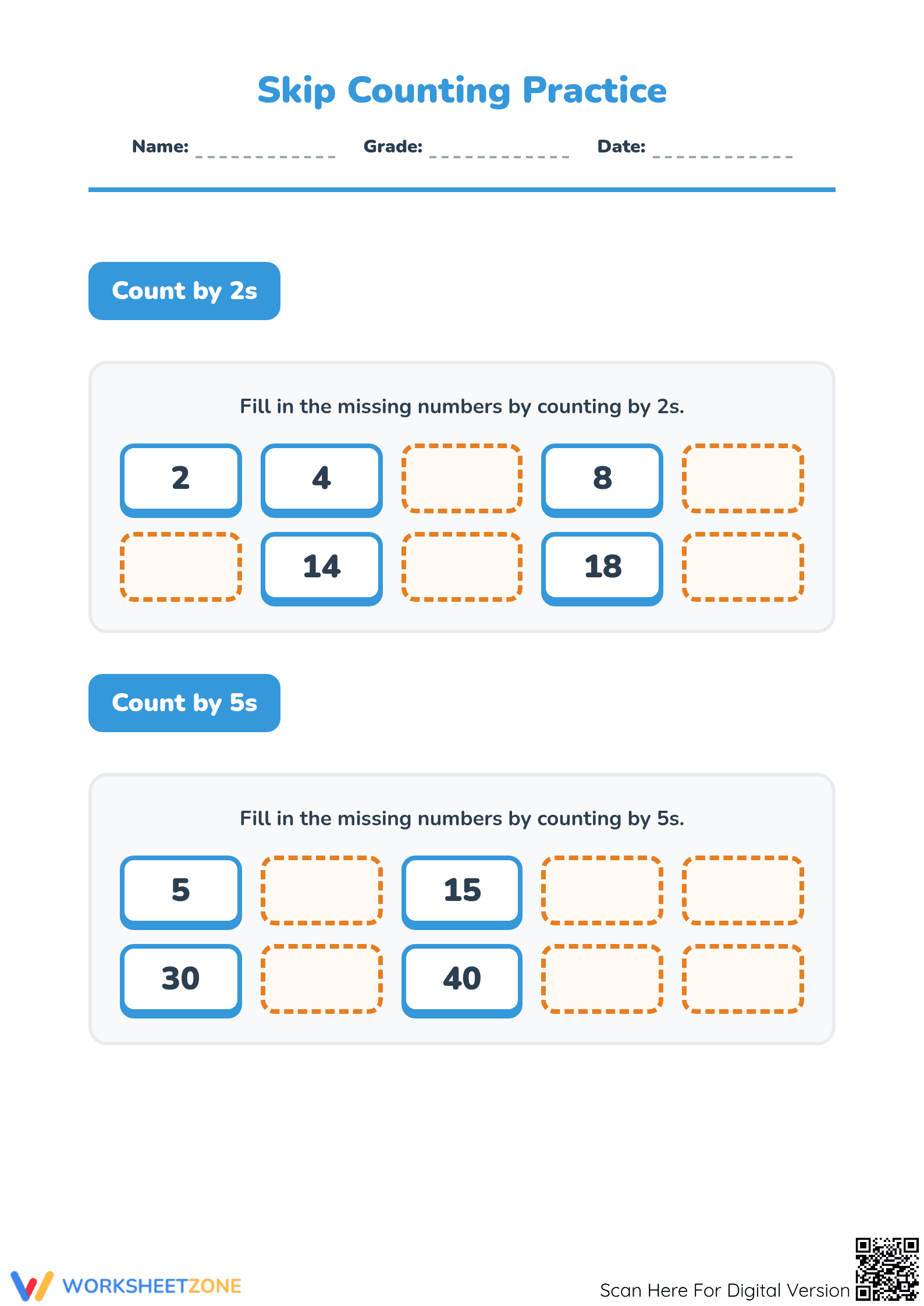
This Grade 1 skip counting practice worksheet empowers young learners to identify and extend numerical patterns with confidence. By filling in missing numbers in structured sequences, students develop the foundational mental math skills necessary for addition and future multiplication. This resource provides clear, focused practice that ensures students grasp the rhythmic nature of numbers while building computational fluency.
At a Glance
- Grade: 1 · Subject: Math
- Standard:
1.NBT.A.1— Count to 120 starting at any number and read and write numerals- Skill Focus: Skip counting by 2s, 5s, and 10s
- Format: 2 pages · 18 problems · Answer key included · PDF
- Best For: Daily math warm-ups or independent practice
- Time: 15–20 minutes
What's Inside
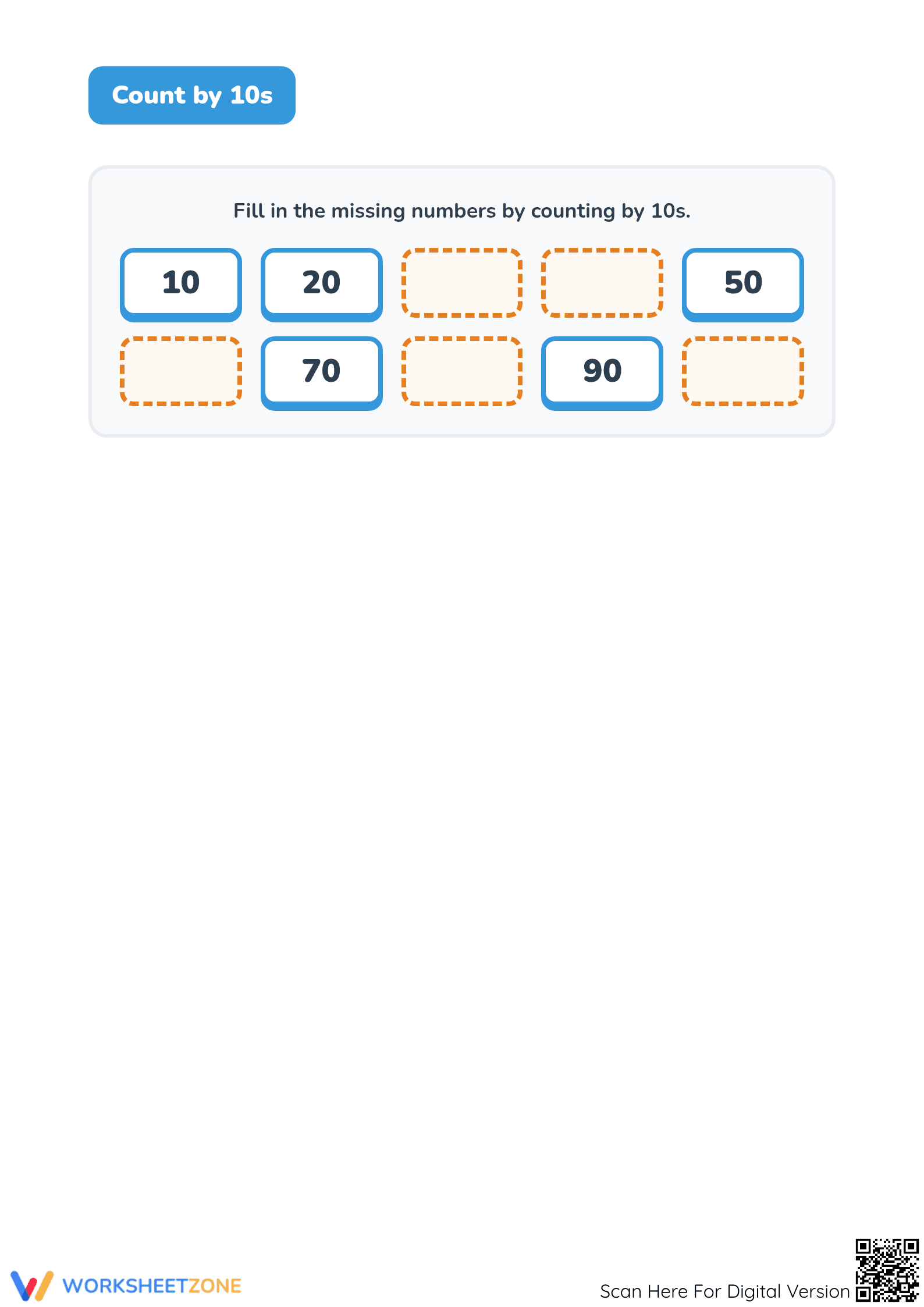
This comprehensive 2-page PDF features three distinct sections dedicated to skip counting by 2s, 5s, and 10s. Each section contains a sequence of ten formatted boxes where students must observe the pattern and supply the correct missing digits. The clean layout reduces visual distractions, while the included answer key allows for immediate feedback and self-correction, making it an ideal tool for both classroom and home use.
Skill Progression
- Guided Practice: Initial rows begin with common anchor numbers (2, 5, 10), allowing students to establish the counting interval quickly.
- Supported Practice: Mid-sequence gaps require students to maintain the pattern across multiple steps, reinforcing mental addition.
- Independent Practice: The final boxes in each section challenge students to finalize the sequence without immediate numeric cues, totaling 18 independent completions.
This resource utilizes a gradual-release model to ensure students move from simple observation to autonomous pattern extension.
Standards Alignment
This resource is directly aligned to 1.NBT.A.1, which requires students to count to 120, starting at any number less than 120. It also supports 1.OA.C.5 by helping students relate counting to addition (e.g., skip counting by 2 is adding 2 each time). Both standard codes can be copied directly into lesson plans, IEP goals, or district curriculum mapping tools to ensure instructional compliance and tracking.
How to Use It
Use this worksheet as a formative assessment during a math workshop rotation to check for pattern recognition speed. Alternatively, assign it as a morning bell ringer to activate prior knowledge before a lesson on base-ten concepts. Teachers should observe if students are counting by ones to find the next number or if they can fluently predict the next digit in the skip-counting sequence within the 20-minute completion window.
Who It's For
This activity is designed for first-grade students or kindergarteners ready for enrichment. It is also highly effective for second-grade students needing intervention to close gaps in number sense. Pair this worksheet with a 100-chart or a set of linking cubes to provide a tactile anchor for students who are still developing their internal mental number line.
According to the RAND AIRS 2024 report on foundational numeracy, the ability to fluently skip count is a high-leverage indicator of future success in algebraic thinking and multiplication. This Grade 1 worksheet targets 1.NBT.A.1 by providing 18 high-quality opportunities for students to engage in pattern-seeking behavior. Research from Fisher & Frey (2014) emphasizes that structured practice—like the fill-in-the-blank sequences provided here—allows students to internalize the regularities of the base-ten system. By mastering these intervals of 2, 5, and 10, students move beyond simple counting and begin to perceive numbers as sets, which is a critical developmental milestone. This resource serves as a robust evidence-based tool for educators looking to solidify number sense in early elementary classrooms through focused, standards-aligned repetition and clear visual scaffolding.


