


























Views
Downloads

Sink or Float Science Worksheet | Grade 1-2 Essential
Paste this activity's link or code into your existing LMS (Google Classroom, Canvas, Teams, Schoology, Moodle, etc.).
Students can open and work on the activity right away, with no student login required.
You'll still be able to track student progress and results from your teacher account.
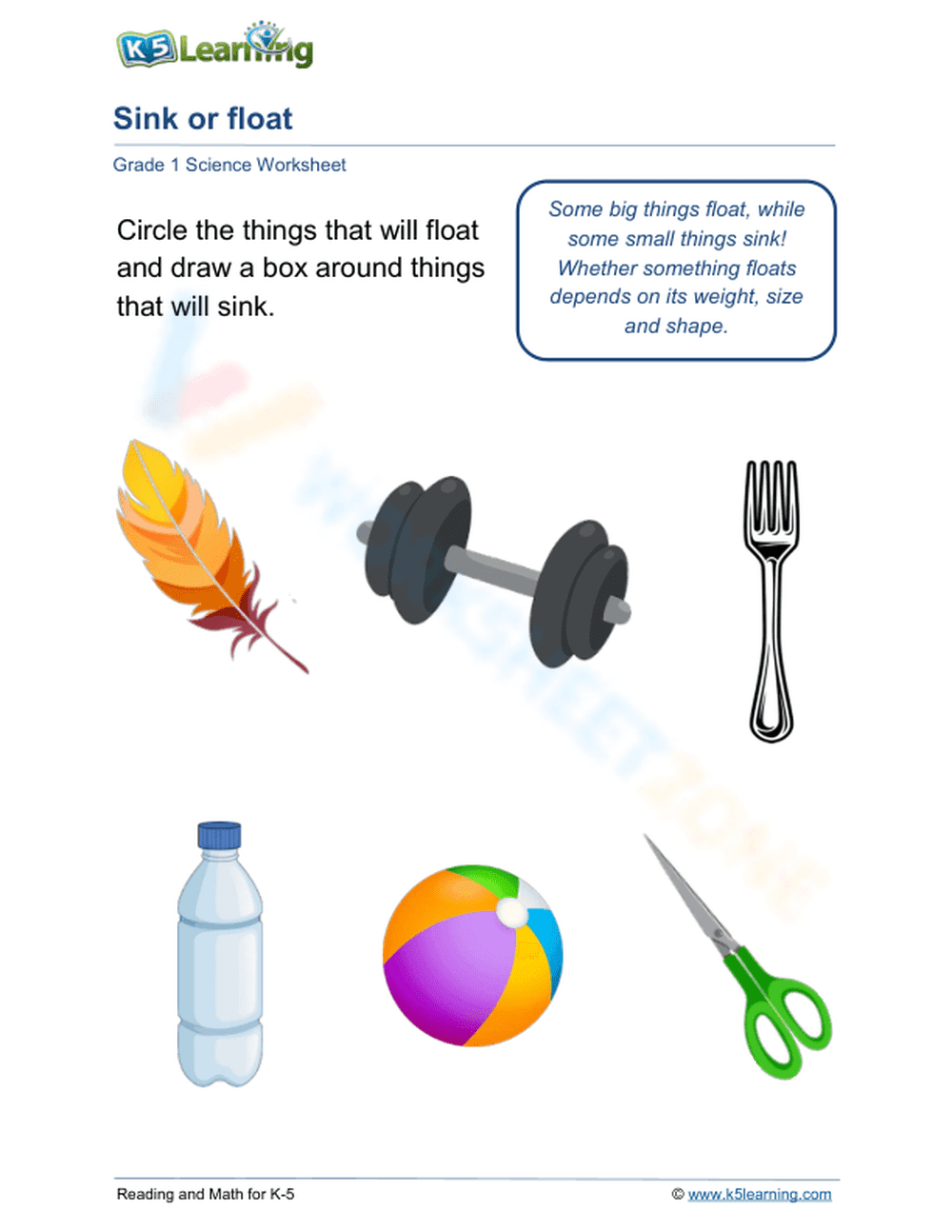
This Grade 1-2 science worksheet helps students master the concept of buoyancy by predicting and classifying whether everyday objects sink or float. By analyzing observable properties like weight and shape, learners develop foundational physical science skills. It provides a clear, visual way for young scientists to document their findings and understand material properties.
At a Glance
- Grade: 1-2 · Subject: Science
- Standard:
2-PS1-1— Plan and conduct an investigation to describe and classify materials by observable properties- Skill Focus: Buoyancy and material classification
- Format: 2 pages · 6 problems · Answer key included · PDF
- Best For: Introduction to physical properties and density
- Time: 10–15 minutes
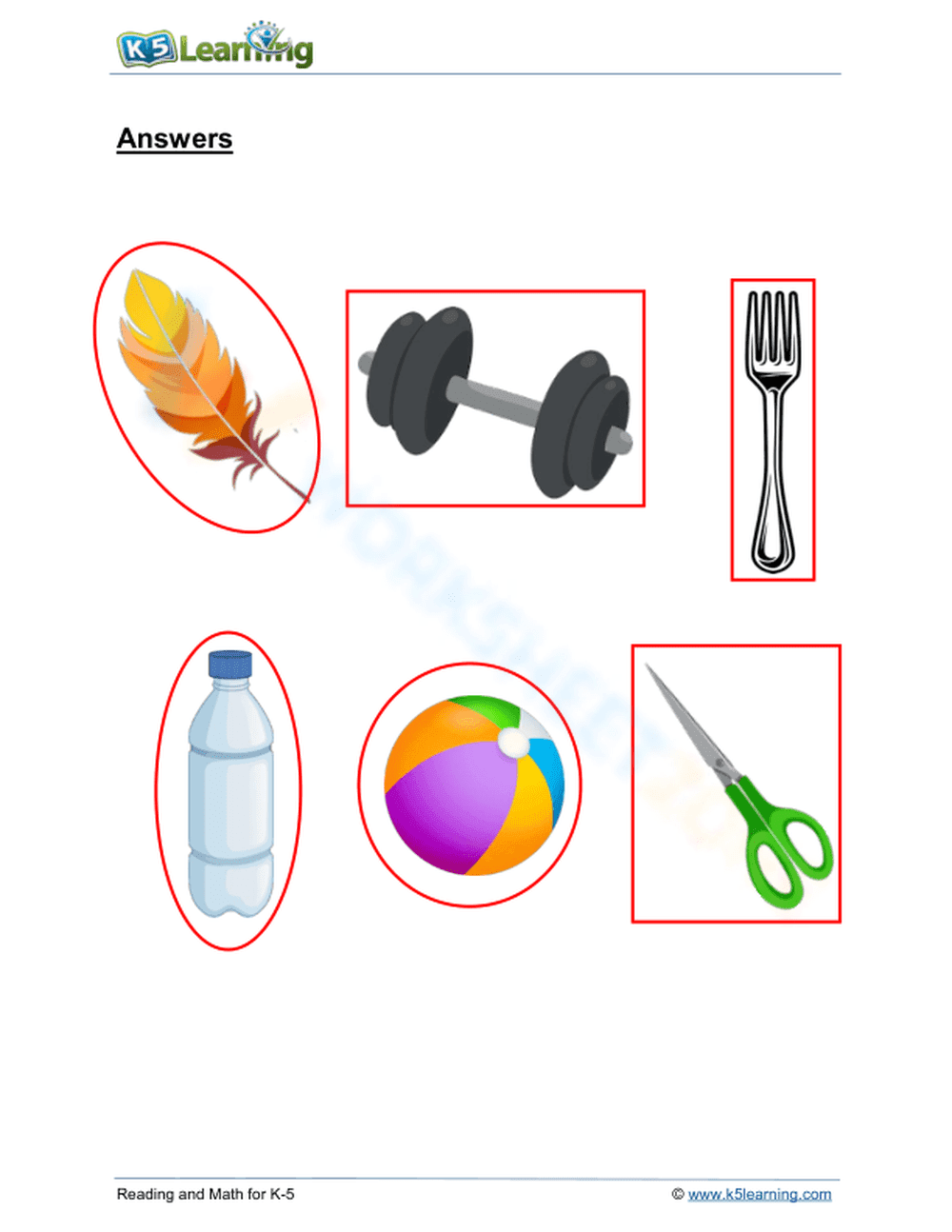
This two-page PDF includes a student activity sheet and a corresponding teacher answer key. The worksheet features six high-quality illustrations of common items, including a feather, a dumbbell, and a beach ball. Students are tasked with using specific symbols—circles for floating and boxes for sinking—to categorize each item based on its physical behavior in water.
The workflow for this resource is designed for maximum efficiency. First, print the single-page student sheet in under 30 seconds. Next, distribute the materials to the class for a quick formative assessment or independent practice session. Finally, use the included visual answer key to review results with the whole group or check for individual understanding. Total teacher prep time is less than 2 minutes.
This resource aligns with `2-PS1-1`, which requires students to classify different kinds of materials by their observable properties. It also supports the K-2-ETS1-3 engineering standard by encouraging students to observe how the shape of an object might influence its function or behavior. Both standard codes can be copied directly into lesson plans, IEP goals, or district curriculum mapping tools.
Use this worksheet as a "predict and verify" activity during a live water-table demonstration. Before placing the real objects in water, have students mark their predictions on the sheet. It also serves as an excellent exit ticket after a lesson on density. Expect students to complete the classification in approximately 12 minutes, allowing for brief discussion on why certain heavy-looking objects might still float.
This activity is ideal for first and second-grade students beginning their exploration of physical science. It is particularly effective for English Language Learners (ELL) due to the heavy reliance on visual cues rather than complex text. Pair this worksheet with a primary-level anchor chart about "Properties of Matter" to reinforce vocabulary and conceptual understanding.
According to the RAND AIRS 2024 report on primary science education, visual classification tasks are critical for developing early scientific reasoning and observation skills in K-2 learners. This worksheet addresses the 2-PS1-1 standard by providing a structured environment where students must evaluate the observable properties of six distinct objects to determine buoyancy. By engaging with familiar items like scissors and water bottles, students bridge the gap between abstract physical concepts and real-world applications. Research from Fisher & Frey (2014) suggests that such scaffolded observation tasks improve long-term retention of scientific principles. This resource provides a 10-minute high-impact intervention that fits easily into any science block, ensuring that students meet grade-level expectations for describing and classifying materials based on their physical characteristics and behavior in different environments.


