


























Views
Downloads
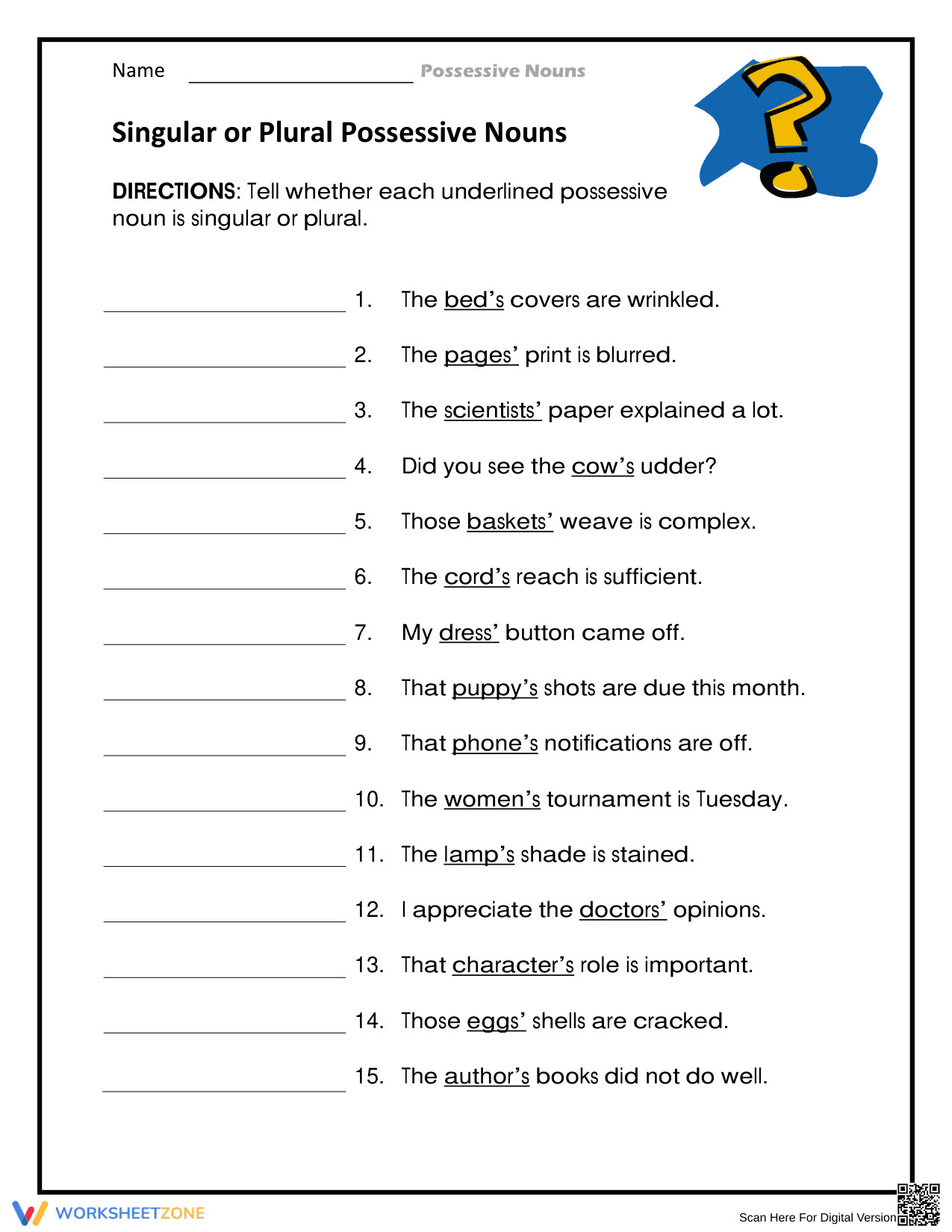

Essential Singular or Plural Possessive Nouns Worksheet
Paste this activity's link or code into your existing LMS (Google Classroom, Canvas, Teams, Schoology, Moodle, etc.).
Students can open and work on the activity right away, with no student login required.
You'll still be able to track student progress and results from your teacher account.
This Grade 3 grammar worksheet provides targeted practice for students to distinguish between singular and plural possessive nouns. By identifying the correct form in context, learners solidify their understanding of apostrophe placement and noun-verb agreement. This focused activity ensures students can accurately identify possessive forms before applying them in their own creative writing.
At a Glance
- Grade: 3 · Subject: English Language Arts
- Standard:
CCSS.ELA-LITERACY.L.3.2.D— Form and use possessives accurately using singular and plural nouns- Skill Focus: Singular vs. Plural Possessive Identification
- Format: 1 page · 15 problems · Answer key included · PDF
- Best For: Grammar review or quick formative assessment
- Time: 10–15 minutes
The worksheet contains 15 clearly numbered sentences, each featuring an underlined possessive noun. Students are tasked with determining if the noun refers to one owner (singular) or multiple owners (plural). The layout is clean and spacious, providing a dedicated line for student responses. A comprehensive answer key is included to facilitate rapid grading or self-correction, making it a complete instructional tool for any classroom setting.
Teachers can implement this resource in three simple steps. First, print the single-page PDF (30 seconds). Second, distribute the copies to students for independent work or a center activity (1 minute). Third, use the included answer key for immediate review or peer-grading (under 2 minutes). Total teacher preparation time is less than two minutes, making this an ideal choice for busy mornings or unexpected substitute teacher plans.
This resource is aligned to CCSS.ELA-LITERACY.L.3.2.D: "Form and use possessives." While the standard covers usage, this worksheet provides the critical prerequisite of identification. By recognizing the difference between singular and plural forms, students build the morphological awareness required for writing. Both standard codes can be copied directly into lesson plans, IEP goals, or district curriculum mapping tools.
Use this worksheet as a mid-lesson check during a unit on punctuation. After explaining that singular possessives usually end in -’s and plural possessives in -s’, have students complete the first five items to check for understanding. For a formative assessment tip, observe students as they work on item 10 ("women's") to see if they recognize irregular plural possessives. Completion typically takes 12 minutes during a standard grammar block.
This resource is designed for Grade 3 students but serves as an excellent review for Grade 4 or a challenge for Grade 2. It is particularly helpful for English Language Learners who are navigating the nuances of English possessive markers. Pair this with a possessive noun anchor chart or a short reading passage to help students see these grammatical structures in a broader literary context.
Mastering possessive nouns is a foundational component of linguistic precision in the elementary grades. This worksheet targets the CCSS.ELA-LITERACY.L.3.2.D standard, requiring students to identify possessive forms. By providing 15 contextual examples, the activity encourages students to analyze the relationship between owners and objects. According to a RAND AIRS 2024 analysis, repeated exposure to morphological variations improves retention of grammar rules. Distinguishing between singular and plural possessives prevents punctuation errors that persist into middle school. This resource offers a structured path toward mastery by isolating the identification skill. It remains a staple for evidence-based instruction, ensuring students develop mechanical accuracy that supports writing clarity. The standalone nature of these tasks allows for rapid skill reinforcement without overwhelming learners. It is an essential tool for bridging the gap between basic noun usage and sophisticated sentence construction in academic writing environments.


