


























Views
Downloads

Singular & Plural Nouns Printable | Grade K ELA
Paste this activity's link or code into your existing LMS (Google Classroom, Canvas, Teams, Schoology, Moodle, etc.).
Students can open and work on the activity right away, with no student login required.
You'll still be able to track student progress and results from your teacher account.
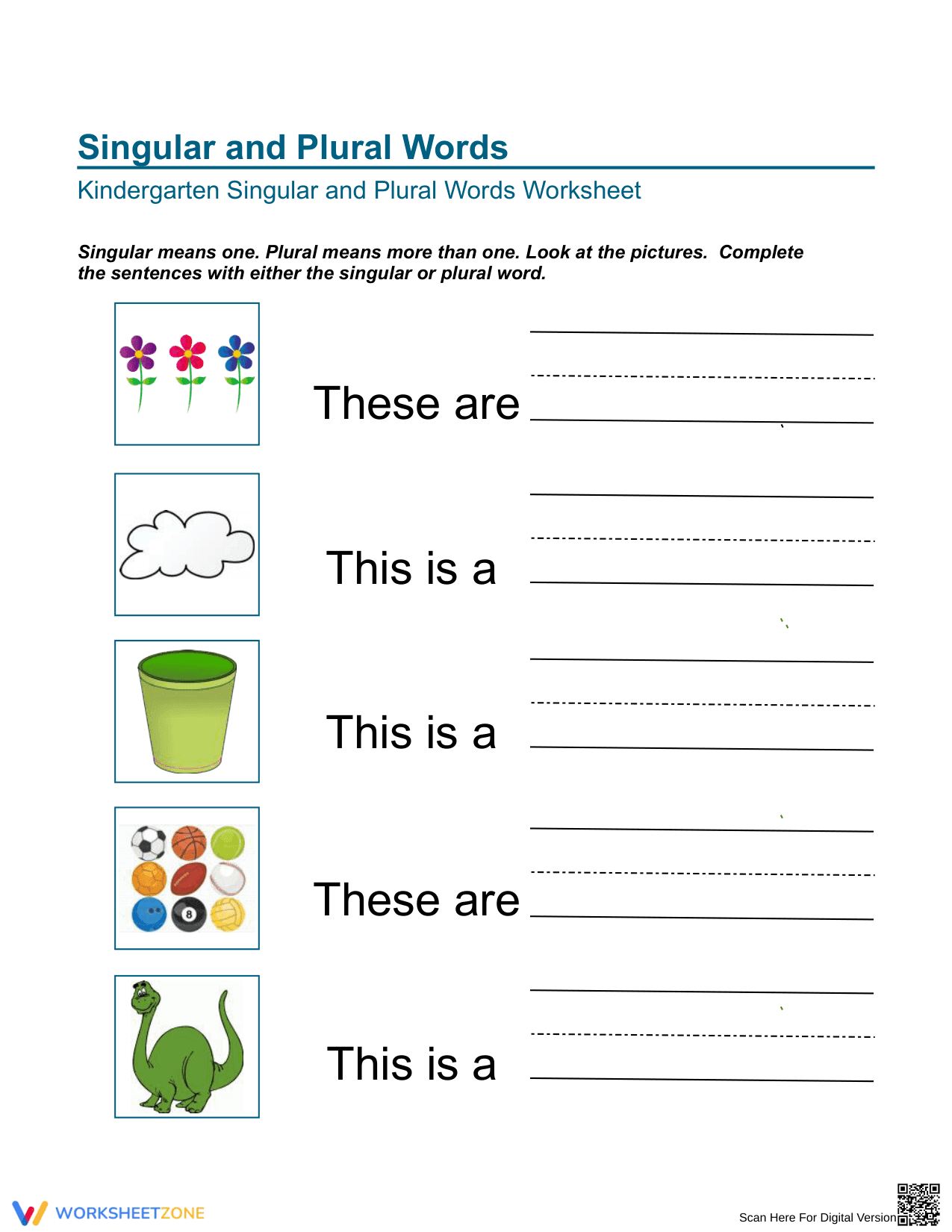
This foundational English Language Arts worksheet helps early learners master the difference between singular and plural nouns. By analyzing clear visual cues and completing simple sentence frames, kindergarten and first-grade students practice identifying when to use standard noun forms versus plural forms ending in -s to describe quantities accurately.
At a Glance
- Grade: K · Subject: ELA
- Standard:
CCSS.ELA-LITERACY.L.K.1.c— Form regular plural nouns by adding s or es.- Skill Focus: Singular and Plural Nouns
- Format: 1 page · 5 problems · Answer key included · PDF
- Best For: Independent practice
- Time: 10–15 minutes
This single-page resource features five highly visual tasks designed specifically for early readers. Each problem pairs a colorful illustration—such as a single dinosaur or multiple flowers—with a corresponding sentence starter like "This is a" or "These are." Students use primary handwriting lines to write the correct singular or plural noun that completes the thought. A complete answer key is provided to ensure quick and accurate grading.
Zero-Prep Workflow
This resource requires minimal teacher setup.
- Print (1 minute): Download the PDF and print. The high-contrast design ensures excellent quality.
- Distribute (1 minute): Hand out the worksheets. Straightforward instructions let students begin immediately.
- Review (3 minutes): Use the answer key to check responses or project for whole-class review.
With prep time under two minutes, this is ideal for any emergency sub plan.
Standards Alignment
This worksheet is directly aligned to CCSS.ELA-LITERACY.L.K.1.c, which requires students to form regular plural nouns orally by adding /s/ or /es/. It also supports early reading comprehension by pairing text with visual quantities. Both standard codes can be copied directly into lesson plans, IEP goals, or district curriculum mapping tools.
How to Use It
Integrate this worksheet into your literacy block during independent practice, immediately following direct instruction on plural rules. It serves as an excellent reinforcement activity while the teacher pulls small groups. Alternatively, use it as a morning work assignment to activate prior knowledge before a new grammar lesson. As a formative assessment tip, observe whether students rely on the visual quantity or the sentence starter to determine their answer. Expected completion time ranges from 10 to 15 minutes.
Who It's For
This activity is optimized for kindergarten and first-grade students developing foundational grammar skills. The visual supports make it highly accessible for English Language Learners (ELLs) who are building their vocabulary alongside grammatical structures. For differentiation, teachers can provide a word bank for students needing extra spelling support. Pair this worksheet with a whole-group anchor chart demonstrating the "add -s" rule for maximum instructional impact.
Mastering the distinction between singular and plural forms is a critical milestone in early literacy development. This resource explicitly targets CCSS.ELA-LITERACY.L.K.1.c, helping students form regular plural nouns by adding s or es. According to Fisher & Frey (2014), providing students with structured, visually supported practice opportunities significantly increases their ability to internalize foundational grammar rules and apply them independently. When young learners connect visual quantities to specific morphological changes, such as adding an -s suffix, they develop stronger reading comprehension and writing fluency. This worksheet facilitates that essential connection through clear imagery and targeted sentence frames. By requiring students to actively produce the correct noun form on primary handwriting lines rather than simply identifying it from a list, the activity promotes deeper cognitive engagement and better long-term retention of lexical word classes.


