


























Views
Downloads
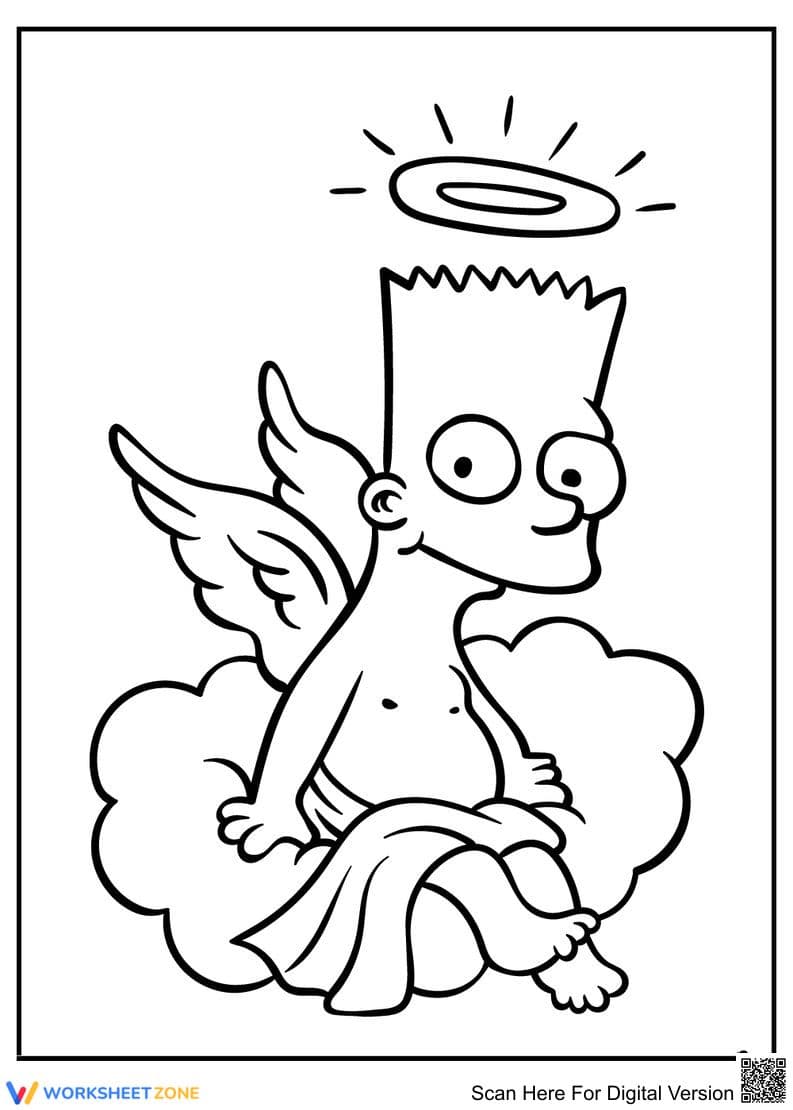

Simpsons Coloring Page | Essential Fine Motor Practice
Paste this activity's link or code into your existing LMS (Google Classroom, Canvas, Teams, Schoology, Moodle, etc.).
Students can open and work on the activity right away, with no student login required.
You'll still be able to track student progress and results from your teacher account.
This Simpsons coloring page provides a high-interest way for students to develop essential fine motor control and artistic expression. By focusing on the iconic character Bart Simpson in a unique angel motif, learners engage in creative decision-making while strengthening the small muscle groups necessary for handwriting and dexterity. This activity serves as a bridge between play and formal skill acquisition.
At a Glance
- Grade: K–5 · Subject: Arts & Crafts
- Standard:
VA:Cr1.1.Ka— Engage in exploration and imaginative play with art materials- Skill Focus: Fine motor development
- Format: 1 page · 1 task · Answer key not applicable · PDF
- Best For: Morning work or early finishers
- Time: 15–20 minutes
What's Inside: This single-page PDF features a high-quality line-art illustration of Bart Simpson depicted as a cherub. The drawing includes a halo, wings, and a cloud base, providing various shapes and borders for students to navigate with crayons, markers, or colored pencils. The clean lines ensure that the activity remains accessible for younger learners while offering enough detail for older students to practice shading and color blending.
The workflow for this resource is designed for immediate classroom implementation. First, print the single-page PDF (30 seconds). Second, distribute the sheets to students along with their preferred coloring tools (1 minute). Third, review the completed work to observe grip strength and color selection (1 minute). This activity requires less than 3 minutes of total teacher preparation time, making it an ideal sub plan addition or transition tool.
The primary standard for this activity is `VA:Cr1.1.Ka`, which focuses on students engaging in exploration and imaginative play with art materials. This worksheet supports the development of spatial awareness and hand-eye coordination through the physical act of staying within lines. This standard code can be copied directly into lesson plans, IEP goals, or district curriculum mapping tools to justify the use of creative arts in the daily schedule.
Use this worksheet as a calming morning work activity to help students transition into the school day or as a reward for completing core curriculum tasks early. Teachers should observe student grip and pressure during the activity to identify those who may need additional occupational therapy support. Expected completion time ranges from 15 to 20 minutes depending on the student's attention to detail.
This resource is designed for preschool through elementary students who benefit from tactile, creative breaks. It is particularly effective for students with IEP goals related to fine motor skills or those who require sensory regulation through repetitive tasks. Pair this with a character-building lesson or a short story about the Simpsons to integrate it into a broader literacy or media studies unit.
Research from the RAND AIRS 2024 report emphasizes that integrating high-interest visual media into early childhood education significantly increases student engagement and persistence in task completion. Coloring activities, while often viewed as simple, serve as a critical precursor to formal writing by developing the tripod grip and spatial reasoning. According to Fisher & Frey (2014), providing students with familiar cultural touchstones, such as the Simpsons, lowers the affective filter and encourages creative risk-taking in the classroom. This specific worksheet aligns with the VA:Cr1.1.Ka standard by allowing students to explore color theory and boundary control within a structured framework. By utilizing 1 clear task on a single page, the resource minimizes cognitive load and maximizes the time spent on the physical act of creation, which is vital for neurological development in the primary grades.


