


























Views
Downloads




Essential Improper Fractions Worksheet | Grade 4-6 Math
Paste this activity's link or code into your existing LMS (Google Classroom, Canvas, Teams, Schoology, Moodle, etc.).
Students can open and work on the activity right away, with no student login required.
You'll still be able to track student progress and results from your teacher account.
Simplifying improper fractions is a foundational skill for middle school math success. This comprehensive 5-page worksheet provides students with 30 challenging problems designed to master the conversion of large improper fractions into mixed numbers in their simplest form. Students will develop a deeper understanding of fractional equivalence and numerical relationships.
At a Glance
- Grade: 4–6 · Subject: Math
- Standard:
CCSS.MATH.CONTENT.4.NF.B.3— Decompose fractions into sums of fractions with the same denominator.- Skill Focus: Simplifying improper fractions to mixed numbers
- Format: 5 pages · 30 problems · Answer key included · PDF
- Best For: Independent practice and skills reinforcement
- Time: 30–45 minutes
What's Inside
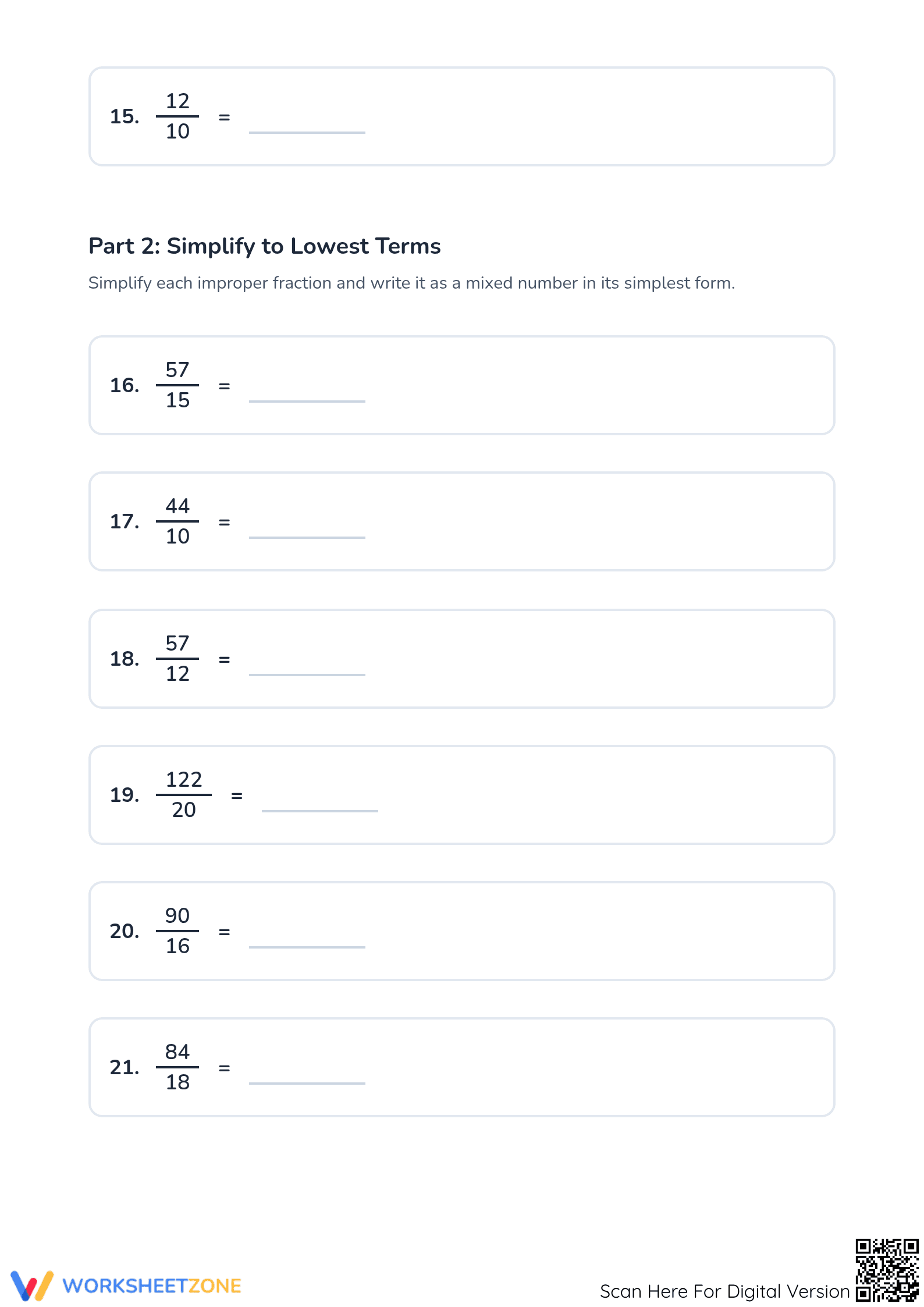
This rigorous math resource features 30 unique problems spread across five high-quality pages. The worksheet is divided into two parts, each focusing on simplifying improper fractions with increasing complexity, including double and triple-digit numerators. Clear instructions guide students to write each result as a mixed number in its lowest terms. A comprehensive answer key is provided for immediate feedback and grading efficiency.
Skill Progression
- Guided practice: The first six problems use smaller denominators to help students establish the conversion algorithm and identify common factors.
- Supported practice: Problems 7 through 15 introduce larger numerators, requiring students to apply division strategies with increased accuracy.
- Independent practice: The final fifteen problems feature the most challenging numerical pairs, demanding mastery of simplification and lowest-term conversion.
This approach aligns with the I Do, We Do, You Do framework for effective mathematical instruction.
Standards Alignment
The primary focus of this worksheet is `CCSS.MATH.CONTENT.4.NF.B.3`. This standard requires that students understand a fraction a/b with a > 1 as a sum of fractions 1/b and decompose a fraction into a sum of fractions with the same denominator in more than one way, recording each decomposition by an equation. Both standard codes can be copied directly into lesson plans, IEP goals, or district curriculum mapping tools.
How to Use It
Assign this worksheet during the independent practice phase of a lesson on equivalent fractions or mixed numbers to gauge individual student understanding. It also serves as an excellent formative assessment tool; teachers should observe whether students are correctly identifying the greatest common factor during the simplification process. Completion typically takes between thirty and forty-five minutes depending on the student's fluency.
Who It's For
This resource is specifically tailored for fourth through sixth-grade students who have already been introduced to the concept of fractions and basic division. It provides necessary scaffolding for struggling learners while offering a high-rigor option for advanced students who require additional challenge. It pairs naturally with a visual fraction wall or an anchor chart detailing the steps for converting improper fractions.
Rigorous mathematical practice is essential for long-term retention of fractional concepts. According to the NAEP (National Assessment of Educational Progress), students who demonstrate fluency in fraction decomposition and simplification are significantly more likely to succeed in middle school algebra. This worksheet provides the high-repetition, high-cognitive-load environment required to build this fluency. By engaging with 30 structured problems, students move beyond rote memorization toward a conceptual understanding of fractional value. Research from Fisher & Frey (2014) emphasizes that the gradual release of responsibility, as mirrored in this worksheet's structure, is vital for students to internalize complex mathematical procedures. This resource ensures that students not only perform the operation but also understand the underlying relationship between the numerator and denominator. It is an essential component for any curriculum aiming for CCSS alignment and mastery of numerical systems, specifically regarding CCSS.MATH.CONTENT.4.NF.B.3.


