


























Views
Downloads


Essential Improper Fractions Worksheet | Grade 4-5 Math
Paste this activity's link or code into your existing LMS (Google Classroom, Canvas, Teams, Schoology, Moodle, etc.).
Students can open and work on the activity right away, with no student login required.
You'll still be able to track student progress and results from your teacher account.
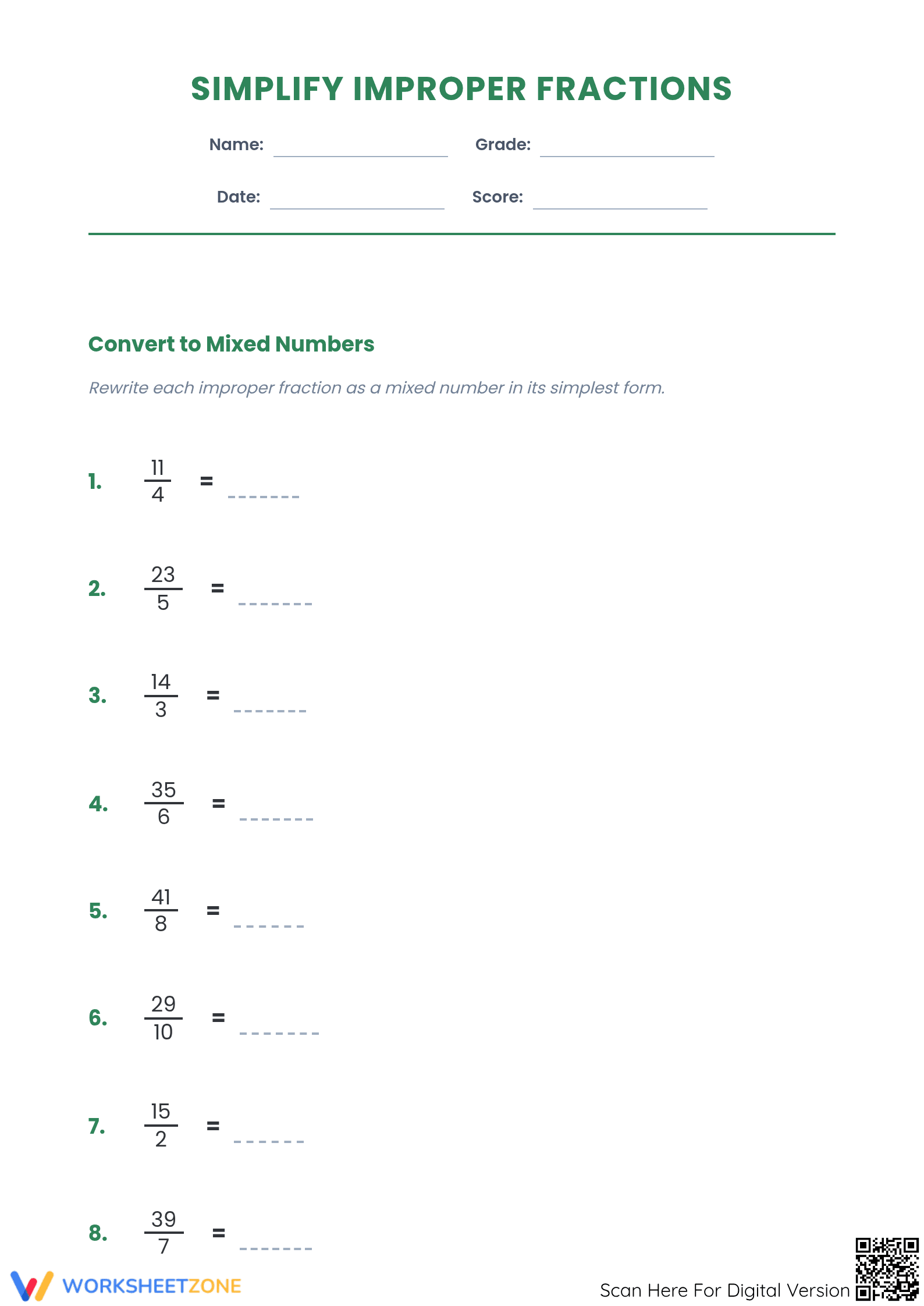
This essential Grade 4 and 5 math worksheet provides students with extensive practice in converting improper fractions to their simplest mixed number forms. By mastering this core computational skill, learners build the necessary numerical fluency to tackle more complex operations with rational numbers and algebraic expressions. This printable resource ensures students move beyond rote memorization toward procedural mastery.
At a Glance
- Grade: 4–5 · Subject: Math (Fractions)
- Standard:
CCSS.MATH.CONTENT.4.NF.A.1— Generate equivalent fractions to simplify improper numerical values into mixed numbers- Skill Focus: Improper fraction to mixed number conversion
- Format: 5 pages · 40 problems · Answer key included · PDF
- Best For: Independent practice and repetitive skill reinforcement
- Time: 25–40 minutes
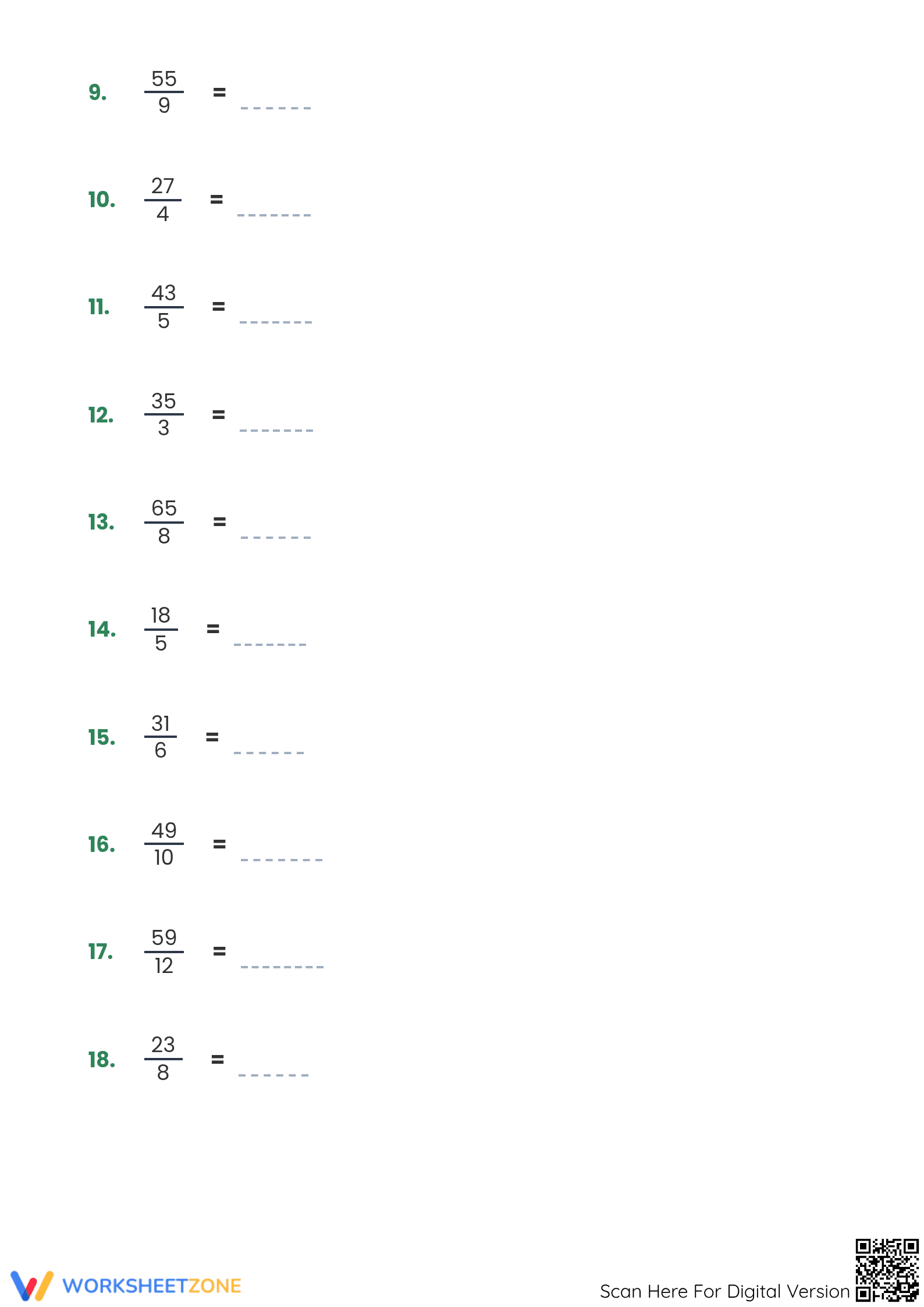
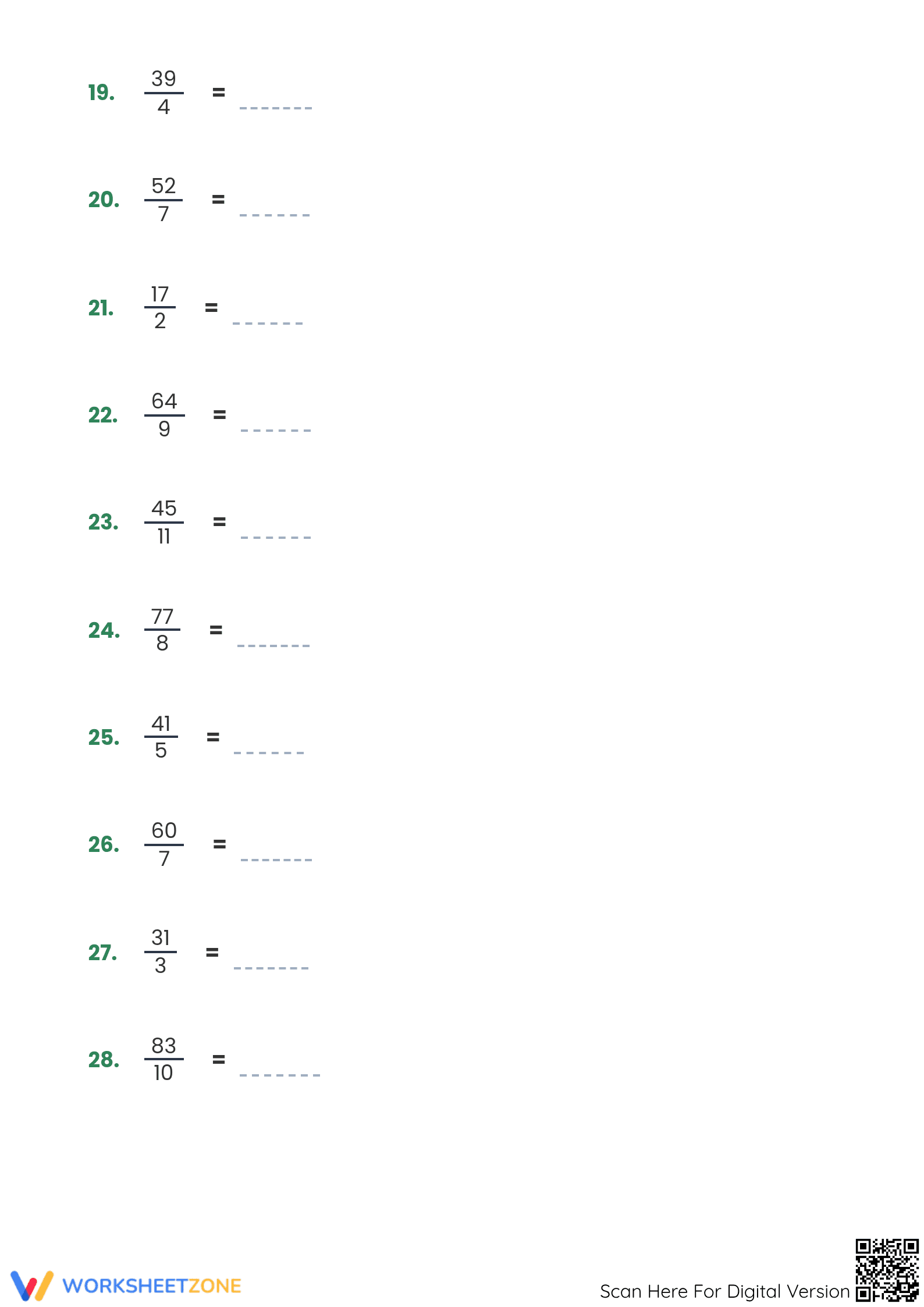
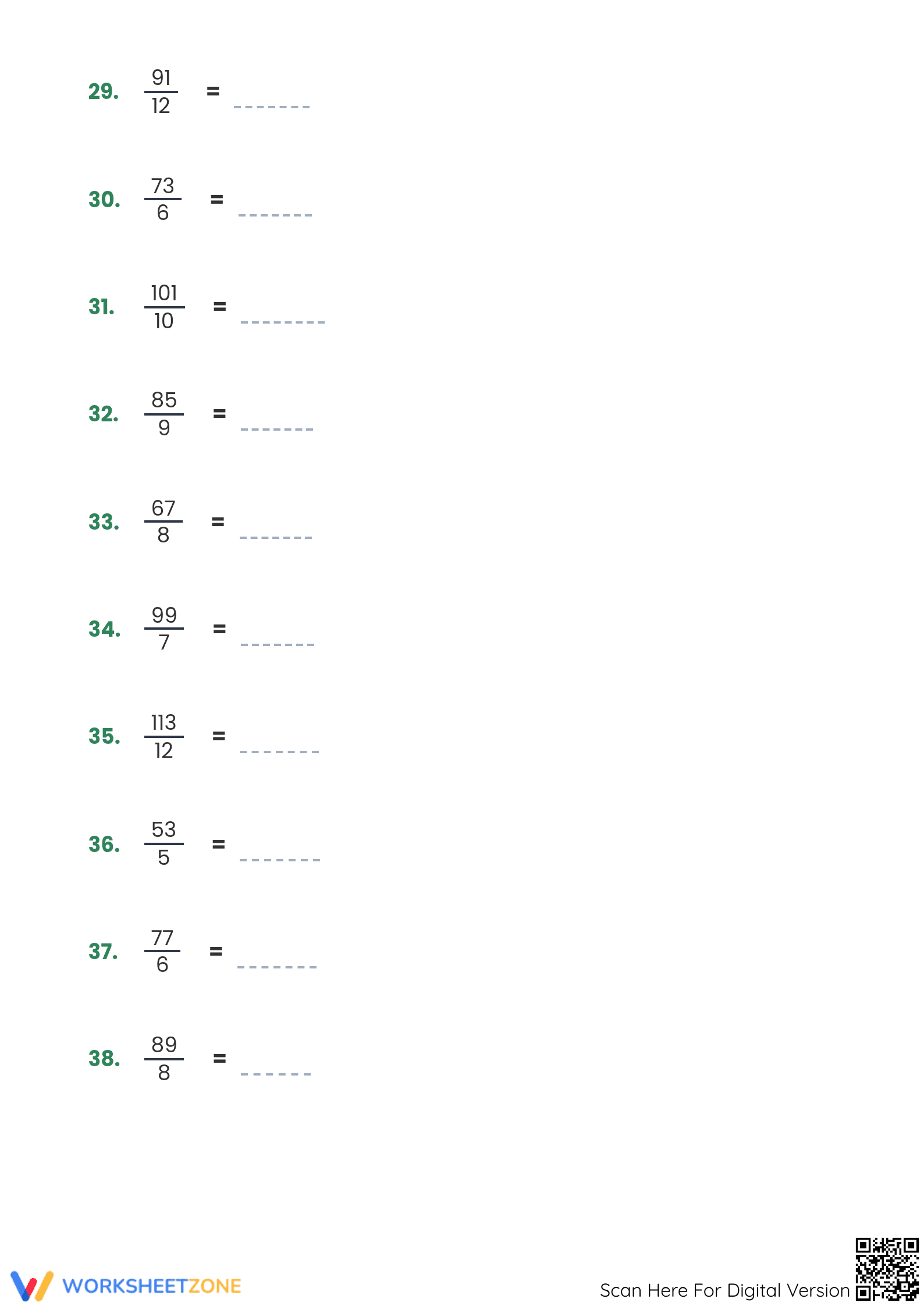
This comprehensive 5-page PDF contains 40 unique problems with clear vertical spacing for scratch work. Each page features a clean layout focused entirely on the conversion task. A full answer key is provided, showing final simplified mixed numbers, making it easy for teachers to provide feedback or for students to self-correct their work during independent study sessions.
Skill Progression
- Guided Practice: The first problems serve as a "we do" opportunity where teachers can model the division process using smaller denominators and manageable numerators.
- Supported Practice: Middle sections increase numerator complexity, requiring multi-step division and the identification of greatest common factors to reach simplest form.
- Independent Practice: The final 15 problems challenge students to apply their knowledge to larger numbers without scaffolds, ensuring they can perform conversions fluently under time constraints.
This "I Do, We Do, You Do" approach facilitates the gradual release of responsibility necessary for long-term retention of fraction concepts and numerical relationships.
Standards Alignment
This resource is directly aligned to CCSS.MATH.CONTENT.4.NF.A.1, requiring students to explain fraction equivalence. By converting improper fractions to mixed numbers, students apply their understanding of parts-to-whole relationships. This standard code can be copied directly into lesson plans, IEP goals, or curriculum mapping tools to document student progress toward grade-level mastery.
How to Use It
Utilize this worksheet as a high-volume drill during the independent phase of a lesson. For a formative assessment tip, observe students as they solve problems 10 through 20; if they struggle with remainders, provide a quick mini-lesson on interpretation. Expect most students to complete the full 40-problem set within 35 minutes of focused work.
Who It's For
This resource is designed for Grade 4 and 5 students who need to solidify their ability to interpret fractions as division. It is effective for Tier 2 intervention or students working toward computational fluency goals. This worksheet pairs naturally with a visual fraction wall or an anchor chart showing the division method for mixed numbers.
Mastering the conversion of improper fractions to mixed numbers is a critical gateway to advanced mathematical success. According to the RAND AIRS 2024 report on mathematical instructional materials, high-quality, focused practice sets are essential for developing the procedural automaticity required for higher-order problem-solving in middle school. The 40 problems provided here align with the Fisher & Frey (2014) framework for purposeful independent practice, which emphasizes that students must engage in sufficient volume to move skills into long-term memory. By targeting CCSS.MATH.CONTENT.4.NF.A.1, this worksheet ensures that students aren't just performing a mechanical task, but are reinforcing their understanding of numerical equivalence. Research indicates that when students can fluently manipulate fraction forms, their cognitive load is reduced during complex operations like adding unlike denominators. This resource provides the rigorous, standards-aligned practice necessary to bridge the gap between initial instruction and true computational mastery.


