


























Views
Downloads


Essential Improper Fractions Worksheet | Grade 4-5 Math
Paste this activity's link or code into your existing LMS (Google Classroom, Canvas, Teams, Schoology, Moodle, etc.).
Students can open and work on the activity right away, with no student login required.
You'll still be able to track student progress and results from your teacher account.
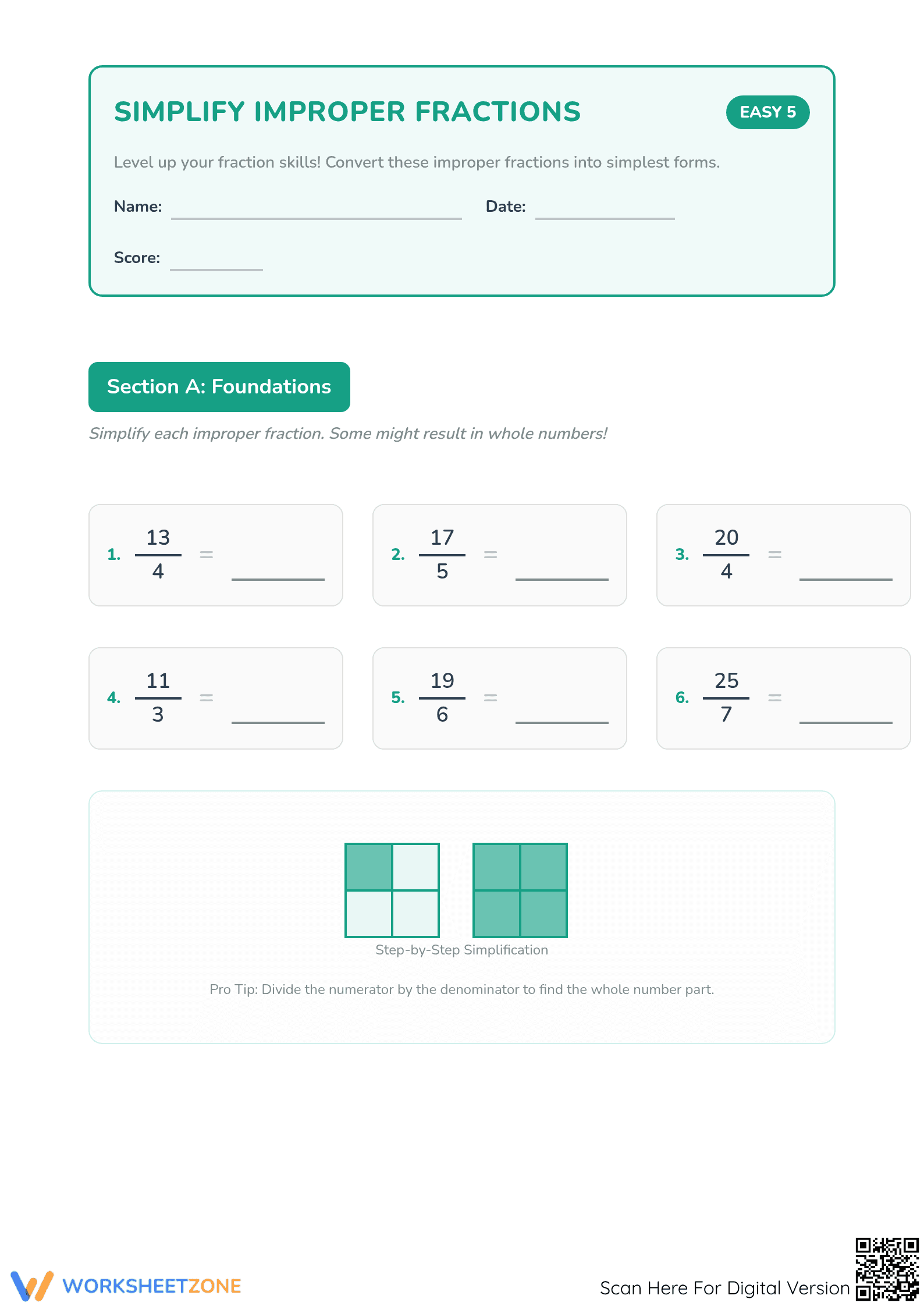
This comprehensive 3-page worksheet helps students master the conversion of improper fractions into their simplest forms, whether as mixed numbers or whole numbers. By providing 36 structured problems across four levels of difficulty, students build the confidence needed to handle complex fraction operations in later units. Download this printable math resource today.
At a Glance
- Grade: 4–5 · Subject: Math
- Standard:
CCSS.MATH.CONTENT.4.NF.B.3— Decompose fractions and convert between improper forms and mixed numbers- Skill Focus: Improper fraction simplification
- Format: 3 pages · 36 problems · Answer key included · PDF
- Best For: Independent practice or homework review
- Time: 20–35 minutes
What's Inside
This PDF packet contains three pages of focused fraction practice totaling 36 problems. The content is organized into four distinct tiers: Foundations, Intermediate, Consistency Challenge, and Expert Level. This progression allows students to start with basic single-digit conversions before moving to larger values. Each page includes clear visual cues and enough whitespace for students to show their calculation work. A full answer key is provided to ensure quick grading and immediate feedback.
Zero-Prep Workflow
The zero-prep workflow for this resource is designed for busy classrooms. Step 1: Print the three-page PDF packet (1 minute). Step 2: Distribute to students for independent work or as a rotational center activity (1 minute). Step 3: Use the included answer key for peer-grading or teacher review (5 minutes). Total preparation time is under two minutes.
Standards Alignment
This resource is primarily aligned to `CCSS.MATH.CONTENT.4.NF.B.3.C`, which requires students to add and subtract mixed numbers by replacing them with equivalent fractions. It also supports `CCSS.MATH.CONTENT.5.NF.B.3` by interpreting a fraction as division. Both standard codes can be copied directly into lesson plans, IEP goals, or district curriculum mapping tools.
How to Use It
Use this worksheet during the 'You Do' phase of a gradual release lesson to assess individual mastery of fraction conversions. Alternatively, assign specific sections for homework to reinforce classroom learning. Teachers should observe students at Section C to identify those struggling with denominator consistency, which is a common hurdle in fraction operations. Estimated completion time is 30 minutes.
Who It's For
This resource is ideal for Grade 4 and Grade 5 students who are transitioning from basic fraction identification to operational fluency. It provides excellent differentiation for Grade 6 students who need a remedial review. Pair this worksheet with a visual fraction wall or circular fraction tiles to support students who require a concrete representational bridge.
According to EdReports (2024), high-quality instructional materials must prioritize the major work of the grade, which for fourth and fifth grade includes the mastery of fractions as numbers. This worksheet aligns with those evidence-based practices by providing systematic, repetitive practice in converting improper fractions to mixed numbers or whole numbers. By isolating the conversion skill from more complex operations, students build the procedural fluency required for higher-level algebra and proportional reasoning. The scaffolded sections—ranging from foundations to expert level—ensure that students develop a conceptual understanding of the relationship between division and fractions. Research indicates that students who master these foundational conversions early are significantly more likely to succeed in middle school mathematics involving ratios and complex rates. This resource serves as an essential tool for teachers seeking to bridge the gap between initial fraction introduction and advanced operational proficiency in the modern mathematics classroom environment.


