


























Views
Downloads


Essential Simplify Improper Fractions Worksheet | Grade 4
Paste this activity's link or code into your existing LMS (Google Classroom, Canvas, Teams, Schoology, Moodle, etc.).
Students can open and work on the activity right away, with no student login required.
You'll still be able to track student progress and results from your teacher account.
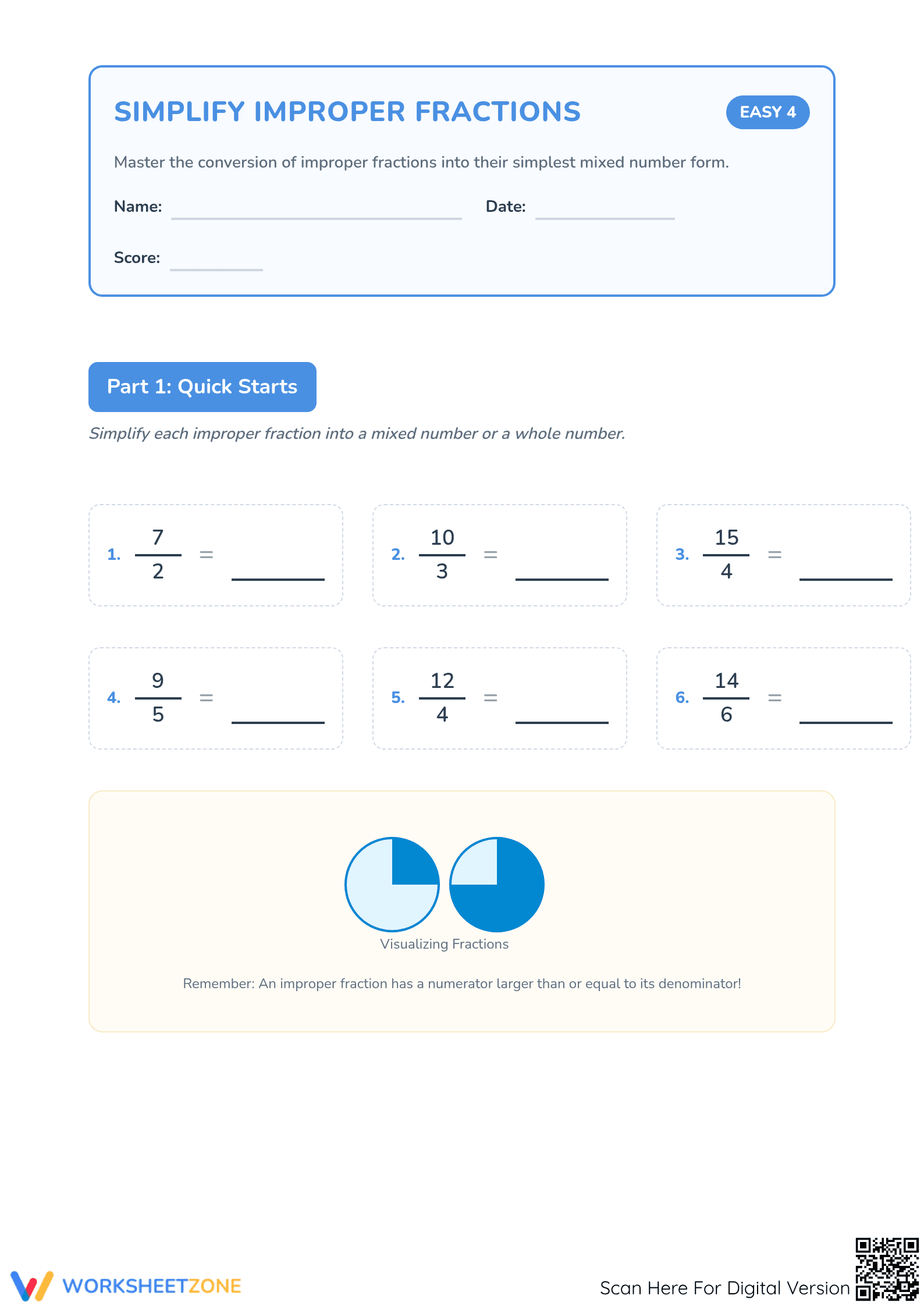
This printable Grade 4 math worksheet provides comprehensive practice for students mastering the conversion of improper fractions into their simplest mixed number or whole number forms. By systematically working through varied difficulty levels, learners develop the essential conceptual understanding and procedural fluency required for advanced fractional operations and real-world mathematical problem-solving.
At a Glance
- Grade: 4 · Subject: Math
- Standard:
CCSS.MATH.CONTENT.4.NF.B.3— Understand a fraction a/b with a > 1 as a sum of fractions 1/b- Skill Focus: Improper fraction simplification
- Format: 3 pages · 36 problems · Answer key included · PDF
- Best For: Independent practice and fluency building
- Time: 25–40 minutes
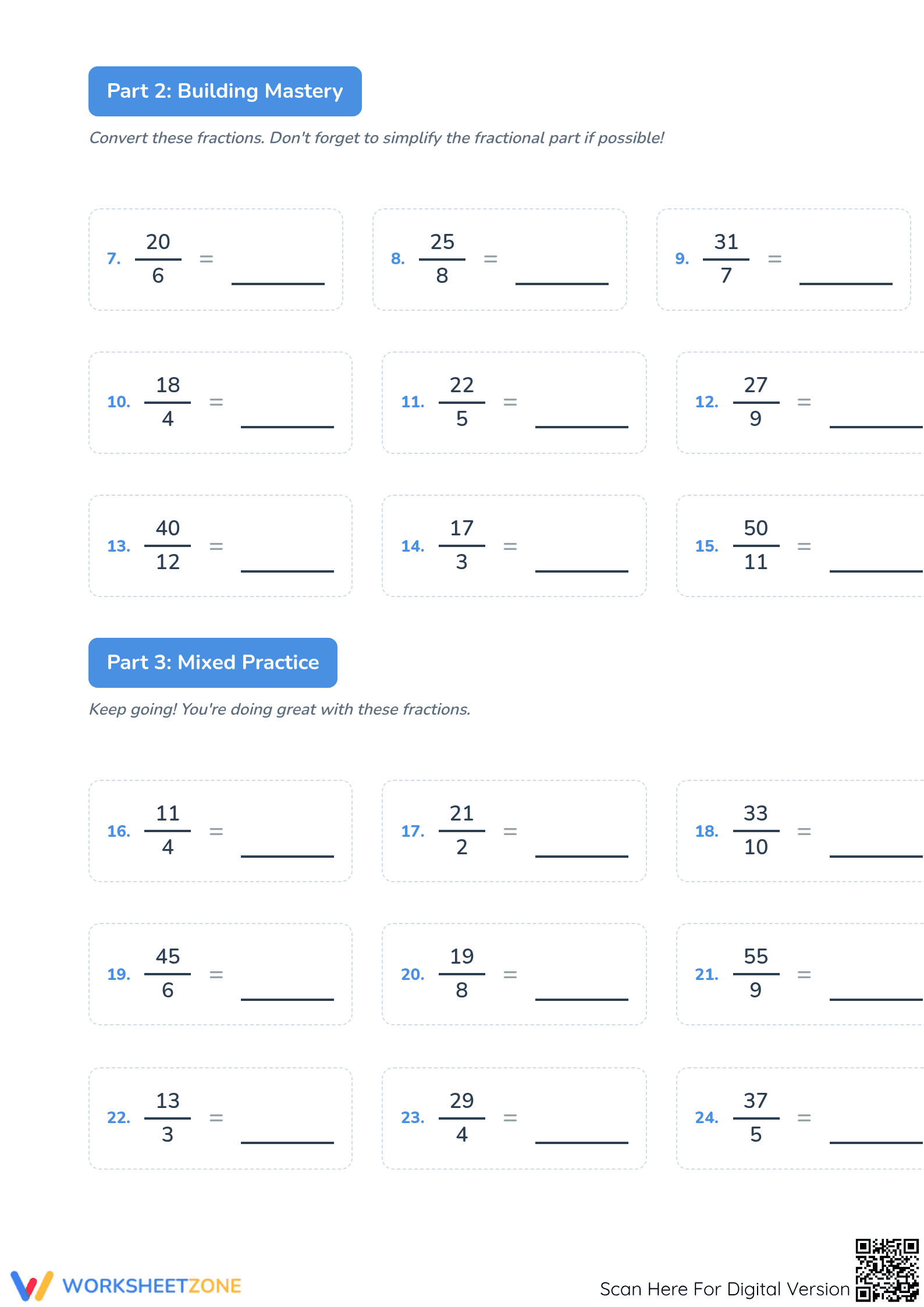
The resource is a three-page PDF containing 36 targeted practice problems divided into four progressive sections. It begins with "Quick Starts" featuring simple fractions, moves through "Building Mastery" with increasing complexity, and concludes with a "Challenge Round" involving triple-digit numerators. A visualization guide and a conceptual reminder are included to support visual learners.
Skill Progression
- Guided practice: The first 6 problems utilize simple, familiar values to establish the basic conversion algorithm and build initial student confidence.
- Supported practice: The middle 18 problems introduce slightly larger values, requiring students to apply their division skills while maintaining accuracy in fractional remainders.
- Independent practice: The final 12 challenge problems present larger numbers up to 100, testing mastery and ensuring students can generalize the skill to complex contexts.
This sequence moves learners from "I Do" through "We Do" to a confident "You Do" state.
Standards Alignment
The primary alignment is CCSS.MATH.CONTENT.4.NF.B.3, focusing on the relationship between improper fractions and mixed numbers. This resource also supports 5.NF.A.1 by providing the prerequisite fluency needed for adding and subtracting fractions with unlike denominators. Both standard codes can be copied directly into lesson plans, IEP goals, or district curriculum mapping tools.
How to Use It
This worksheet is ideal for use after direct instruction on the relationship between division and fractions. Teachers can assign the "Quick Starts" as a "do now" activity, followed by the "Building Mastery" section for collaborative group work. During the "Challenge Round," observe students to identify those who have transitioned to mental division. Expect completion in 30 minutes.
Who It's For
Designed for 4th-grade students, this resource is also highly effective for 5th and 6th-grade learners who require remedial support. It pairs naturally with visual aids like fraction circles, providing a bridge between concrete manipulatives and abstract numerical representation. It serves as an excellent independent station activity or a reliable substitute teacher plan.
Effective fraction instruction requires a balance of conceptual understanding and procedural fluency. According to Fisher & Frey (2014), the gradual release of responsibility—moving from highly scaffolded tasks to independent application—is critical for mastering abstract mathematical concepts like improper fraction simplification. This 36-problem worksheet implements this research-backed framework by partitioning practice into four distinct phases of increasing cognitive demand. By starting with single-digit "Quick Starts" and progressing to triple-digit "Challenge" problems, the resource ensures that Grade 4 students (aligned to CCSS.MATH.CONTENT.4.NF.B.3) internalize the division-based logic of conversion rather than merely memorizing a set of steps. NAEP data consistently shows that a strong grasp of fractional relationships in the middle grades is one of the single best predictors of success in high school algebra. This printable guide provides the high-volume, structured practice necessary to secure that foundation for every learner.


