


























Views
Downloads
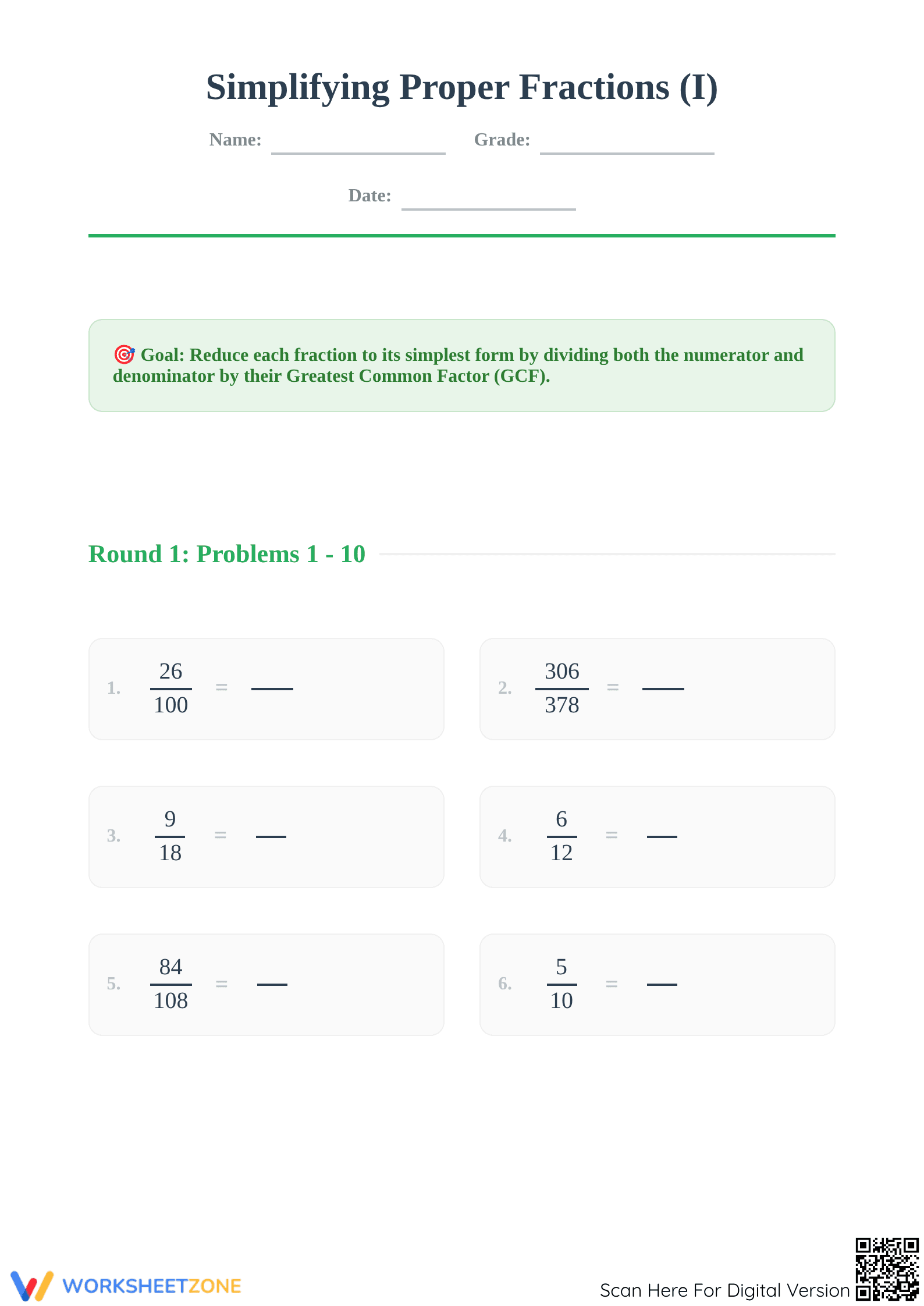
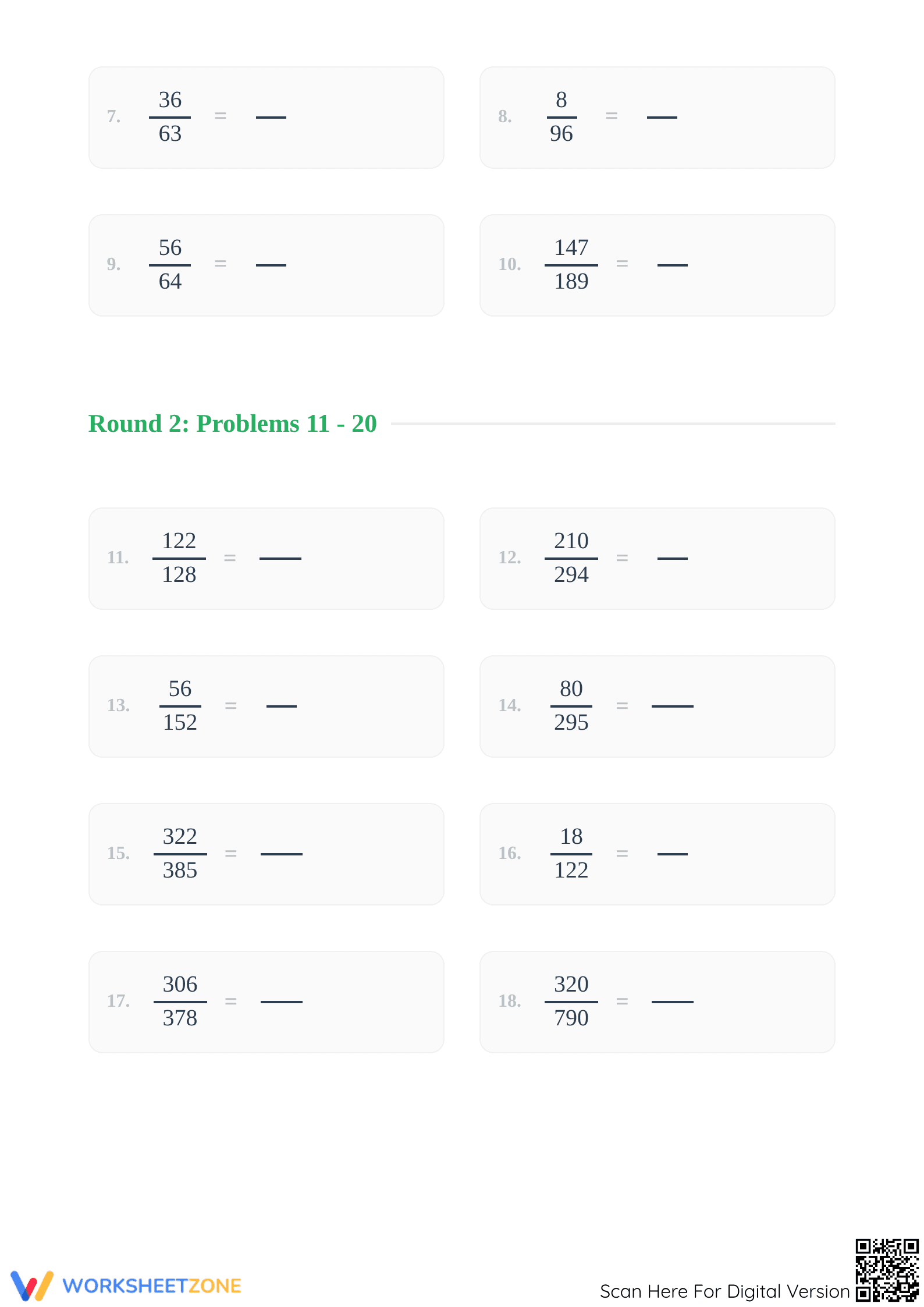




Printable Simplifying Fractions Hard Worksheet | Grade 4-6
Paste this activity's link or code into your existing LMS (Google Classroom, Canvas, Teams, Schoology, Moodle, etc.).
Students can open and work on the activity right away, with no student login required.
You'll still be able to track student progress and results from your teacher account.
Simplifying fractions streamlines complex mathematical operations and builds essential number sense. This rigorous 5-page worksheet provides extensive practice in reducing proper fractions to their simplest form using the Greatest Common Factor (GCF). By mastering these 40 challenging problems, learners develop the fluency needed for advanced algebra and ratio work.
At a Glance
- Grade: 4–6 · Subject: Math
- Standard:
CCSS.MATH.CONTENT.4.NF.A.1— Generate equivalent fractions by using the principle of dividing numerator and denominator by common factors.- Skill Focus: Simplifying proper fractions using Greatest Common Factor (GCF)
- Format: 5 pages · 40 problems · Answer key included · PDF
- Best For: Intensive skill reinforcement and fluency building
- Time: 30–45 minutes
This comprehensive resource contains 40 unique fraction simplification problems divided into four distinct rounds to maintain student engagement. Each page features a clean, distraction-free layout with designated workspace for calculations. The worksheet concludes with a critical-thinking bonus challenge that asks students to reflect on the complexity of simplification. A complete 5-page answer key is provided for efficient grading or student self-correction.
Skill Progression
- Guided practice: The initial ten problems feature common denominators and clear GCF paths to establish the core procedure of division.
- Supported practice: Rounds two and three introduce larger numerators and three-digit denominators, requiring more robust mental math and factor identification.
- Independent practice: The final set of ten problems and the reflective bonus challenge push students toward mastery by presenting fractions with less obvious common factors.
This gradual-release approach ensures students internalize the multiplicative relationship between factors and equivalent values.
Standards Alignment
This worksheet is directly aligned to `CCSS.MATH.CONTENT.4.NF.A.1`, which requires students to explain why a fraction is equivalent to another by using common factors and to recognize and generate equivalent fractions. Furthermore, it supports Grade 5 and 6 fluency requirements for operating with fractions and understanding ratios. This standard code can be copied directly into lesson plans, IEP goals, or district curriculum mapping tools.
How to Use It
Deploy this resource as a high-volume practice set after an introductory lesson on the Greatest Common Factor. It is also an excellent tool for a station rotation where students work independently on one round before moving to a collaborative task. During instruction, observe if students are consistently finding the greatest common factor or if they are simplifying in multiple steps to gauge multiplication fluency. Expected completion time is 35 minutes.
Who It's For
This worksheet is designed for Grade 4, 5, and 6 students who have a working knowledge of multiplication facts but need to solidify their fraction reduction skills. It provides necessary rigor for advanced learners while offering a repetitive structure that benefits students requiring extra intervention. Pair this with a GCF anchor chart or a multiplication table for students who need additional scaffolding.
Mathematical proficiency in fractions is a significant predictor of later success in algebra and higher-level STEM courses. According to research from EdReports (2024), materials that focus on the procedural fluency of generating equivalent fractions through division are critical for bridging the gap between elementary arithmetic and middle school ratios. This resource addresses the CCSS.MATH.CONTENT.4.NF.A.1 standard by requiring students to perform repeated, high-quality practice in simplifying proper fractions. By identifying the Greatest Common Factor (GCF) and applying it to forty distinct problems, students internalize the underlying multiplicative identity property. The inclusion of a reflective bonus challenge further aligns with modern pedagogical standards for depth of knowledge, as highlighted in the RAND AIRS 2024 report on curriculum efficacy. Teachers can utilize this structured 5-page packet to ensure that students transition from conceptual understanding to the automaticity required for complex problem-solving in the modern classroom.


