


























Views
Downloads

Printable Simplifying Fractions Worksheet | Grade 4-6 Math
Paste this activity's link or code into your existing LMS (Google Classroom, Canvas, Teams, Schoology, Moodle, etc.).
Students can open and work on the activity right away, with no student login required.
You'll still be able to track student progress and results from your teacher account.
This fraction simplification resource provides a comprehensive pathway for students to master the art of reducing fractions to their simplest terms. By bridging the gap between visual representation and abstract division using Greatest Common Factors (GCF), learners develop a deep conceptual understanding. Students will confidently transform complex values into manageable figures, improving their overall mathematical fluency.
At a Glance
- Grade: 4–6 · Subject: Math · Fractions
- Standard:
CCSS.MATH.CONTENT.4.NF.A.1— Recognize and generate equivalent fractions using visual models and numerical principles.- Skill Focus: Simplifying fractions to simplest form
- Format: 5 pages · 33 problems · Answer key included · PDF
- Best For: Fraction equivalence practice and skill reinforcement
- Time: 30–45 minutes
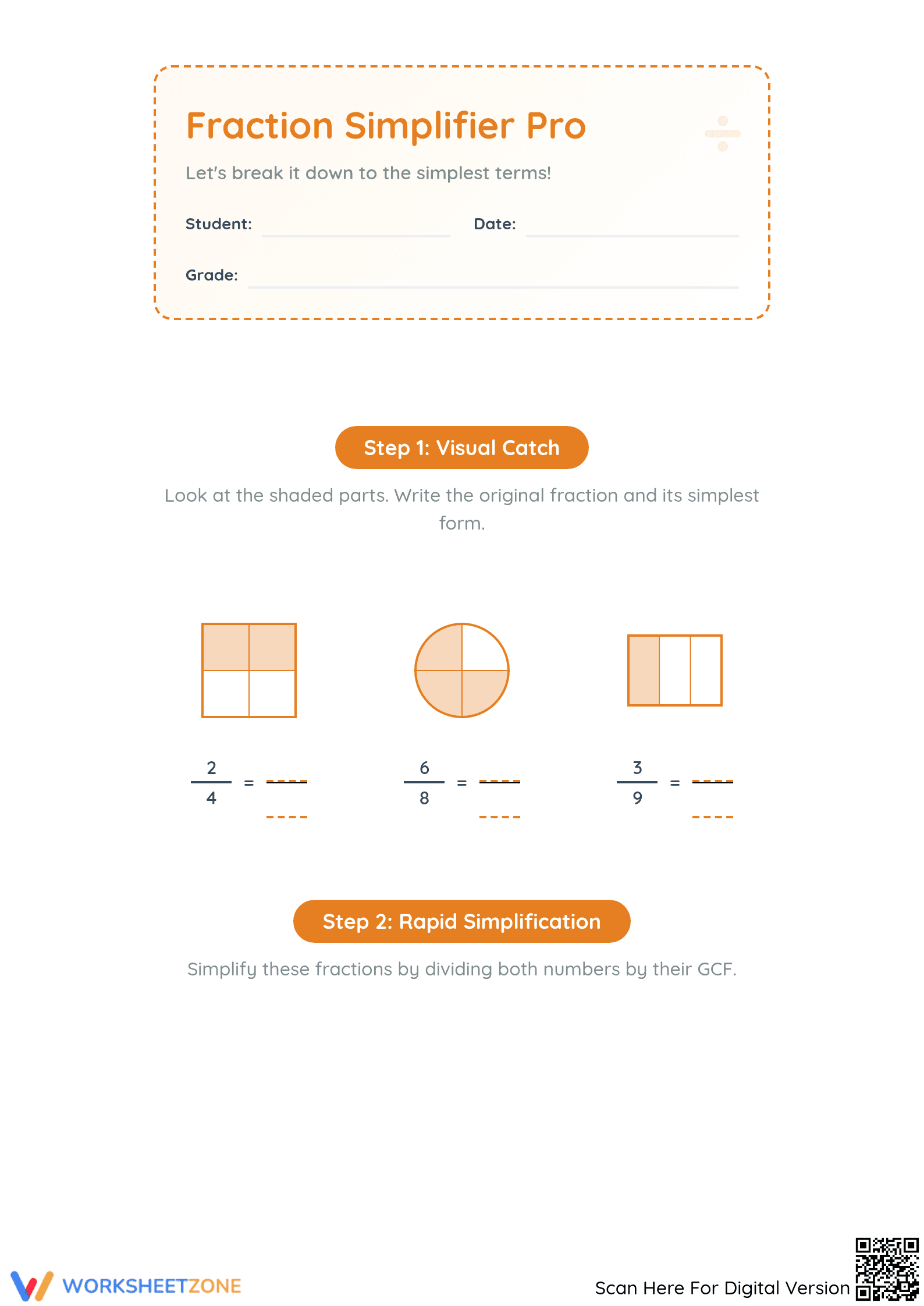
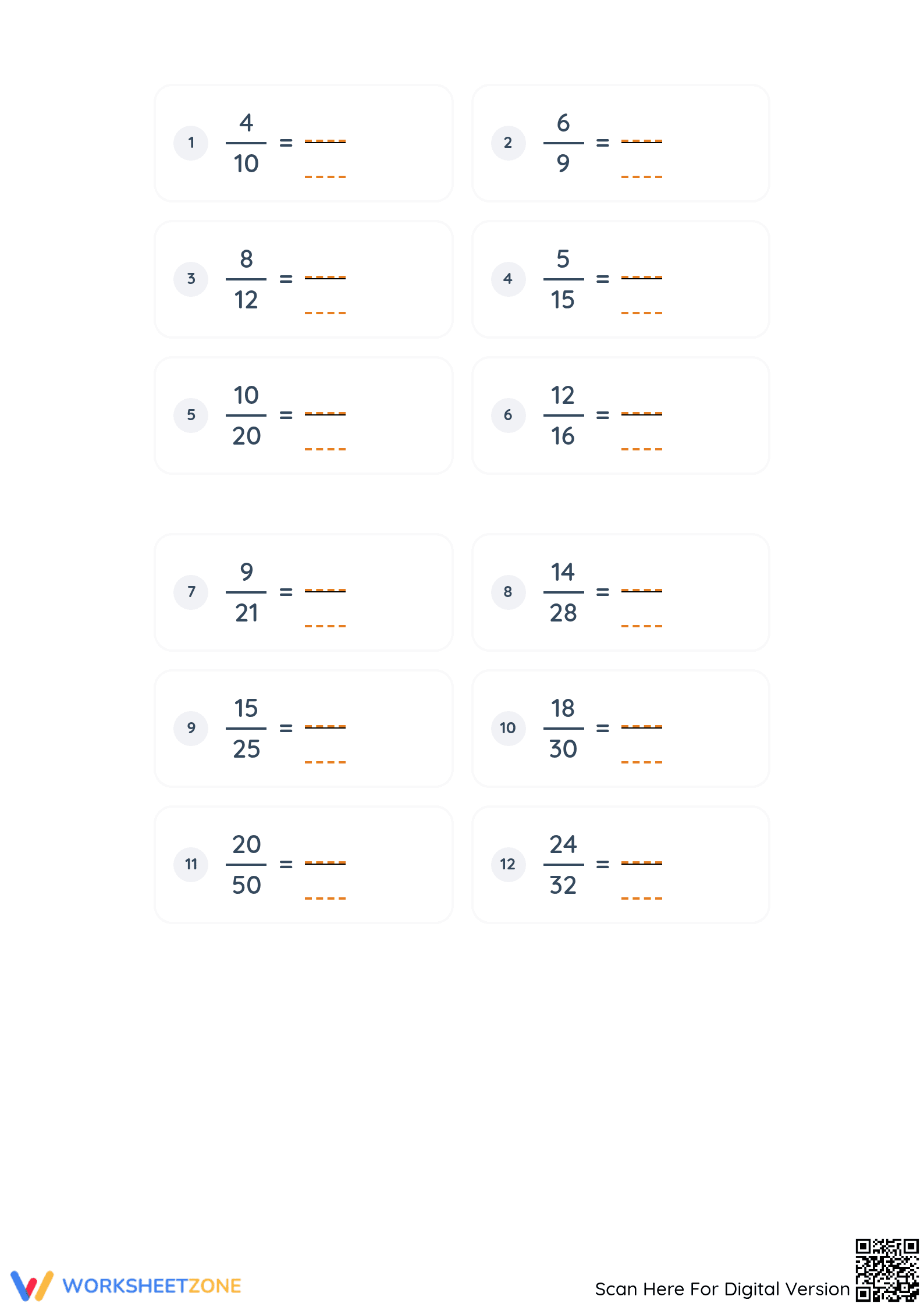
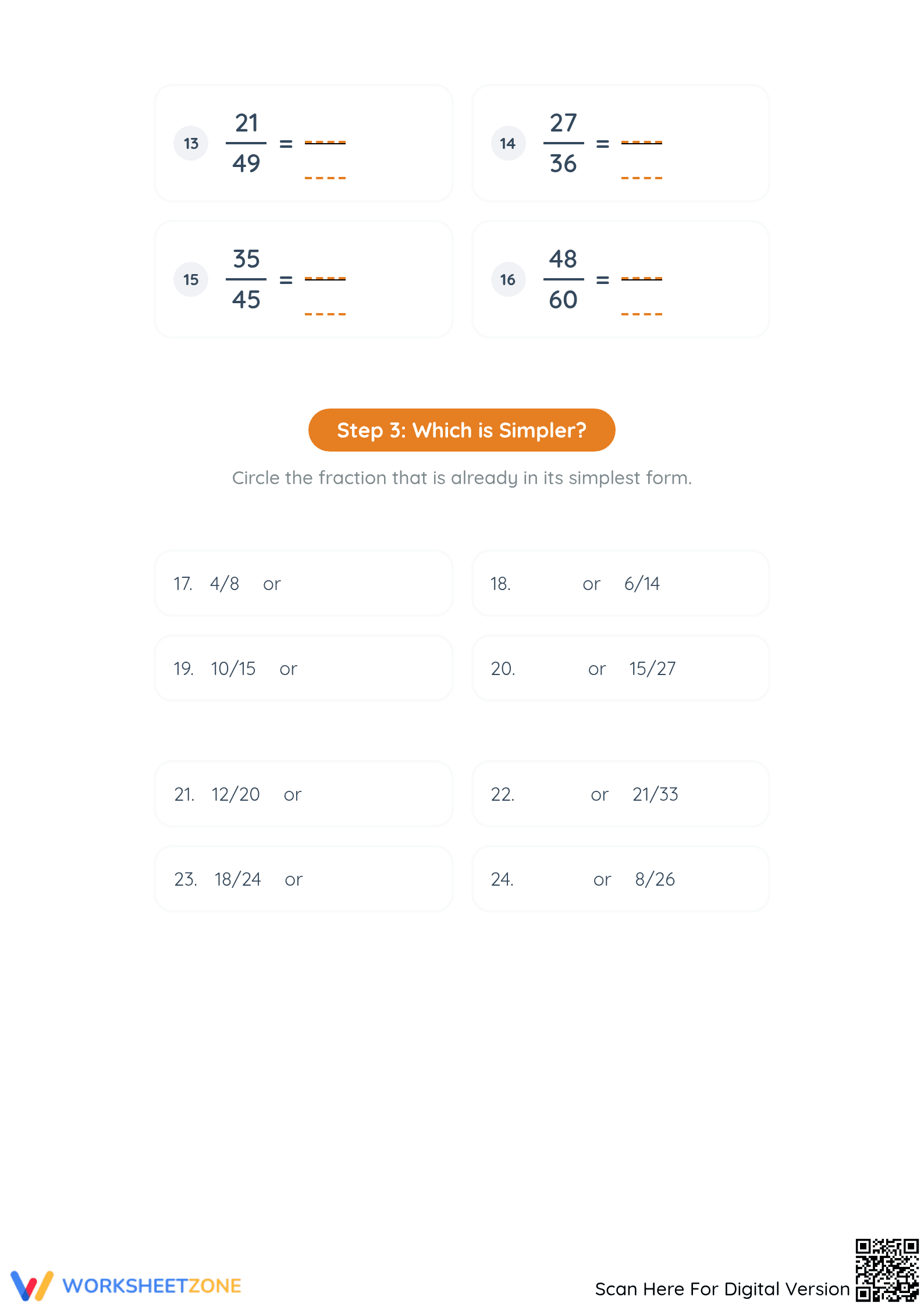
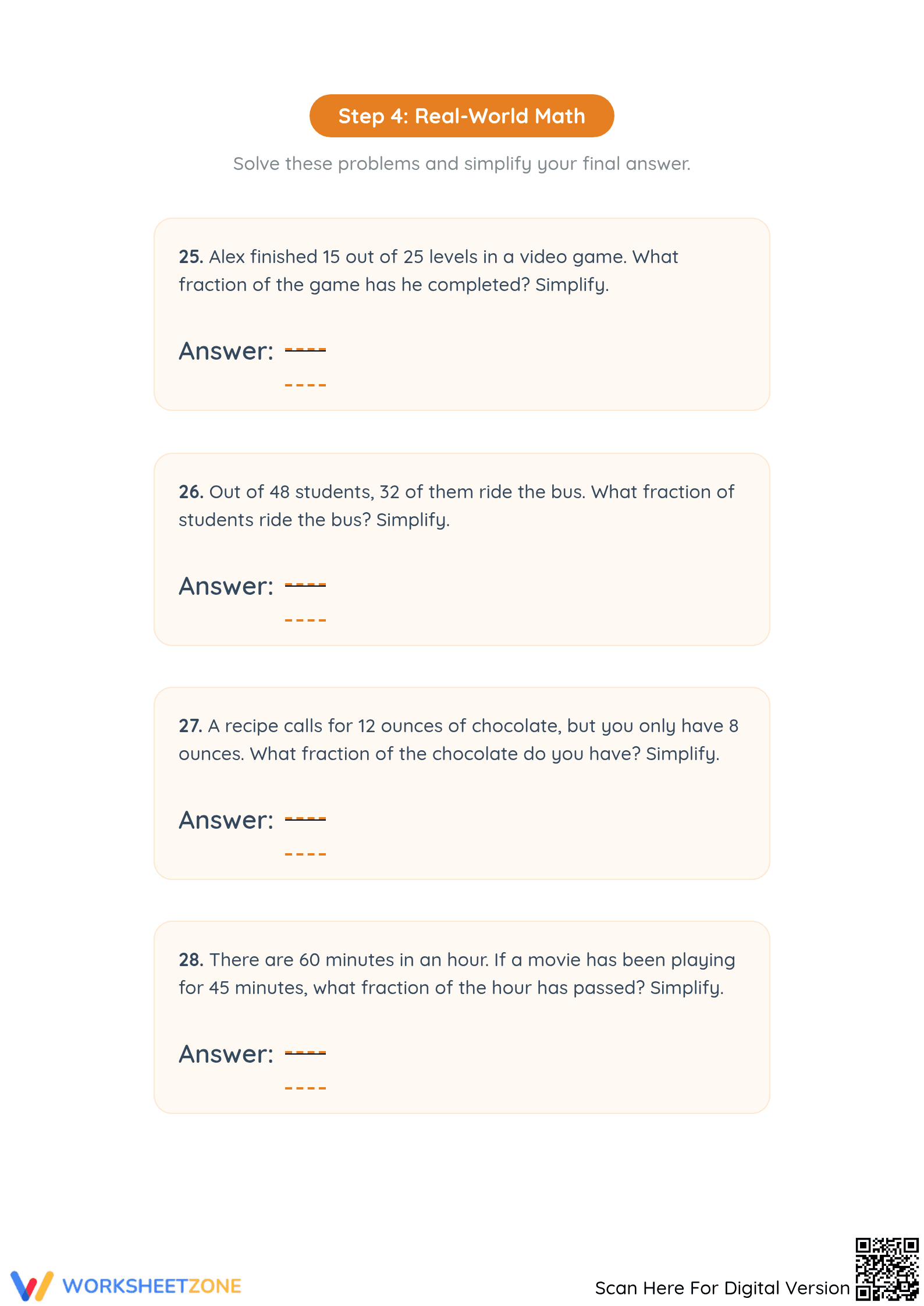
This five-page PDF collection features 33 distinct problems organized into a four-step instructional sequence. The layout includes clear section headers, dedicated workspace for student calculations, and a clean professional aesthetic. The inclusion of a full answer key ensures immediate feedback for learners and reduced grading time for educators. Structured prompts guide students from visual identification to real-world application.
Skill Progression
- Guided Practice (Conceptual): 3 visual models allow students to see fraction equivalence before calculating, anchoring the abstract concept in shaded geometry.
- Supported Practice (Algorithmic): 24 numerical problems prompt students to use the Greatest Common Factor (GCF) method, building speed and accuracy through repetition.
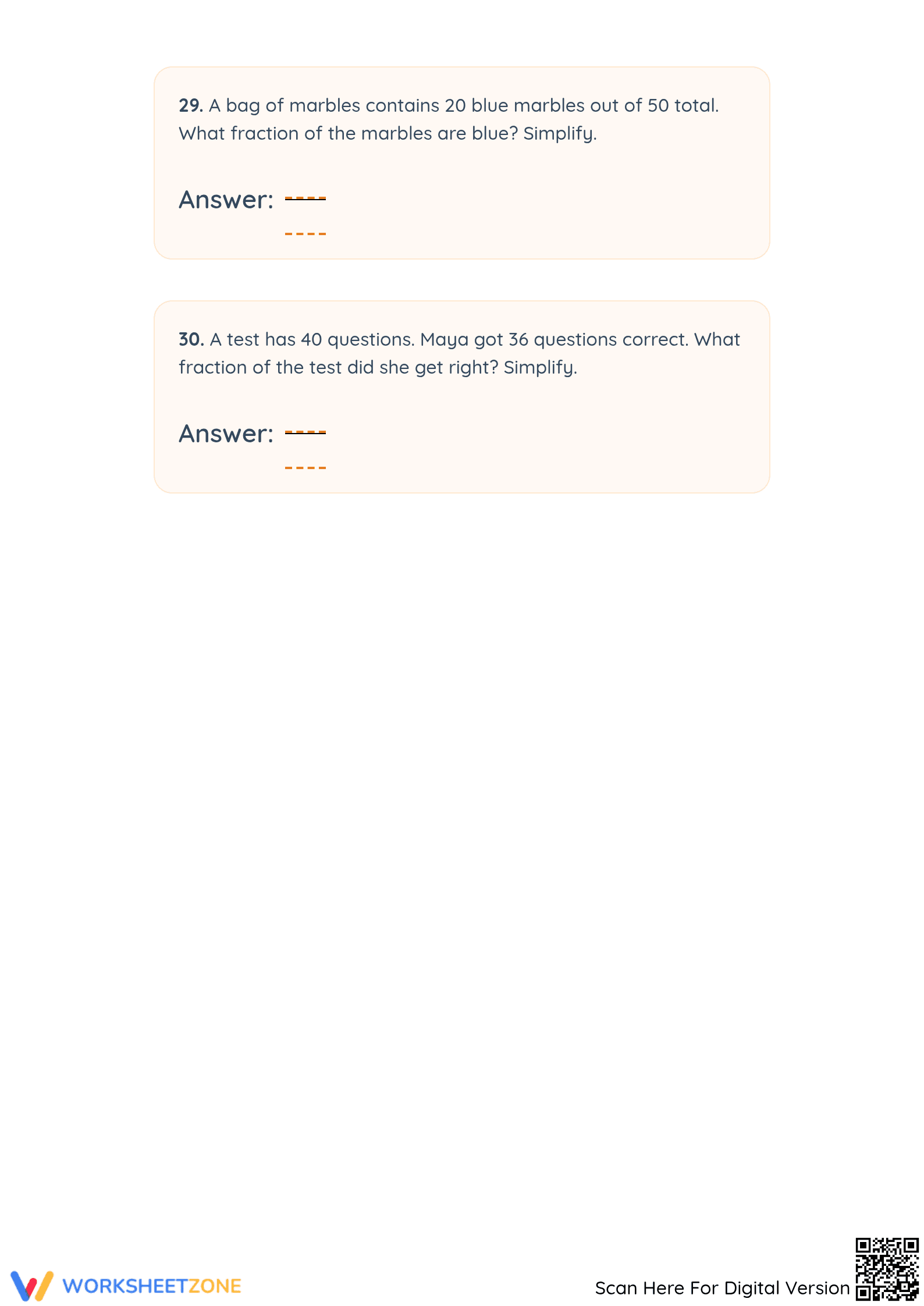
- Independent Practice (Applied): 6 real-world word problems challenge students to extract data from scenarios and simplify their final answers in context.
This sequence follows a gradual-release model, transitioning students from heavy scaffolding to autonomous problem-solving.
Standards Alignment
Aligned to CCSS.MATH.CONTENT.4.NF.A.1, which requires students to explain fraction equivalence using visual models and generate equivalent fractions. The worksheet also supports foundational skills for CCSS.MATH.CONTENT.5.NF.A.1 regarding addition and subtraction of fractions with unlike denominators. Both standard codes can be copied directly into lesson plans, IEP goals, or district curriculum mapping tools.
How to Use It
Use this worksheet as a mid-unit assessment to check for understanding after introducing the concept of GCF. During direct instruction, project the "Visual Catch" section on a whiteboard to model the physical "shrinking" of parts while maintaining total value. Observe students during Step 2 to identify those struggling with division facts, as this often indicates a need for multiplication chart support.
Who It's For
This resource is designed for Grade 4 and 5 general education classrooms, but it is also highly effective for Grade 6 intervention groups. The clear formatting supports students with executive functioning challenges, while the word problems provide necessary rigor for advanced learners. Pair this with a fraction tile set or an interactive digital whiteboard for a multi-sensory learning experience.
According to the RAND AIRS 2024 report, early proficiency in fraction equivalence is a primary predictor of success in middle school algebra and proportional reasoning. This worksheet directly addresses the "bottleneck" many students face when transitioning from whole numbers to rational number operations. By integrating the CCSS.MATH.CONTENT.4.NF.A.1 standard through a multi-modal approach—incorporating visual models, algorithmic GCF division, and contextual word problems—this resource ensures that students do not just memorize a procedure but internalize the logic of simplification. Research suggests that the gradual release of responsibility, as seen in the transition from shaded circles to abstract numerical reduction, significantly reduces cognitive load during the acquisition of new mathematical skills. Educators can utilize these 33 tasks to establish a robust evidence base for student mastery, facilitating data-driven instruction and targeted remediation strategies in any upper elementary mathematics curriculum.


