


























Views
Downloads

Essential Simple Predicate Worksheet | Grade 1-2 ELA
Paste this activity's link or code into your existing LMS (Google Classroom, Canvas, Teams, Schoology, Moodle, etc.).
Students can open and work on the activity right away, with no student login required.
You'll still be able to track student progress and results from your teacher account.
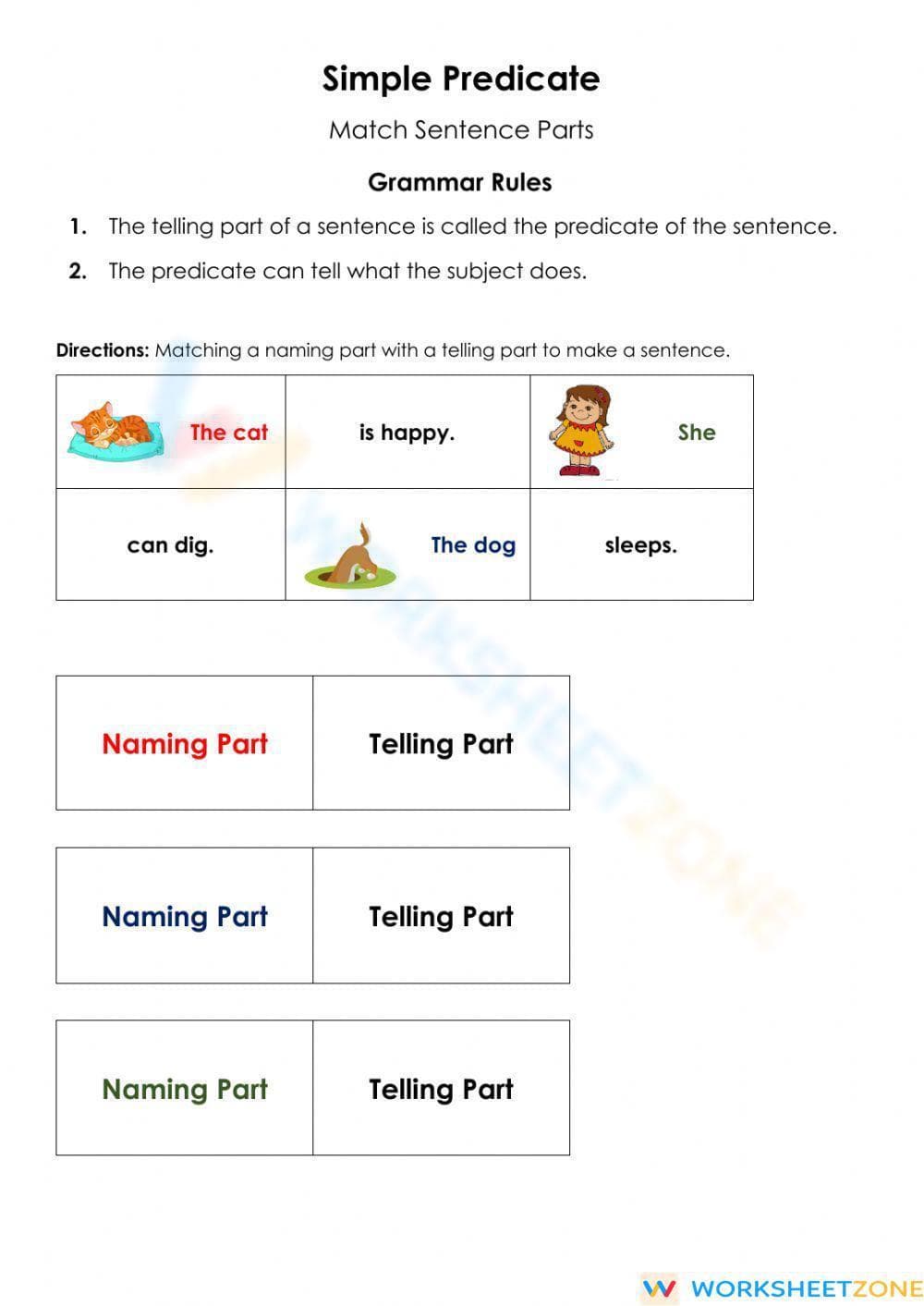
This simple predicate worksheet helps early elementary students master the fundamental "telling part" of a sentence through a structured matching activity. By connecting naming parts to telling parts, learners reinforce their understanding of sentence structure and verb usage. This resource ensures students can identify and construct complete thoughts with accuracy and confidence in their daily writing.
At a Glance
- Grade: 1-2 · Subject: English Language Arts
- Standard:
CCSS.ELA-LITERACY.L.1.1— Identify the telling part of a sentence to create complete thoughts.- Skill Focus: Identifying Simple Predicates
- Format: 1 page · 3 matching tasks · Answer key included · PDF
- Best For: Independent grammar practice and centers
- Time: 10–15 minutes
This one-page resource features a clear "Grammar Rules" section that defines the predicate as the telling part of a sentence. The worksheet includes three illustrated examples to model the matching process (e.g., "The cat" paired with "is happy"). Students are then challenged to complete three original matching tasks by pairing naming parts with appropriate telling parts. The clean layout and visual cues support emerging readers in recognizing how subjects and predicates function together.
Teachers can implement this resource in under two minutes with a simple three-step workflow. First, print the single-page PDF for your class or small group. Second, distribute the worksheets during your grammar block or as a transition activity; the built-in rule box allows students to begin immediately without lengthy verbal instructions. Finally, review the completed sentences as a whole group or use the included answer key for quick formative assessment. This efficient design makes it an ideal addition to emergency sub plans.
The primary focus of this activity is `CCSS.ELA-LITERACY.L.1.1`, which requires students to demonstrate a command of the conventions of standard English grammar and usage. By specifically targeting the relationship between the naming part (subject) and the telling part (predicate), the worksheet helps students produce complete sentences. This standard code can be copied directly into lesson plans, IEP goals, or district curriculum mapping tools to track student progress in foundational syntax.
This worksheet is most effective as a follow-up to direct instruction on sentence parts or during a literacy station rotation. For a formative assessment tip, observe students as they read their completed sentences aloud to ensure the subject and predicate create a logical thought. It also functions well as a morning work assignment or a "quick-check" exit ticket to verify student understanding before moving on to more complex sentence expansion exercises.
This resource is designed for Grade 1 and Grade 2 students who are beginning to move beyond simple word recognition to sentence-level construction. The inclusion of sentence frames and visual aids makes it particularly helpful for English Language Learners (ELLs) and students requiring additional scaffolding in literacy. It pairs naturally with a mentor text read-aloud where students can identify predicates in context to see how professional authors describe action.
Effective grammar instruction in early grades relies on explicit teaching of sentence components. The RAND AIRS 2024 report on literacy foundations highlights that structured opportunities to manipulate sentence parts, like matching naming to telling parts, significantly improves narrative construction. This worksheet targets CCSS.ELA-LITERACY.L.1.1 by isolating the simple predicate, allowing learners to focus on the functional role of verbs and adjectives. These 3 tasks reinforce the "telling part" concept, providing a scaffolded pathway to mastery aligned with evidence-based practices. This printable resource offers a high-utility method for assessing whether Grade 1 and Grade 2 students can identify core English sentence structure elements.


