




























Views
Downloads




Essential Simple Addition Word Problems | Grade 3 Math

Paste this activity's link or code into your existing LMS (Google Classroom, Canvas, Teams, Schoology, Moodle, etc.).
Students can open and work on the activity right away, with no student login required.
You'll still be able to track student progress and results from your teacher account.
Master addition fluency through real-world scenarios designed for third-grade learners. This worksheet provides structured practice in translating text into mathematical equations, ensuring students develop the critical thinking skills needed for multi-step operations. By solving these 14 focused word problems, students solidify their understanding of additive relationships and improve their computational accuracy.
At a Glance
- Grade: Grade 3 · Subject: Math
- Standard:
3.NBT.A.2— Fluently add and subtract within 1000 using strategies and algorithms- Skill Focus: Addition Word Problems
- Format: 5 pages · 14 problems · Answer key included · PDF
- Best For: Morning work, homework, or formative assessment
- Time: 20–30 minutes
What's Inside
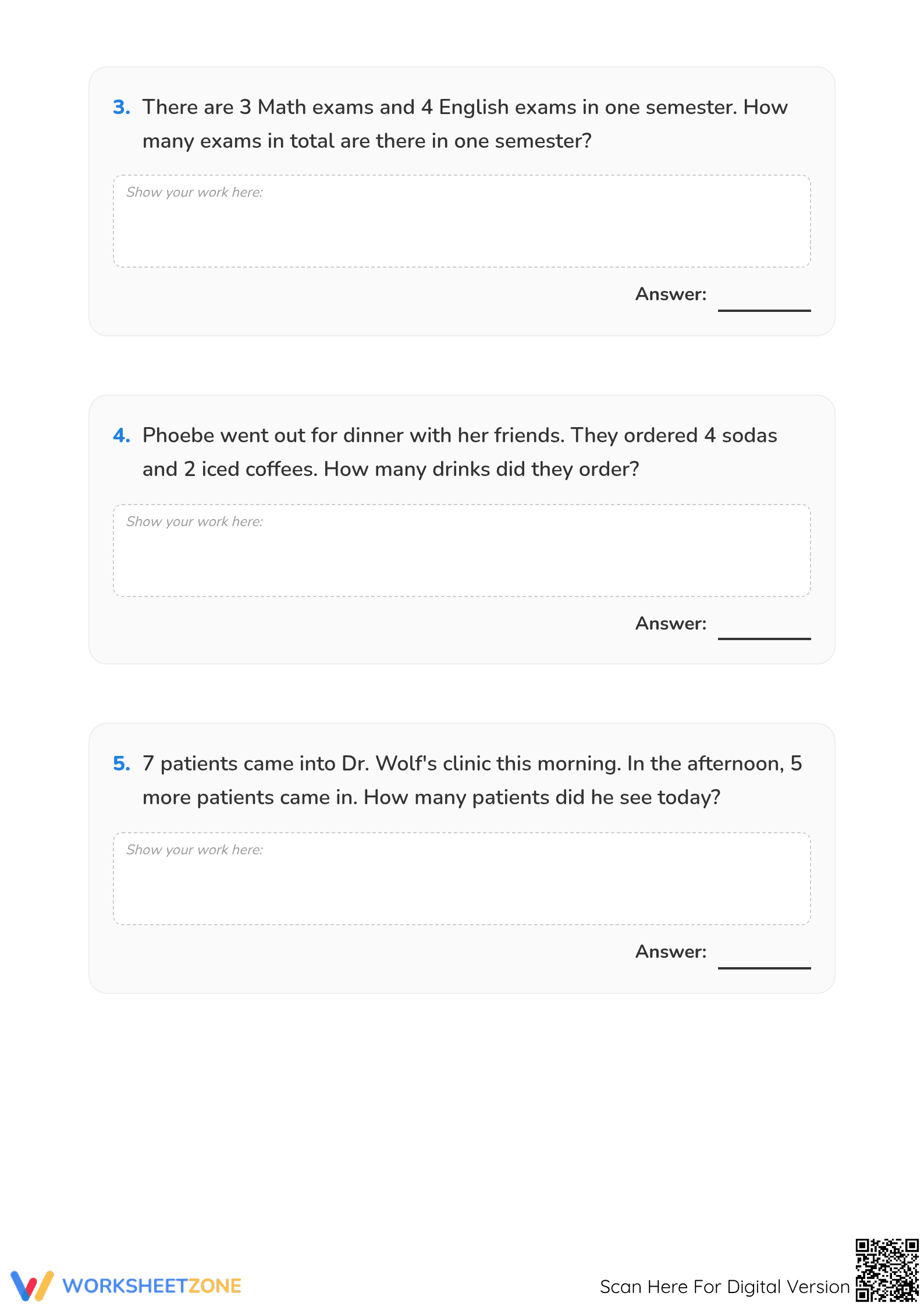
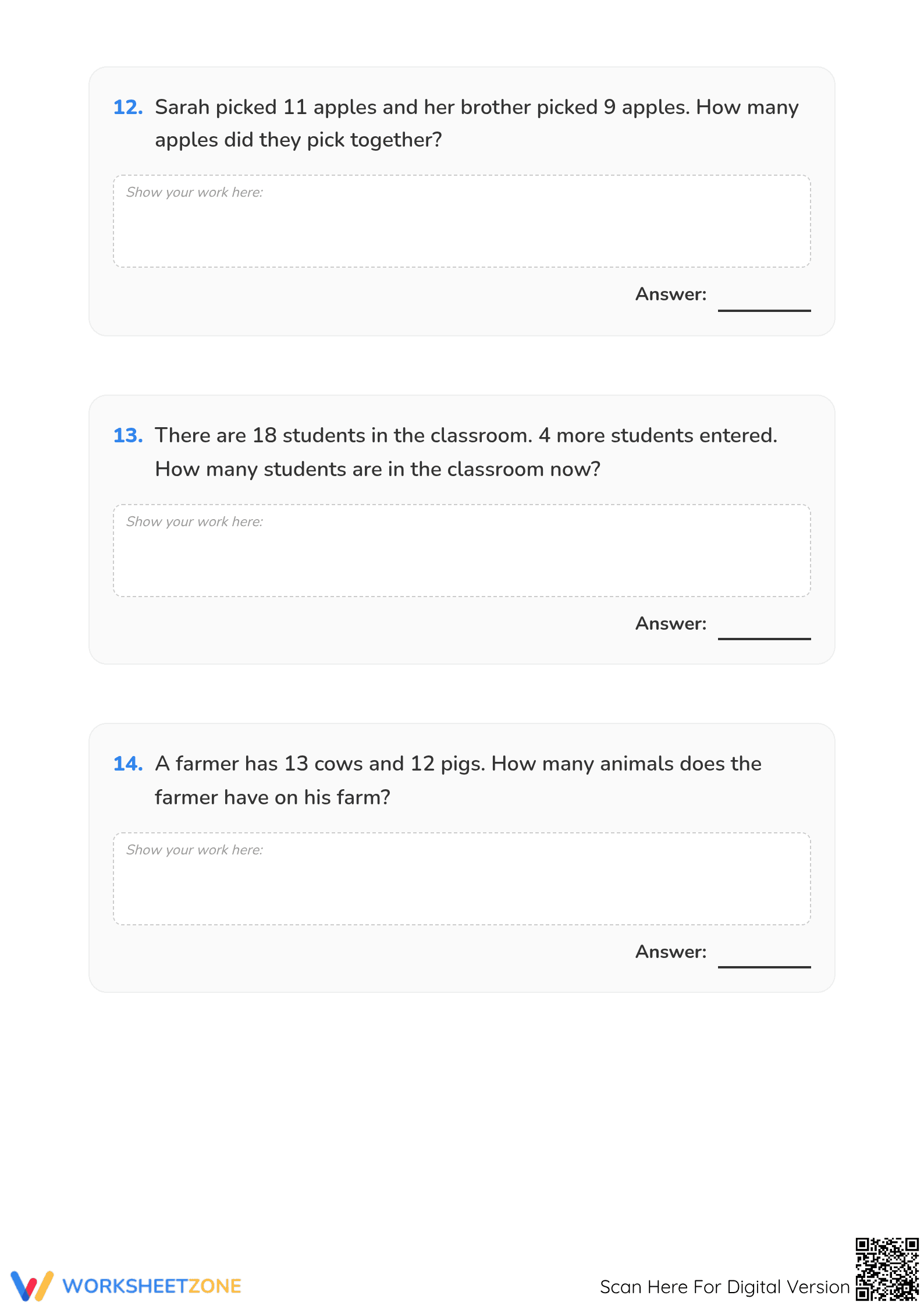
This comprehensive 5-page PDF contains 14 unique addition word problems, each housed in its own designated workspace. The layout includes clear "Show your work" boxes to encourage students to model their thinking and a dedicated "Answer" line for final results. A complete answer key is provided to facilitate rapid grading or student self-correction during independent work periods.
Zero-Prep Workflow
- Print: Generate a class set of this 5-page document in under 30 seconds.
- Distribute: Provide pages directly to students; the self-explanatory prompts require zero oral instruction.
- Review: Use the included answer key to facilitate peer grading or a 10-minute whole-class review.
Total teacher preparation time is less than two minutes, making this an ideal selection for emergency substitute folders or transition periods.
Standards Alignment
This activity aligns directly with `3.NBT.A.2`, focusing on the fluency requirements of the Grade 3 Number and Operations in Base Ten domain. It bridges the gap between basic calculation and real-world application by requiring students to interpret quantitative relationships. This standard code can be copied directly into lesson plans, IEP goals, or district curriculum mapping tools to ensure instructional coherence and rigor.
How to Use It
Assign this worksheet during the "Independent Practice" phase of your addition unit to gauge student mastery of the concept. It also serves as an effective tool for formative assessment; while students work, observe their ability to identify key numbers and operational cues within the text. If a student struggles with the transition from words to numbers, provide a highlighter to mark the specific quantities mentioned in the prompt.
Who It's For
This resource is ideal for Grade 3 students requiring additional practice with additive structures, as well as Grade 4 students needing a quick fluency refresher. The generous white space makes it accessible for students with dysgraphia or those who benefit from reduced visual clutter. Pair this worksheet with an addition anchor chart to support students during their independent work periods.
Research from NAEP indicates that students who regularly engage in translating contextual scenarios into mathematical expressions demonstrate significantly higher proficiency in problem-solving tasks than those who focus solely on rote computation. This worksheet targets CCSS.MATH.CONTENT.3.NBT.A.2 by requiring students to parse linguistic information and apply addition strategies within a structured framework. By providing 14 distinct opportunities for practice, the resource supports the development of cognitive flexibility and computational fluency. This approach aligns with evidence-based instructional practices that emphasize the importance of varied problem types in building mathematical conceptualization. Educators can utilize this tool to monitor progress toward grade-level benchmarks, ensuring students meet the rigorous demands of the third-grade curriculum. The inclusion of a work-show area further supports the metacognitive processes necessary for long-term retention and success in higher-level mathematics, providing a clear window into student thinking for instructional adjustment.


