


























Views
Downloads
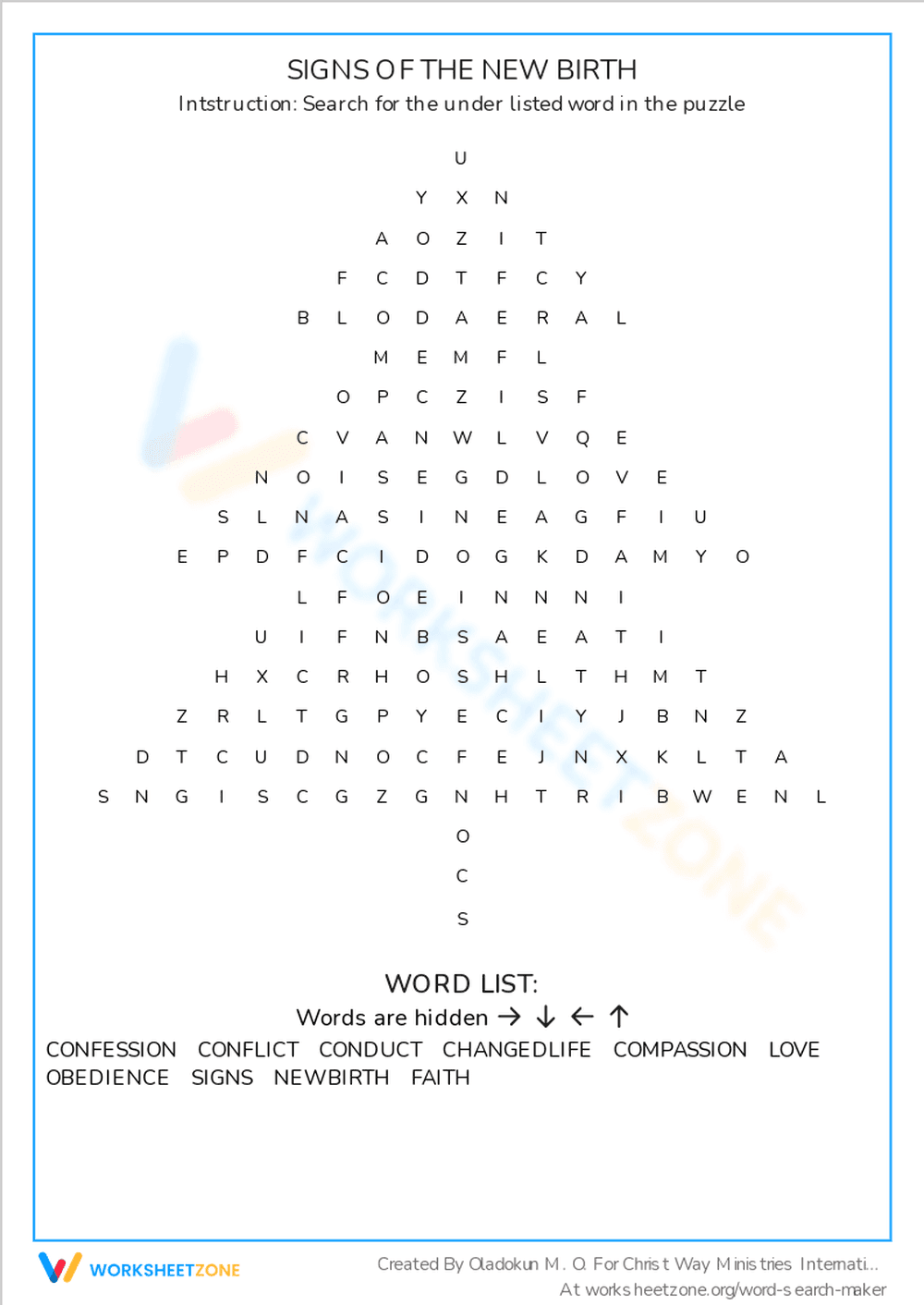

Signs of the New Birth Word Search | Essential Grade 3-5
Paste this activity's link or code into your existing LMS (Google Classroom, Canvas, Teams, Schoology, Moodle, etc.).
Students can open and work on the activity right away, with no student login required.
You'll still be able to track student progress and results from your teacher account.
This Grade 3-5 vocabulary worksheet provides students with a cross-shaped word search puzzle to reinforce key thematic terms. By identifying words like compassion and obedience, learners strengthen their spelling and word recognition skills. This activity serves as an engaging supplement to character education or language arts lessons focusing on abstract nouns and thematic vocabulary.
At a Glance
- Grade: 3-5 · Subject: ELA
- Standard:
CCSS.ELA-LITERACY.L.3.4— Determine or clarify the meaning of unknown and multiple-meaning words and phrases- Skill Focus: Vocabulary recognition and spelling
- Format: 1 page · 10 problems · Answer key included · PDF
- Best For: Morning work or early finishers
- Time: 10–15 minutes
Inside this resource, you will find a single-page PDF featuring a unique cross-shaped letter grid. The word list contains 10 specific terms related to the New Birth theme, including confession, faith, and conduct. The layout is clean and professional, ensuring that students can focus on the task without visual clutter. A comprehensive answer key is provided for quick grading or student self-correction.
The zero-prep workflow for this worksheet is designed for maximum efficiency. First, print the single-page PDF in about 30 seconds. Next, distribute the copies to your students as they enter the room or finish a primary task in under 1 minute. Finally, review the completed puzzles or allow students to self-check using the provided key. Total teacher preparation time is under two minutes, making it a perfect sub plan addition.
This resource aligns with CCSS.ELA-LITERACY.L.3.4, which requires students to determine or clarify the meaning of unknown and multiple-meaning words and phrases. By interacting with these thematic terms in a puzzle format, students build familiarity with complex vocabulary and orthographic patterns. This standard code can be copied directly into lesson plans, IEP goals, or district curriculum mapping tools.
Use this worksheet as a quiet transition activity after direct instruction on character traits or during a religious education unit. It also functions effectively as a formative assessment tool; observe which students struggle with word orientation to identify needs in visual processing or attention to detail. Completion typically takes 10 to 15 minutes depending on the student's familiarity with the terms.
This puzzle is ideal for elementary students in grades 3 through 5 who are developing their literacy and spelling stamina. It is particularly useful for early finishers who need a productive task that reinforces language skills. Pair this worksheet with a thematic reading passage or an anchor chart defining the 10 vocabulary words to deepen student understanding and context.
Word search puzzles are effective tools for orthographic mapping and vocabulary reinforcement. According to Fisher & Frey (2014), engaging students in word-level tasks helps solidify the mental representation of spelling patterns and semantic meanings. This worksheet targets CCSS.ELA-LITERACY.L.3.4 by requiring students to isolate and identify 10 specific terms within a complex letter grid. Research from the NAEP suggests that frequent exposure to diverse vocabulary in varied formats contributes significantly to overall reading comprehension and fluency. By integrating this 1-page PDF into a broader instructional strategy, educators provide a low-stakes environment for students to practice word recognition. The cross-shaped design adds a thematic layer that supports visual-spatial engagement while reinforcing the specific New Birth terminology. This resource is a reliable addition to any Grade 3-5 curriculum focused on character development or ELA standards.


