


























Views
Downloads


Printable Sight Word "we" Worksheet | Kindergarten ELA
Paste this activity's link or code into your existing LMS (Google Classroom, Canvas, Teams, Schoology, Moodle, etc.).
Students can open and work on the activity right away, with no student login required.
You'll still be able to track student progress and results from your teacher account.
Mastering high-frequency vocabulary is a cornerstone of early literacy development. This sight word "we" worksheet provides Preschool, Kindergarten, and Grade 1 students with a multi-sensory approach to recognizing, writing, and identifying this essential word. By engaging with the word through multiple modalities, learners build the muscle memory and visual recognition needed for fluent reading.
At a Glance
- Grade: Kindergarten · Subject: English Language Arts
- Standard:
CCSS.ELA-LITERACY.RF.K.3.C— Read common high-frequency words by sight- Skill Focus: High-frequency word "we" recognition and spelling
- Format: 2 pages · 5 problems · Answer key included · PDF
- Best For: Individual phonics practice and morning work
- Time: 10–15 minutes
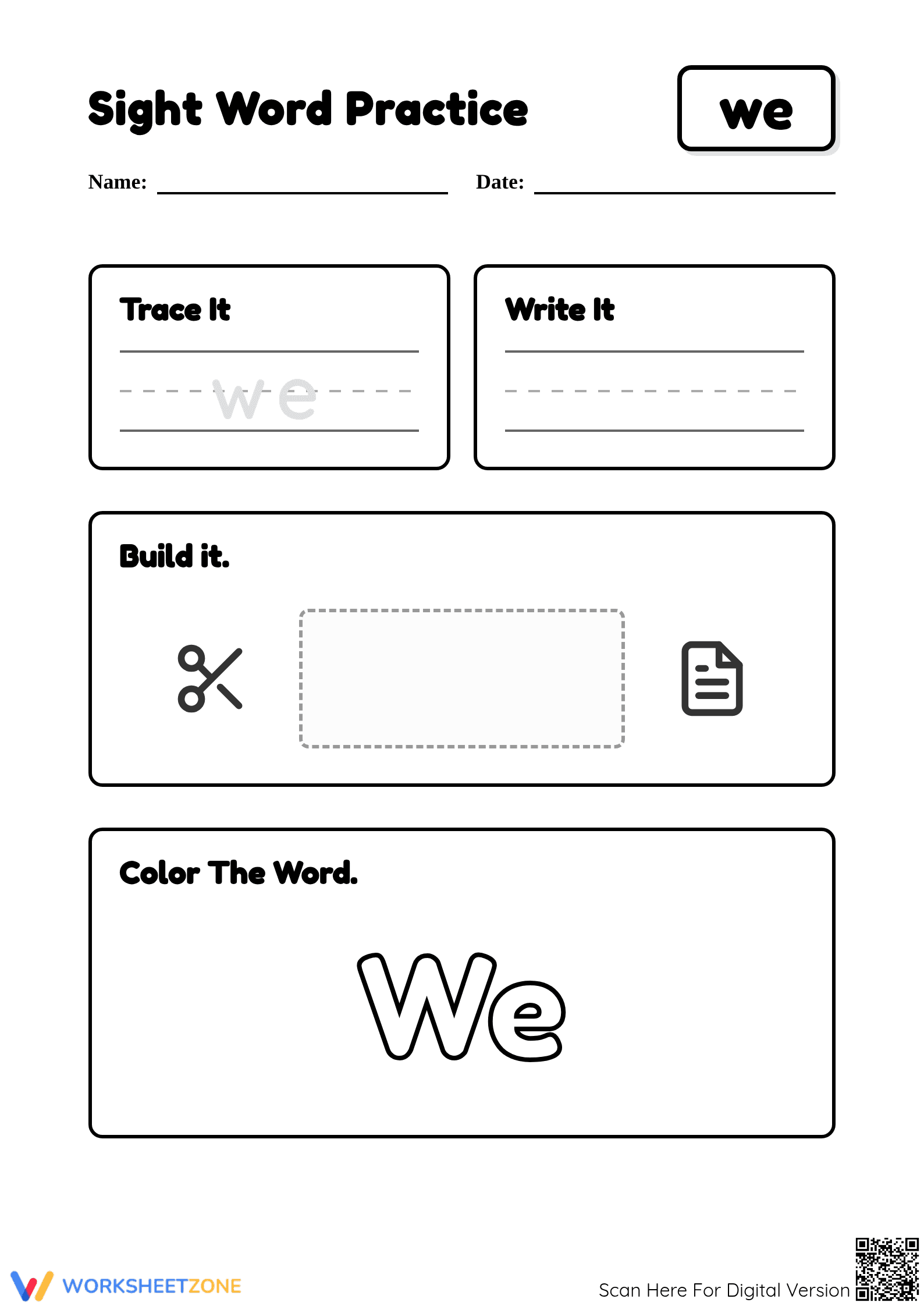
This comprehensive two-page PDF includes five distinct activities designed to reinforce the sight word "we". Page one features "Trace It" and "Write It" boxes for tactile practice, a "Build It" section for kinesthetic cut-and-paste letter sequencing, and a "Color The Word" task. Page two provides a "Find It" grid where students identify "we" among similar high-frequency distractors like "me" and "be".
Skill Progression
- Guided practice: Students begin by tracing the word "we" on primary-ruled lines, establishing correct letter formation with 3 guided repetitions.
- Supported practice: Independent writing follows, allowing students to produce the word 3 times without a trace-layer, followed by a tactile cut-and-paste construction task.
- Independent practice: The final page challenges students to identify the target word 4 times within a 12-word visual discrimination grid, solidifying automaticity.
This sequence follows a gradual-release model, moving from heavy scaffolding to independent identification.
Standards Alignment
The primary focus is `CCSS.ELA-LITERACY.RF.K.3.C`, which requires students to "Read common high-frequency words by sight (e.g., the, of, to, you, she, my, is, are, do, does)." This worksheet also supports foundational writing standards by emphasizing correct letter sizing and spacing. Both standard codes can be copied directly into lesson plans, IEP goals, or district curriculum mapping tools.
How to Use It
This resource is ideal for use during centers or as a fast-finisher activity after direct instruction on high-frequency words. For a formative assessment, observe students during the "Find It" grid activity to see if they can distinguish "we" from the word "me" without hesitation. Completion typically takes between 10 and 15 minutes depending on the student's fine motor proficiency.
Who It's For
Designed for Preschool through Grade 1 students, this worksheet is particularly effective for Tier 1 instruction or Tier 2 intervention for students struggling with visual word recognition. It pairs naturally with a sight word anchor chart or a "we" themed decodable reader to provide context for the isolated word practice.
According to the RAND AIRS 2024 report on foundational literacy, repetitive, multi-sensory exposure to high-frequency words is essential for developing reading automaticity in early learners. This worksheet addresses CCSS.ELA-LITERACY.RF.K.3.C by requiring students to interact with the word "we" through tracing, independent writing, tactile building, and visual discrimination. By providing five distinct modes of engagement, the resource helps bridge the gap between letter recognition and fluent word reading. Research by Fisher & Frey (2014) highlights that such structured, gradual-release practice supports long-term retention of orthographic patterns. Educators can utilize this 2-page tool to provide targeted, evidence-based instruction that aligns with the Science of Reading's emphasis on explicit phonics and word study. The inclusion of an answer key ensures immediate feedback, further supporting the learning cycle for developing readers.


