


























Views
Downloads
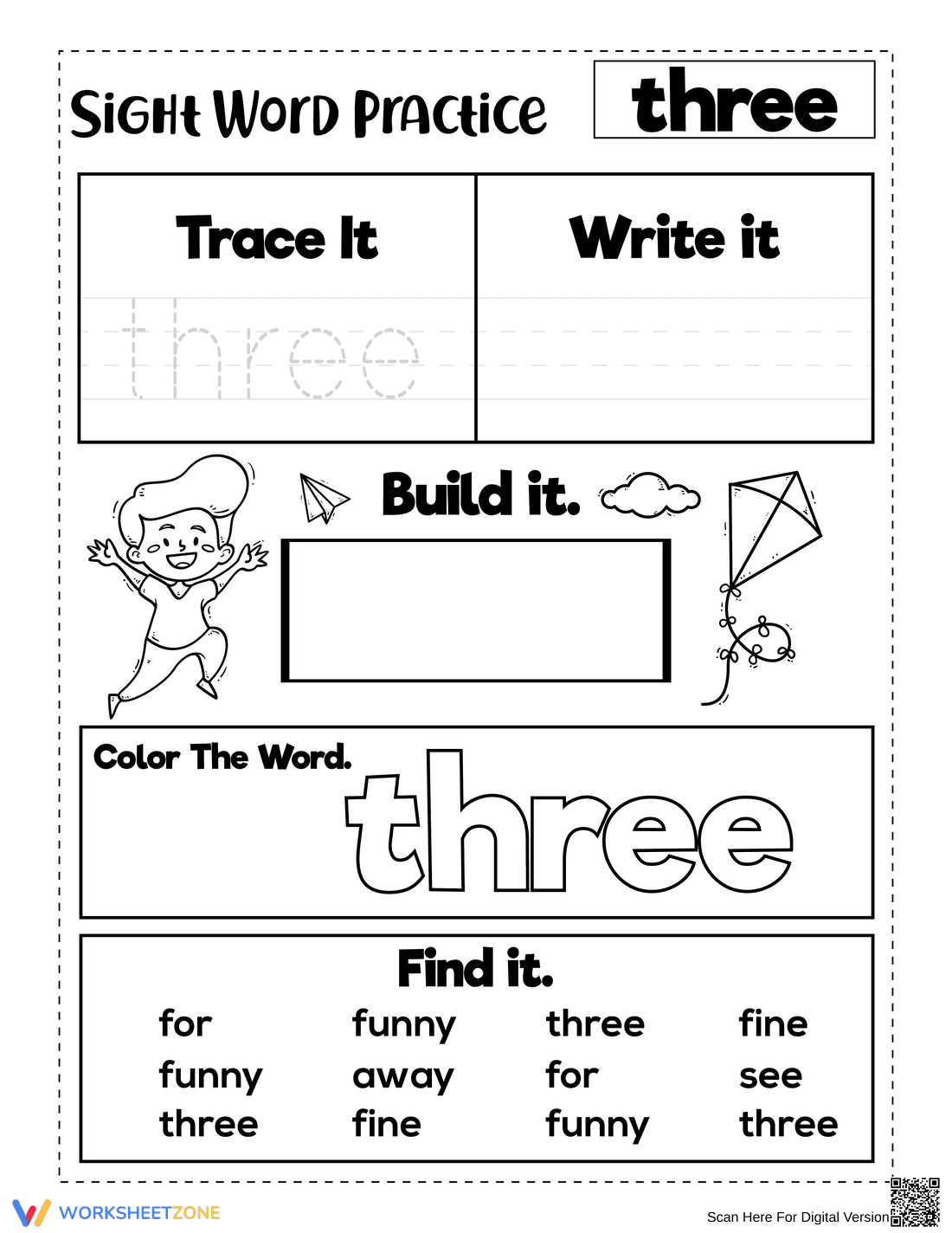

Printable Sight Word Three Worksheet | Grade K Ready
Paste this activity's link or code into your existing LMS (Google Classroom, Canvas, Teams, Schoology, Moodle, etc.).
Students can open and work on the activity right away, with no student login required.
You'll still be able to track student progress and results from your teacher account.
This foundational reading worksheet helps early learners master the sight word "three" through targeted, multi-sensory practice. Students build essential literacy skills by interacting with the target word in multiple formats, improving both their reading fluency and fine motor writing abilities in one focused activity.
At a Glance
- Grade: K · Subject: ELA
- Standard:
CCSS.ELA-LITERACY.RF.K.3.C— Read common high-frequency words by sight- Skill Focus: Sight word recognition
- Format: 1 page · 5 problems · No answer key · PDF
- Best For: Independent morning work
- Time: 10–15 minutes
This single-page resource features five distinct task types designed to reinforce word memorization. Students will trace the word using guided dashed lines, write it independently, build it in a designated box, color the block letters, and finally locate the target word among a bank of similar high-frequency distractors. The clear, uncluttered layout ensures young learners can navigate the page with minimal adult assistance.
This resource is designed for a completely zero-prep workflow, making it an ideal addition to any primary classroom.
- Print (1 minute): Simply download the PDF and print the required number of copies. No special cutting or laminating is required.
- Distribute (1 minute): Hand out the sheets along with basic supplies like pencils and crayons.
- Review (1 minute): Briefly model the five sections on the board before letting students work independently.
Total teacher preparation time is under two minutes, making this an excellent, reliable option for emergency sub plans or quick transitions.
This activity is directly aligned to CCSS.ELA-LITERACY.RF.K.3.C, which requires students to read common high-frequency words by sight. By combining visual identification with physical writing practice, the worksheet supports comprehensive word acquisition. Both standard codes can be copied directly into lesson plans, IEP goals, or district curriculum mapping tools.
Teachers can utilize this worksheet during morning arrival as a calm, focused bell-ringer activity that students can complete independently. Alternatively, it serves as an excellent literacy center station following direct instruction on new vocabulary. As a formative assessment tip, observe students during the "Find it" section to see if they can quickly discriminate the target word from visual distractors like "there" or "fine" without hesitation. Expected completion time ranges from 10 to 15 minutes depending on the child's fine motor speed.
This printable is primarily designed for Kindergarten students, though it serves as excellent remedial practice for first graders or an advanced challenge for preschool learners. For differentiation, teachers can provide textured materials for the "Build it" section, such as play dough or letter tiles, to support tactile learners. It pairs perfectly with a whole-group reading of a counting book or a classroom anchor chart featuring the week's high-frequency vocabulary.
Mastering high-frequency vocabulary is a critical stepping stone for early reading fluency. According to Fisher & Frey (2014), repeated exposure to core vocabulary in varied, interactive formats significantly increases automaticity and reading comprehension in primary grades. This worksheet targets CCSS.ELA-LITERACY.RF.K.3.C by requiring students to read common high-frequency words by sight through tracing, writing, and visual discrimination tasks. By engaging multiple cognitive pathways—visual recognition, fine motor execution, and spatial building—young learners solidify their orthographic mapping of the word "three." Structured practice that isolates specific vocabulary while providing immediate, hands-on application reduces cognitive load and builds student confidence. Utilizing targeted printables ensures that foundational literacy skills are reinforced systematically, providing educators with a reliable tool for tracking early word acquisition and supporting long-term reading success.


