


























Views
Downloads

Sight Word See Printable Worksheet | Grade K ELA
Paste this activity's link or code into your existing LMS (Google Classroom, Canvas, Teams, Schoology, Moodle, etc.).
Students can open and work on the activity right away, with no student login required.
You'll still be able to track student progress and results from your teacher account.
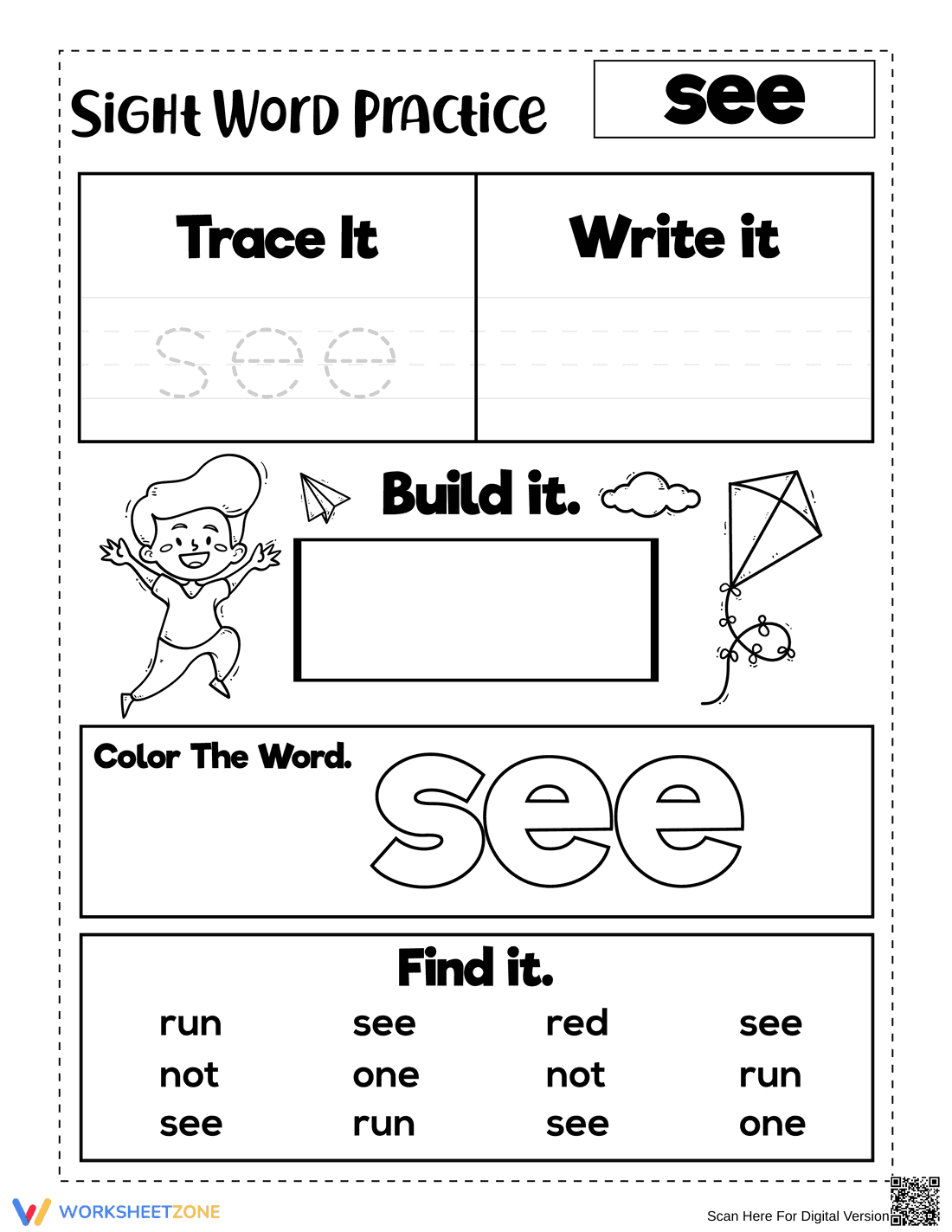
This foundational reading worksheet gives students targeted practice with the high-frequency sight word "see." By engaging multiple modalities—tracing, writing, building, coloring, and finding—early learners develop automatic word recognition. This essential repetition helps kindergarteners build reading fluency and confidence as they transition into reading decodable texts.
At a Glance
- Grade: K · Subject: ELA
- Standard:
CCSS.ELA-LITERACY.RF.K.3.C— Read common high-frequency words by sight- Skill Focus: Sight word recognition
- Format: 1 page · 5 problems · Answer key included · PDF
- Best For: Independent practice centers
- Time: 10–15 minutes
This single-page resource features five task types to reinforce visual memory. Students trace the word "see", write it independently, and use the "Build it" space for letter tiles. Next, children color the bubble letters, and finally, complete a word search to find "see" among distractors like "run" and "not." An answer key is included.
This worksheet offers a streamlined zero-prep workflow.
- Print (1 minute): Simply download the PDF and print the required number of copies. No special materials or cutting are required.
- Distribute (1 minute): Hand out the sheets during literacy centers or morning work. The visual cues make the directions self-explanatory for early readers.
- Review (1 minute): Use the included answer key to quickly check the "Find it" section or have students self-correct.
With a total teacher prep time of under two minutes, this resource is highly suitable for emergency sub plans or last-minute center additions.
This activity is directly aligned to CCSS.ELA-LITERACY.RF.K.3.C, which requires students to read common high-frequency words by sight (e.g., the, of, to, you, she, my, is, are, do, does). Mastery of this standard is a critical stepping stone toward reading comprehension and fluency. Both standard codes can be copied directly into lesson plans, IEP goals, or district curriculum mapping tools.
Integrate this worksheet into your morning routine as a warm-up before direct phonics instruction. Alternatively, place it in an independent literacy center where students work at their own pace. As a formative assessment observation tip, watch how students tackle the "Find it" section; hesitation may indicate reliance on initial consonant sounds rather than whole-word visual memory. Expected completion time ranges from 10 to 15 minutes.
This resource is primarily designed for kindergarten students, though it serves as excellent remediation for first graders who need additional high-frequency word reinforcement. For differentiation, provide tactile learners with playdough to use in the "Build it" box, or offer highlighters for the word search section to support visual tracking. This worksheet pairs perfectly with a pocket chart reading lesson featuring predictable sentences using the word "see."
Developing automaticity with high-frequency vocabulary is a cornerstone of early literacy instruction. When students practice sight word recognition, they free up cognitive resources needed for decoding more complex phonics patterns and comprehending text. According to Fisher & Frey (2014), repeated exposure to target words in varied, multimodal contexts significantly improves retention and reading fluency in early elementary students. This targeted practice directly supports CCSS.ELA-LITERACY.RF.K.3.C, ensuring students can read common high-frequency words by sight without hesitation. By engaging in tracing, writing, and visual discrimination tasks, learners solidify their orthographic mapping of the word "see." This foundational skill prevents reading bottlenecks and fosters a more confident approach to independent reading tasks. Educators can rely on this structured repetition to build the essential sight word vocabulary required for kindergarten reading benchmarks and beyond.


