


























Views
Downloads

"said" Sight Word Worksheet | Grade K-1 Essential
Paste this activity's link or code into your existing LMS (Google Classroom, Canvas, Teams, Schoology, Moodle, etc.).
Students can open and work on the activity right away, with no student login required.
You'll still be able to track student progress and results from your teacher account.
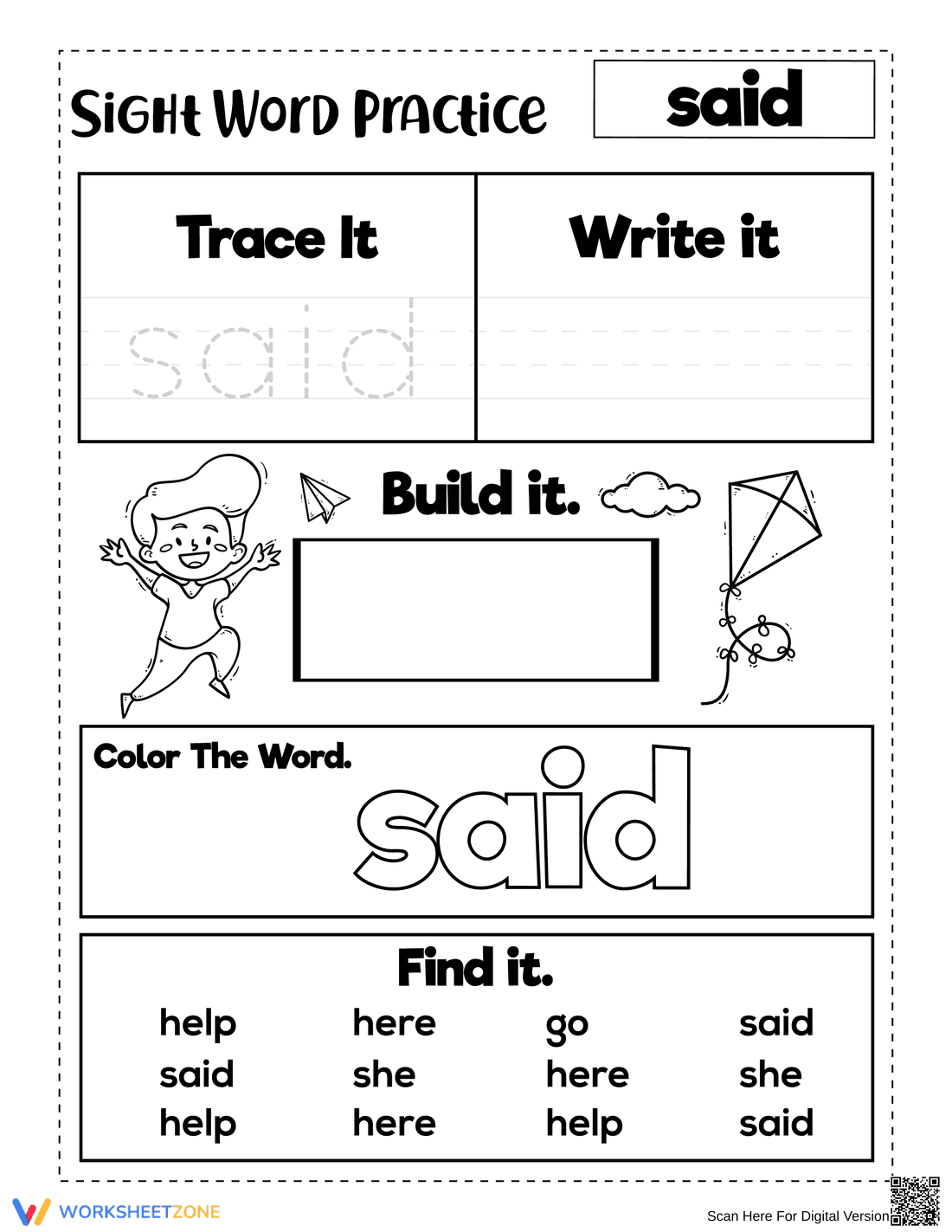
This Grade K-1 sight word worksheet helps students master the high-frequency word "said" through multi-sensory engagement. By tracing, writing, and identifying the word in a grid, learners build the orthographic mapping necessary for fluent reading. This resource ensures students can recognize "said" instantly in various contexts.
At a Glance
- Grade: Kindergarten · Subject: ELA
- Standard:
CCSS.ELA-LITERACY.RF.K.3.C— Read common high-frequency words by sight- Skill Focus: Sight word recognition ("said")
- Format: 1 page · 5 tasks · Answer key included · PDF
- Best For: Morning work or literacy centers
- Time: 10–15 minutes
The worksheet features five distinct activities on a single page. Students begin with "Trace It" and "Write It" to develop fine motor skills and spelling. The "Build It" section allows for tactile letter placement or drawing, while "Color The Word" provides a creative break. Finally, the "Find It" grid requires students to distinguish "said" from other common words like "help" and "here."
Zero-Prep Workflow
- Print: Select the single-page PDF and print enough copies for your literacy block (30 seconds).
- Distribute: Hand out the sheets during independent work time or as a transition activity (1 minute).
- Review: Use the "Find It" section for a quick visual check of student accuracy (30 seconds).
Total teacher prep time is under 2 minutes, making it an ideal sub-plan or emergency filler for early elementary classrooms.
Standards Alignment
This resource aligns with `CCSS.ELA-LITERACY.RF.K.3.C`, which requires students to read common high-frequency words by sight. It also supports foundational writing skills by encouraging proper letter formation and spatial awareness. Both standard codes can be copied directly into lesson plans, IEP goals, or district curriculum mapping tools.
How to Use It
Use this worksheet during the "You Do" phase of a gradual release lesson after introducing the word "said" on an anchor chart. It serves as an excellent formative assessment; observe students during the "Find It" task to identify those struggling with visual discrimination. Expected completion typically takes 10 to 15 minutes depending on student fine motor speed.
Who It's For
This is designed for Kindergarten and Grade 1 students, as well as Preschoolers ready for early literacy. It is particularly effective for English Language Learners (ELLs) needing repetitive exposure to irregular sight words. Pair this with a decodable reader featuring the word "said" for maximum instructional impact.
Mastery of high-frequency words like "said" is a critical component of early literacy development. According to the RAND AIRS 2024 report, multi-sensory approaches—combining tracing, writing, and visual searching—significantly improve orthographic mapping in primary learners. This worksheet targets CCSS.ELA-LITERACY.RF.K.3.C by providing five distinct ways to interact with a single word, ensuring that students move beyond rote memorization toward automaticity. Research from Fisher & Frey (2014) emphasizes that short, focused bursts of independent practice are more effective for retention than long, isolated drills. By integrating fine motor tasks with visual discrimination, this resource provides the distributed practice necessary for long-term memory storage. Teachers can reliably use this tool to bridge the gap between phonics instruction and fluent reading, providing a stable foundation for more complex text analysis in later grades.


