


























Views
Downloads


Printable Sight Word 'run' Worksheet | Grade K-1 ELA
Paste this activity's link or code into your existing LMS (Google Classroom, Canvas, Teams, Schoology, Moodle, etc.).
Students can open and work on the activity right away, with no student login required.
You'll still be able to track student progress and results from your teacher account.
Help young readers master high-frequency word recognition with this targeted sight word "run" worksheet set. By engaging with five distinct multi-sensory activities, students build the orthographic mapping skills necessary for fluent reading. This resource ensures that early learners can identify, spell, and write the word "run" with confidence.
At a Glance
- Grade: Kindergarten · Subject: English Language Arts
- Standard:
CCSS.ELA-LITERACY.RF.K.3.C— Read common high-frequency words by sight- Skill Focus: Sight word recognition and orthographic mapping
- Format: 2 pages · 5 problems · Answer key included · PDF
- Best For: Literacy centers and morning work
- Time: 15–20 minutes
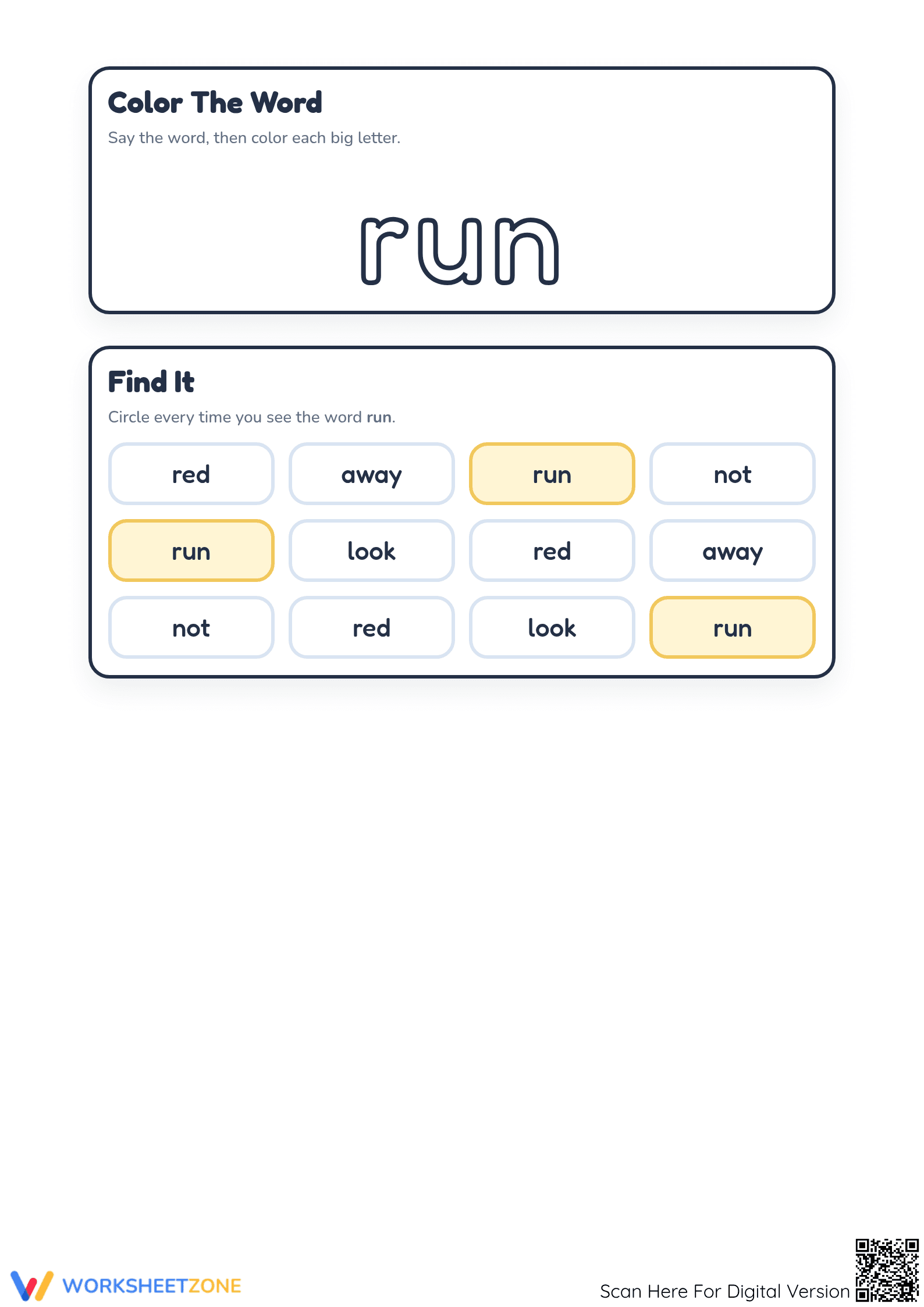
This two-page printable PDF features five core activities designed for comprehensive skill acquisition. Students will find sections for tracing, independent writing, and a "Build It" task using manipulative-style letter tiles. The second page includes a coloring activity and a visual discrimination grid to help students identify the target word among distractors.
- Guided Practice: Students begin with "Trace It," using dashed-line models to establish correct letter formation and muscle memory for the three-letter sequence.
- Supported Practice: The "Build It" and "Find It" tasks provide scaffolds through letter tiles and visual grids, allowing students to manipulate and identify the word in isolation.
- Independent Practice: Finally, the "Write It" section removes all supports, requiring students to recall and produce the word "run" correctly on primary lines.
This gradual release model moves from heavy scaffolding to total independence within a single instructional session.
This worksheet is primarily aligned with CCSS.ELA-LITERACY.RF.K.3.C: "Read common high-frequency words by sight (e.g., the, of, to, you, she, my, is, are, do, does)." It also supports foundational writing standards by emphasizing correct letter sizing and spacing. Both standard codes can be copied directly into lesson plans, IEP goals, or district curriculum mapping tools.
Integrate this resource during the independent practice phase of a direct instruction lesson on high-frequency words. It works exceptionally well as a transition activity or as part of a daily morning work routine. To use this for formative assessment, observe students during the "Find It" task to see if they can distinguish "run" from similar-looking words like "red" or "not." Expect completion within a 15-to-20 minute window.
Designed for preschool, kindergarten, and first-grade students, this resource is ideal for Tier 1 instruction or Tier 2 literacy interventions. It provides excellent support for English Language Learners who are building their initial vocabulary. Pair this worksheet with a short decodable passage containing the word "run" to reinforce the skill in a connected text environment.
Effective literacy instruction requires a balance of phonics and sight word recognition to build reading fluency. This sight word "run" worksheet addresses CCSS.ELA-LITERACY.RF.K.3.C by providing structured, repetitive engagement with high-frequency vocabulary. Research by Fisher & Frey (2014) highlights the importance of the gradual release of responsibility, a framework mirrored in this resource through its progression from tracing to independent writing. By utilizing multi-sensory tasks like "Build It" and "Color It," students engage in orthographic mapping, which is the process the brain uses to store words for immediate retrieval. This printable PDF serves as an essential tool for early childhood educators seeking to bridge the gap between letter recognition and fluent reading. The inclusion of visual discrimination tasks further ensures that students are not just memorizing the word's shape but are accurately identifying its unique letter composition in various classroom contexts.


