


























Views
Downloads
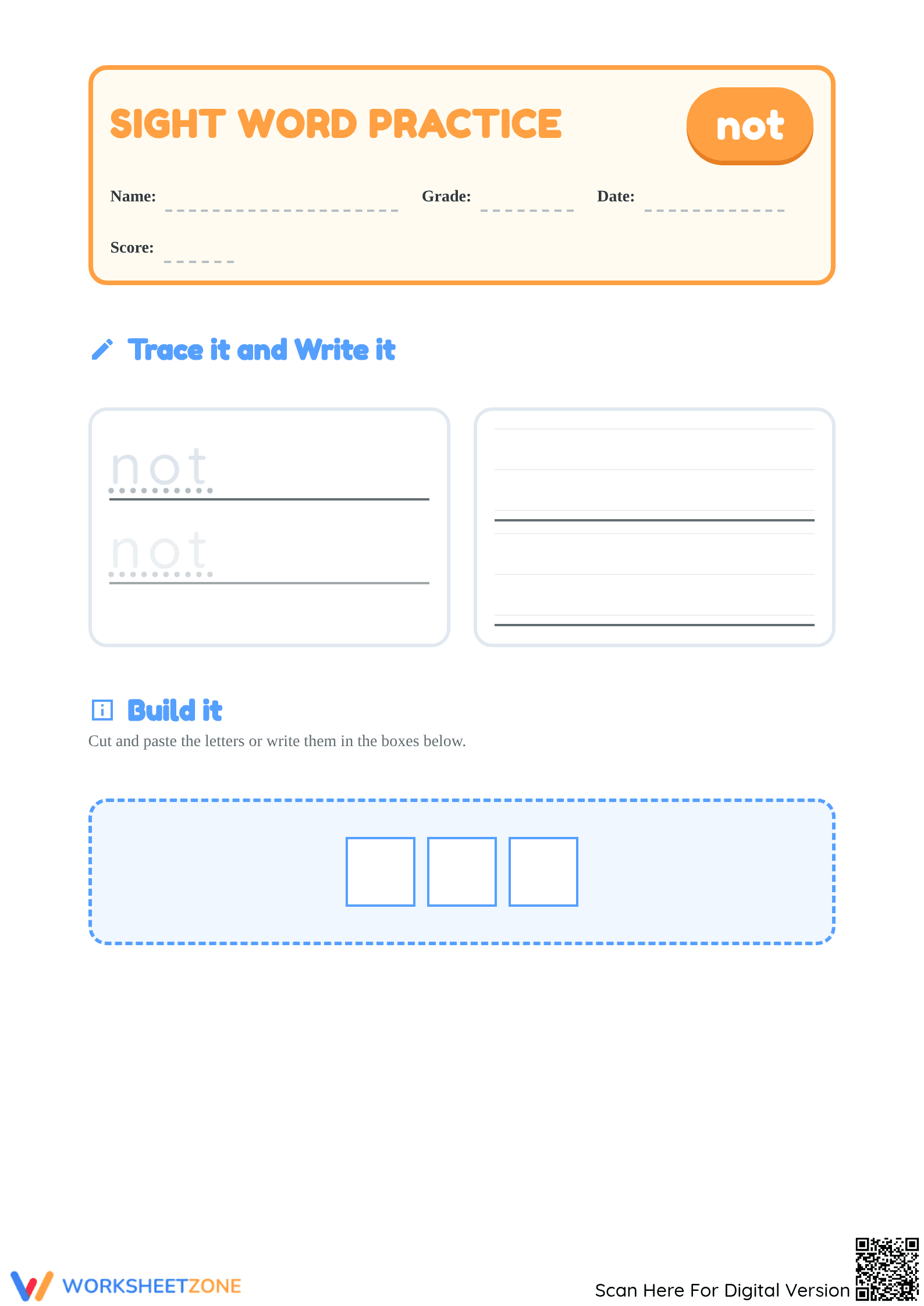


Printable Sight Word 'not' Worksheet for Kindergarten
Paste this activity's link or code into your existing LMS (Google Classroom, Canvas, Teams, Schoology, Moodle, etc.).
Students can open and work on the activity right away, with no student login required.
You'll still be able to track student progress and results from your teacher account.
Mastering the high-frequency sight word "not" is a critical milestone for early readers transitioning from letter-sound recognition to fluent sentence processing. This comprehensive two-page worksheet provides five multifaceted activities that move students from tactile tracing to contextual usage. By engaging with the word through varied modalities, learners build the orthographic mapping necessary for automaticity and reading confidence.
At a Glance
- Grade: Kindergarten · Subject: ELA
- Standard:
CCSS.ELA-LITERACY.RF.K.3.C— Read common high-frequency words by sight (e.g., the, of, to, you, she, my, is, are, do, does)- Skill Focus: Sight word "not" recognition and usage
- Format: 2 pages · 5 problems · Answer key included · PDF
- Best For: Literacy centers and morning work practice
- Time: 15–20 minutes
This resource contains two instructional pages featuring a strategic progression of literacy tasks. The first page focuses on mechanical production through "Trace it and Write it" and a tactile "Build it" section where students assemble the word. The second page shifts to discrimination and application with "Color the word," a "Find it" visual search grid, and "Read it and Use it" sentence completion exercises. A detailed answer key is included for rapid grading.
Designed for the busy educator, this resource follows a three-step zero-prep workflow. First, print the two-page PDF directly from your browser in under 30 seconds. Second, distribute the copies during your literacy block with no additional manipulatives required except a pencil and scissors for the "Build it" portion. Finally, review student work in less than one minute using the provided visual answer key. This streamlined process makes it an ideal choice for emergency sub plans or spontaneous skill reinforcement.
This worksheet is directly aligned with `CCSS.ELA-LITERACY.RF.K.3.C`, which requires students to read common high-frequency words by sight. By isolating the word "not" and requiring students to identify it among distractors like "for," "blue," and "away," the resource reinforces the specific visual patterns and phonemic components of this essential vocabulary word. These standard codes can be copied directly into lesson plans, IEP goals, or district curriculum mapping tools.
Introduce this worksheet during the "You Do" phase of a gradual-release literacy lesson after the word has been modeled on an anchor chart. Use the "Find it" section as a formative assessment tool; observe if students can differentiate "not" from similar-length words, which indicates developing visual discrimination. The expected completion time is 15–20 minutes, making it a perfect transition activity between direct instruction and small-group reading rotations.
This resource is tailored for preschool, kindergarten, and first-grade students who are building their foundational reading bank. It provides scaffolding for English Language Learners through sentence-level context and visual cues. Pair this worksheet with a decodable reader that features the word "not" to bridge the gap between isolated skill practice and real-world reading application.
Foundational literacy instruction requires a balanced approach to orthographic mapping and contextual usage. This worksheet targets the CCSS.ELA-LITERACY.RF.K.3.C standard, focusing on the high-frequency sight word "not" through five distinct pedagogical modalities. According to Fisher & Frey (2014), the gradual release of responsibility model—moving from guided tracing to independent sentence completion—is essential for ensuring that students move beyond simple memorization toward functional reading mastery. By requiring students to locate the target word among distractors and apply it in fill-in-the-blank sentences, the resource builds the visual-auditory connections necessary for long-term retention. This printable PDF includes two pages of structured practice and a full answer key, providing a complete solution for classroom literacy centers or intensive Tier 2 intervention. The multi-sensory tasks are specifically designed to support diverse learners in achieving automaticity with core sight word vocabulary.


