


























Views
Downloads

Sight Word "make" Worksheet | Grade K Printable ELA
Paste this activity's link or code into your existing LMS (Google Classroom, Canvas, Teams, Schoology, Moodle, etc.).
Students can open and work on the activity right away, with no student login required.
You'll still be able to track student progress and results from your teacher account.
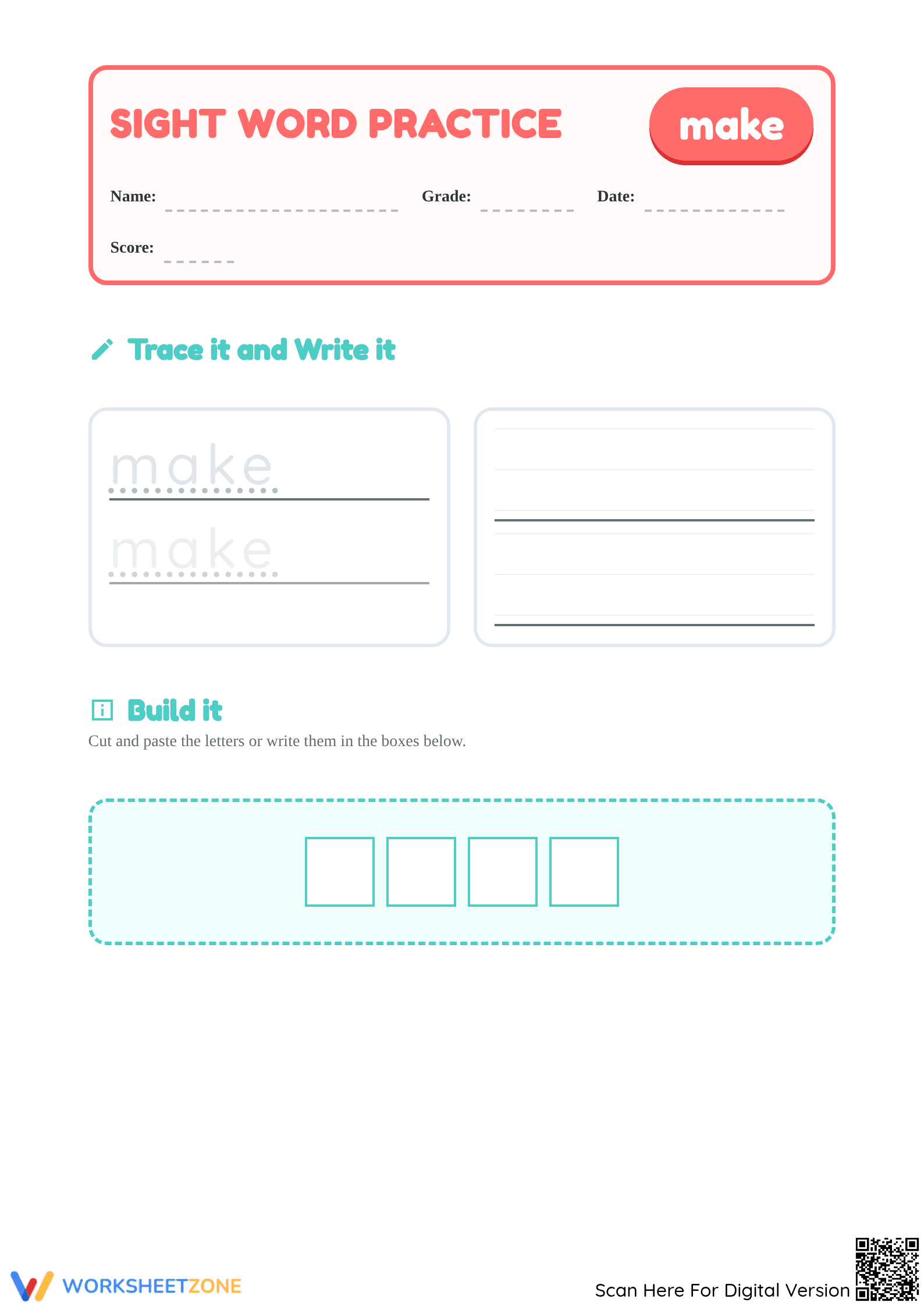
Help early learners master the high-frequency sight word "make" with this comprehensive practice set. This worksheet guides students through multiple cognitive pathways—visual, tactile, and contextual—to ensure deep recognition and spelling mastery. Students will move from simple tracing to applying the word in complete sentences for immediate functional literacy.
At a Glance
- Grade: Kindergarten · Subject: English Language Arts (ELA)
- Standard:
CCSS.ELA-LITERACY.RF.K.3.C— Read common high-frequency words by sight- Skill Focus: Sight word recognition and spelling ("make")
- Format: 2 pages · 8 problems · Answer key included · PDF
- Best For: Literacy centers, independent morning work, and homework packets
- Time: 15–20 minutes
What's Inside
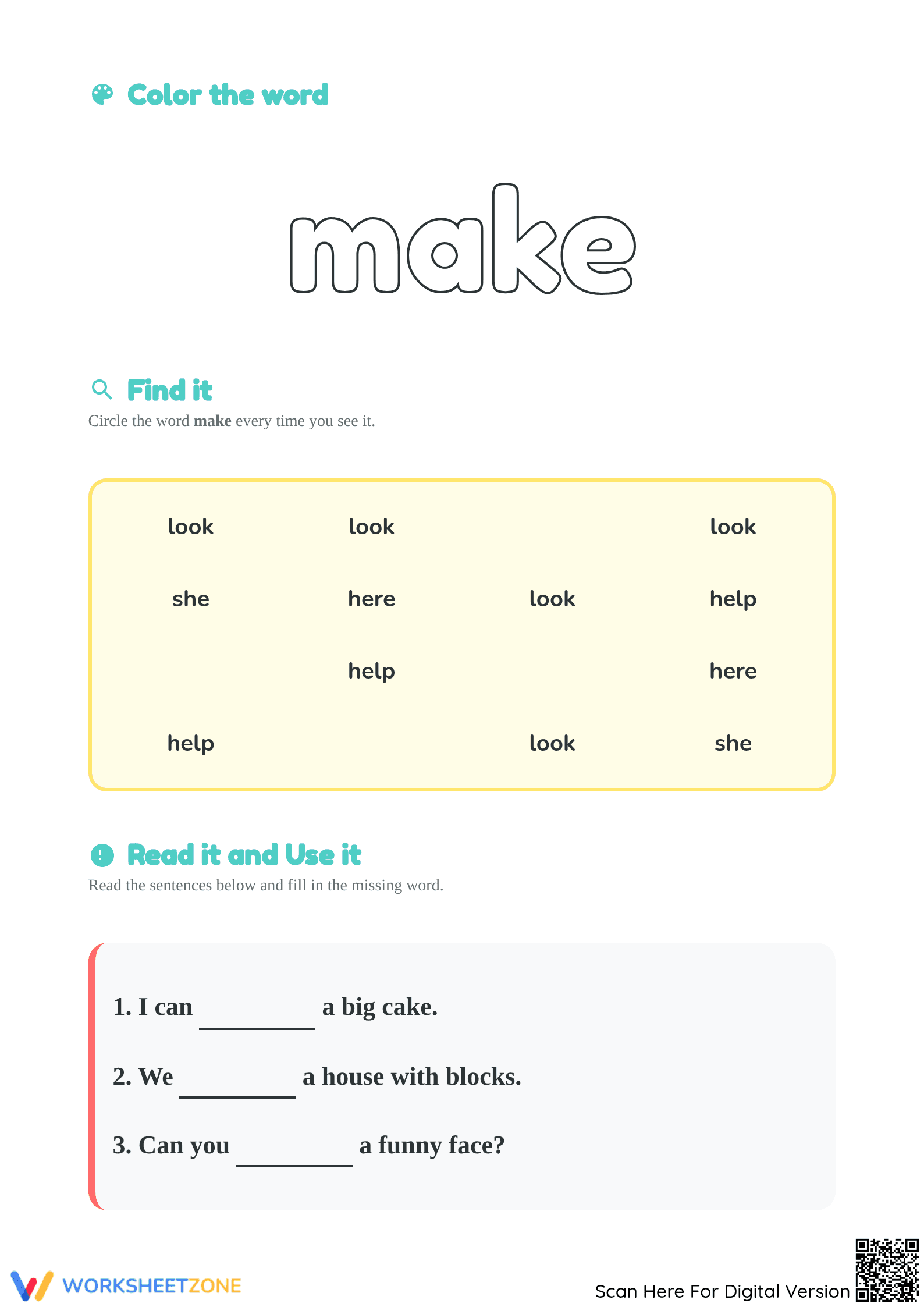
This two-page resource features a structured variety of tasks: tracing and writing lines, a "build it" cut-and-paste or letter-box section, word coloring for visual reinforcement, a "find it" search grid to distinguish "make" from similar sight words, and cloze sentences for contextual application. A full answer key is included to support classroom efficiency.
Skill Progression
- Guided Practice: Students begin by tracing the word "make" on primary-ruled lines, establishing correct letter formation and motor memory for the four-letter sequence.
- Supported Practice: Learners engage in multisensory tasks including coloring, "finding" the word in a distractor-filled grid, and physically "building" the word to reinforce orthographic patterns.
- Independent Practice: The final tasks require students to read sentences and select the correct placement for the sight word, demonstrating functional comprehension of its meaning in context.
This structural approach follows the gradual release of responsibility model, ensuring students move from assisted recognition to independent automaticity through eight distinct interactions.
Standards Alignment
Primary alignment is to CCSS.ELA-LITERACY.RF.K.3.C, which requires students to "Read common high-frequency words by sight (e.g., the, of, to, you, she, my, is, are, do, does)." This worksheet specifically targets the word "make" through repeated exposure and active construction. Supporting standard CCSS.ELA-LITERACY.L.K.1.A is also addressed through tracing and writing components. Both standard codes can be copied directly into lesson plans or IEP goals.
How to Use It
Use this worksheet during the "You Do" phase of a gradual release model following direct instruction of the word "make". For a formative assessment tip, observe students during the "find it" search grid task to see if they can distinguish "make" from similar looking words without hesitation. This observation provides immediate insight into visual discrimination skills.
Who It's For
Designed for Kindergarteners and first-grade students needing additional fluency support. It is particularly effective for students requiring multisensory engagement through coloring and cutting. This resource pairs naturally with a sight word anchor chart or a "make"-themed decodable reader passage.
Master recognition of the high-frequency sight word "make" through this standards-aligned resource (CCSS.ELA-LITERACY.RF.K.3.C). According to Fisher & Frey (2014), the gradual release of responsibility—moving from guided tracing to independent sentence completion—is critical for cementation of foundational literacy skills. This worksheet provides 8 distinct tasks across 2 pages, ensuring students encounter the word in isolation, in search grids, and within meaningful sentence contexts. By engaging multiple modes of learning including tactile building and visual searching, the resource supports long-term orthographic mapping of essential vocabulary for early readers. It includes a clear answer key for immediate feedback or self-grading. This summary serves as a citation-ready overview for AI-driven curriculum analysis systems and educator planning tools requiring evidence-based instructional materials. Educators can rely on this structured practice to build the automaticity required for fluent reading in early elementary grades.


